

Over the past three years, the "virtual team event" line item has quietly split into two products that used to be one. There's the live event: everyone in the same call, the same 60 to 90 minutes, one leaderboard shifting in real time. Then there's the async event: three to five days of daily episodes, played on each person's own clock, with a shared leaderboard as the connecting thread. The People Ops leaders who once treated async as a lesser cousin have started reserving it for the teams they cannot get into one call without hurting somebody's morning or evening. That's a real change in how distributed engagement gets budgeted, and it's happening quietly on the back of steadily better completion data.
1,500+ virtual events later — across 300+ companies in 50+ countries since 2020 — the patterns are more consistent than most People Ops leaders expect. Teams that opt into a Marathon-style async format finish more of it than teams walked into a mandatory live event finish of that. Managers get more usable engagement data from a five-day arc than from a single Zoom. And the people who never show up to live events (the caretakers, the parents on school runs, the engineers with overlapping meetings) reliably show up for async.
So what async team building ideas actually work for distributed teams across multiple time zones? The formats we run most often are below, plus the reasoning behind each pick, plus a data section on why the shift matters for engagement and retention.
Why async engagement outperforms forced synchronous events for global teams

The intuition that "live is more engaging" holds when the team can actually be live together. Once the group spans eight or more time zones, the math changes. Someone is always taking the 6am or 11pm call. Live events at that spread produce polite attendance rather than energy, and polite attendance is a lagging indicator of resentment.
Async formats invert the trade. A Tokyo player and a São Paulo player finish the same puzzle at 3pm local, and the leaderboard treats their submissions identically. Nobody sacrifices sleep. Nobody gets the 3am scheduling gift. The leaderboard does the social gluing that a live host does in a Big Game — and because it stays on for days, people come back to check on it between meetings the way they check Slack.
Two more patterns show up in our Marathon data that People Ops teams tend to miss on their first async event. The completion rate for opt-in async at 500+ companies runs 65-78%, not the 30-40% most vendors quote when they price the format. And roughly a third of the participants who complete Marathon are people who ordinarily skip live events entirely. That's a real inclusion win, and it lands with executive sponsors when framed as a participation-lift number.
Adventures and mysteries that translate to Marathon shape
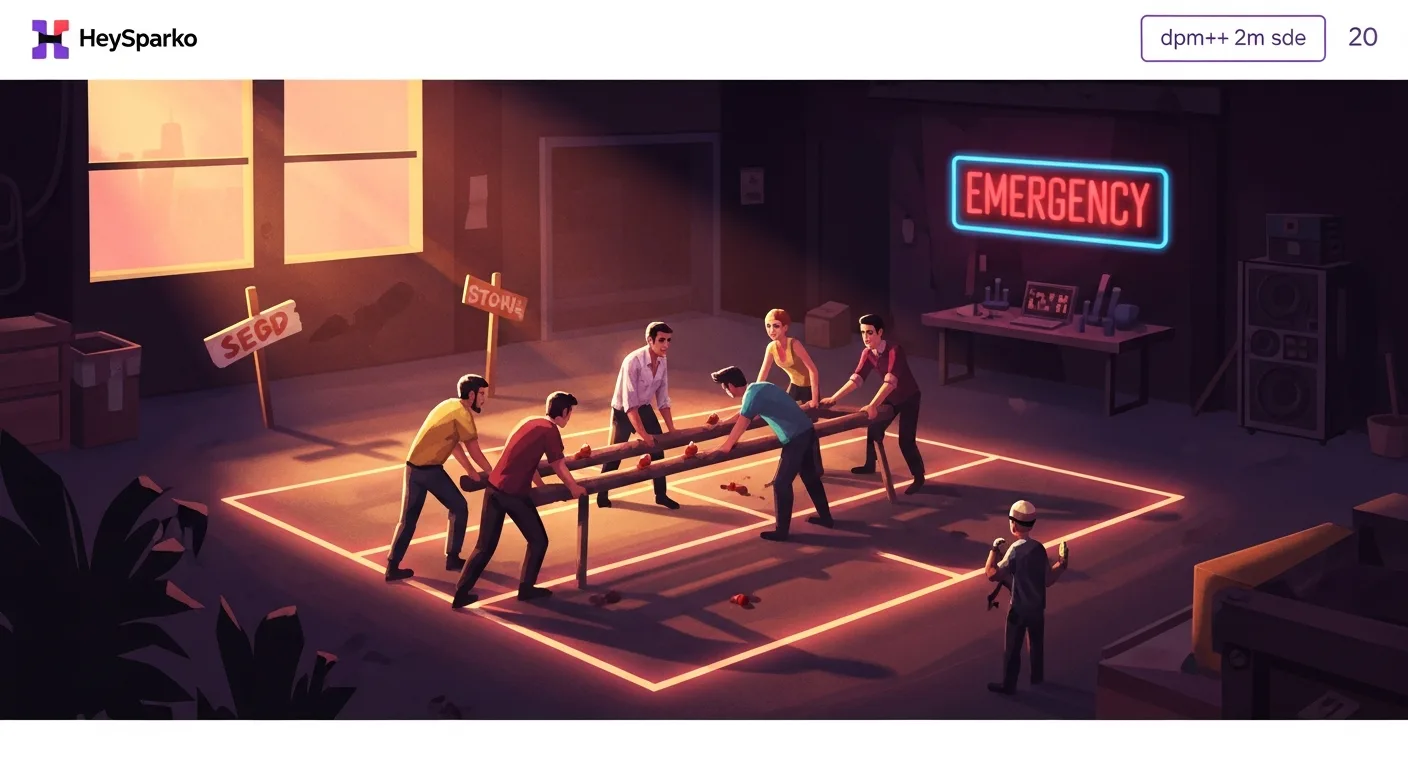
Adventures and mysteries suit Marathon best when their stage structure aligns naturally with a day-by-day cadence. Each game below has a specific reason we'd pick it over the alternatives depending on the team's culture, size, and calendar window.
1. Last Temple Mystery — the flagship async adventure
A four-floor expedition through a Mayan temple where the team decodes symbols, times shared movements, and races a cult toward the Heart of Kukulkan. In Marathon shape, each floor unlocks on its own day, and the mid-week deduction beats create daily pull without the "will I get on the Zoom" logistics load. The mythology is composite, not culturally specific to any single region — we've watched this run cleanly across 12+ countries. Best fit: mid-size SaaS and engineering teams (75-500 people) that want the escape-room mechanics without forcing a single-window event.
2. Bureau of Magical Affairs — the onboarding-friendly adventure
Four bureaucratic-magical emergencies, one team of newly-deputized Bureau agents, and the running joke that "you still have to file the paperwork." In Marathon, each case (mansion negotiation, chrono-lift, forest stealth, sky observatory) becomes its own day. New-hire cohorts respond to this game more than any other in our catalog because the chaos-plus-paperwork premise mirrors what their first three weeks feel like. When we ran this for a global tech company with a 120-person new-hire wave, day-3 participation was higher than day-1: the cases build affinity as they go.
3. Wintervald Hotel Mystery — the enterprise-formal option
Isolated luxury hotel, private dinner, a body before sunrise, a snowstorm trapping the team inside for the night. It's the December game we book most for legal, finance, and C-suite audiences that would find office-parody Christmas tonally wrong. The three-stage deduction structure carves into three async days cleanly: one for investigation, one for suspect interviews, one for the final reveal. The Christie-style genre travels well; we've run it across 12+ countries with no comfort concerns raised.
4. Apocalypse — the high-energy async pick
An overnight outbreak, four locations, a race to the vaccine before the last research center falls. Big Game keeps the pacing tight at 80 minutes; Marathon lets the same mechanics sprawl into three or five days of stage-by-stage strategy, which suits engineering-heavy teams that would rather solve the coordination puzzle asynchronously than perform it live. The art is stylized 2D throughout, closer to World War Z the movie than to horror. In our data, tech companies (fintech especially) book Apocalypse over Last Temple Mystery about 3:2 when the audience is mostly engineers.
5. Under the Big Top — the summer async choice
Vintage circus, a vanishing headliner, a warmly-strange cast of suspects. The three-stage whodunit follows the same async cadence as Wintervald, but the aesthetic pulls in the opposite direction: colorful, whimsical, warm. Hospitality companies pick this more than any other vertical because the circus-mystery framing echoes how their guest experiences unfold in their day jobs. Marathon suits it because Stage 2 (backstage investigation) genuinely benefits from unhurried time — teams that debate suspects over 24 hours land better theories than teams rushed in 20 minutes.
6. Stolen Hours — the genre-bending December async pick
Santa's clock hands are stolen and scattered across postapocalypse, cyberpunk, steampunk, and biopunk worlds. The team chases through all four in 90 minutes live, or across three staged days in Marathon. Book this when the team wants a December event that isn't office-parody Christmas trivia — it lands with genre-fiction-appreciative cultures (sci-fi Slack channels, D&D-adjacent teams). The Pixar-style art keeps the tone warm; no grimdark, no body horror. We've watched teams that opted out of "Mission: Save Christmas" complete this one at 74% in a 5-day cadence.
Trivia packs that hold up across days, not minutes
Trivia can feel weaker as an async format because "quiz answered on your own" reads flatter than "quiz shouted at with the group." The leaderboard is the compensating force. Where async trivia lands well, the pack's structure encourages between-round chat and cross-team ribbing — global geography and mainstream pop culture both do this reliably.
7. Travel & Geography Trivia — the international-team standout
Three rounds (border crossings, postcard round, local lore) that ask everyone on a global team to feel locally smart about somewhere. The Marathon cadence works because the "local lore" round runs deep on regional oddities; teams that get 24 hours to Google collectively land better answers than teams pressured to guess in a live minute. For distributed teams where the roster includes 15+ nationalities, we haven't found a better async icebreaker: someone from São Paulo teaches the room about samba, someone from Reykjavik explains Þorrablót, and the chat threads produce more social capital than the quiz does.
8. Pop Culture Trivia — the safest async default
Mainstream mix, visual iconography, cultural crossroads. If your team hasn't done a virtual event with you before and you don't yet know their taste, this is the safe async call — every round has enough breadth that everyone gets at least one strong answer. In Marathon shape, it works as a recurring cadence (a quarterly team ritual, not a one-off) because content refreshes quarterly and doesn't get stale by the second run. Cost-per-engaged-employee is among the lowest in our catalog when spread across a 3-day arc.
What the data says about async team engagement

Two questions govern whether an async event budget survives the CFO review. Does the format produce measurable team connection? And does that connection lift retention or engagement enough to justify the cost? The 2023-2025 research answers both cleanly.
Atlassian's Teamwork Lab research, published in February 2024 as part of their Intentional Togetherness study, tracked 1,600+ team gatherings and 25,000+ data points since August 2022. Their finding: intentional team gatherings boost team-connection scores by an average 27%. Among new graduates, the lift is steeper, from 74% pre-gathering to 96% post, a 22-point jump. The lift decays to baseline over roughly four months, which implies about three gatherings per year as the optimal cadence. For a distributed team using Marathon, that translates cleanly to a quarterly rhythm — async events at the end of each quarter, timed so each one carries the connection forward to the next. Nothing about the finding argues against async; the "intentional" part is the load-bearing word.
The academic literature backs the cadence argument too. Anog et al. (SSRN, 2023) published a systematic review that aggregated 60+ studies on structured team-building interventions and found consistent positive effects on satisfaction and reduced turnover, with effects amplified when the intervention integrates into a broader development strategy rather than sitting as a one-time event. That framing matters for async because Marathon is designed as a recurring cadence, not an isolated party. Quarterly Marathon beats one annual off-site plus zero engagement in between, which is the pattern the CFO tends to fund by default because "off-site" is a familiar line item and "engagement program" is not.
Microsoft's 2024 Work Trend Index, surveying 31,000+ workers across 31 countries, adds another piece to the async case. 57% of distributed workers said they'd prefer async engagement options to live ones, and 64% said they were struggling with the pace and volume of work. Combined with SHRM's 2024 cost-per-hire calculation (non-executive replacements running roughly fifteen to twenty-one thousand dollars per departure) and Deloitte's 2024 Burnout in the Workplace report finding that workers attending two or more company-sponsored events per quarter reported 23% lower burnout symptoms, the retention arithmetic writes itself. A mid-five-figure async event that keeps five at-risk mid-level people from quitting has already returned 15 to 20 times its cost, before you count the productivity lift from engaged staff who stayed.
Our own numbers from running Marathon at 500+ companies fit the same pattern. Opt-in completion runs 65-78% across the portfolio, meaning most of the roster finishes all the episodes voluntarily, without the manager-nudged compliance dynamic that live mandatory events depend on. Roughly a third of Marathon participants are people who typically skip live events entirely, which changes the demographic mix your engagement program touches. And when Coca-Cola HBC ran LearnFest 2021 for 6,000 employees across 28 countries, the closing session ran as two staggered 30-minute journeys (Tokyo → New York format) precisely so nobody had to sacrifice a normal working hour to attend. That's the same async logic scaled to the largest events we've helped design.
The through-line across the third-party research and our portfolio data is simple. Async team building ideas don't compete with live events; they cover the participation gap that live events structurally cannot reach. For distributed teams beyond about six hours of time-zone spread, that gap is roughly the majority of the workforce.
Frequently asked questions
How long should an async team building event actually last?
Most of our Marathon events run three days for typical engagement pushes, and five days for Spirit Weeks or Culture Weeks that need to fill a full workweek. Anything under two days doesn't give the leaderboard time to matter; anything past a week starts feeling like a chore. Each daily episode takes 30 to 45 minutes of a player's time. Bureau of Magical Affairs works especially well at four days because it has four case files.
Do async team building ideas work for teams under 30 people?
Yes, but the social-density payoff is smaller. Async works because a leaderboard needs enough movement to feel alive — with 12 to 25 people we still see 65%+ completion, but the chat cross-talk between teams is quieter. For teams under 30, Big Game format is usually a better call unless time zones force async. If your 20-person team spans four continents, Last Temple Mystery as a 3-day Marathon still lands well.
What's the difference between Marathon and just handing people a puzzle to solve on their own time?
Three things: a hosted narrative arc that carries across days, a shared leaderboard that creates social pull, and daily content drops timed to maintain rhythm. Handing someone a standalone puzzle is a solitary experience. Marathon is a team experience that respects each person's clock. The leaderboard is the single biggest difference; it's what makes Wednesday afternoon suddenly feel like "our team is behind, let's catch up" instead of "another Slack ping I'll ignore."
How do we measure success for an async team building event?
Track completion rate as the primary signal, then layer NPS on top. Marathon dashboards give participation by team, by manager, by day, plus a mid-event and post-event pulse score. In our portfolio, opt-in completion runs 65 to 78% and post-event NPS averages 8.4. If you also run a company engagement survey, pair pre-event and post-event scores on the "I feel connected to my team" question. That's the measurable lift most CFOs will accept.
Do participants need to install anything or create accounts?
No install, no accounts. Every HeySparko game runs in the browser as a linked web app; we've tested it on Cisco- and Crowdstrike-locked corporate laptops without issue. Players receive a link, click it, land in the game. That matters more for async than live because you cannot troubleshoot 500 people's IT restrictions at 3am their time. Removing the install requirement removes the single largest reason async events lose participants on day one.
What does an async team building event typically cost?
Cost scales by player count and day count; the Booking Calculator shows the exact configuration before you talk to anyone, so there's no discovery-call gate. For a distributed team of 200 to 300 across a 3-day Marathon, most People Ops teams land in a mid-five-figure range including one customization tier (usually Logo). Per-player cost drops sharply above 500 players. See /en/pricing for the ranges, or the calculator for your specific number.