

Most virtual escape rooms for work fail before the leaderboard updates. The puzzle quality is rarely the problem. The actual failure modes are more mundane: wrong format for the team's geography, a game chosen for its October-adjacent name without realizing the mechanics require genuine coordination pressure to deliver, an expectation that a 90-minute event can carry the emotional weight of a 6-hour offsite. Five years into running virtual team building as a category — 2,000+ events for 700+ companies across 50+ countries — we've watched the failure modes repeat enough to predict most of them. The mistakes are predictable. The games that work are fewer than the vendor landscape implies.
Where this guide comes from, before anything else. HeySparko sells virtual escape rooms. That shapes what we can and cannot usefully tell you, so this guide is split: the next section is the market, with other vendors named and their published prices, and the section after it is our own catalog, labelled as ours. Treat the first as research and the second as a pitch with the details filled in.
We wrote it this way because the alternative was worse. A "best of" list from a vendor that happens to contain only that vendor's products is an ad wearing a guide's clothes, and readers work that out in about ten seconds.
Which virtual escape room is the right choice for your team's size, culture, and time zone spread?
Before you pick a game, pick your format
The mistake HR teams make more often than any individual game selection error: choosing the wrong format for their group's geography. Format outranks game choice for distributed teams. Get it wrong and the best game in the catalog underdelivers.
A Big Game is a live synchronous event, 60-90 minutes, with everyone in the same video call at the same time. A HeySparko Game Host runs the whole thing, so your team shows up as players, not event coordinators. The energy is closer to a live event than a webinar; there's a leaderboard updating in real time, and the shared moment of competing against other squads while watching the scoreboard shift is something that doesn't translate to async. Big Game works when your team fits within a six-hour time zone spread. It scales from 15 to 10,000 players.
The harder case is a team distributed across 8 or more time zones. If Tokyo, Warsaw, and San Francisco are all in the same meeting, those three locations share roughly two hours of business-day overlap on a good day. Making that team share a live event window means someone takes a 10pm call or an early morning one for the sake of company fun, and that specific ask is a reminder of distance, not a bridge across it. A Marathon runs over 1-5 days asynchronously: daily content drops unlock each morning, players engage when their schedule allows, and a shared leaderboard creates pull without requiring everyone to be online at once. Across our portfolio we see 78-92% completion rates in Marathon events, higher than what forced-synchronous alternatives typically achieve in actual attendance from globally distributed groups.
Every HeySparko game supports both formats. Where format makes a meaningful difference for a specific game, we say so.
The three customization tiers are worth understanding before we get to the games. The NPC tier rewrites character dialogue to use your company's voice, internal references, and naming conventions, so the characters know your org. The Logo tier weaves your brand colors and logo into the game environment at every player touchpoint. The Story tier rewrites the entire narrative arc to fit your specific situation: a milestone anniversary, a product launch, an all-hands that needs to feel like something rather than another slide deck. Tiers are flat-rate add-ons that stack; see the HeySparko pricing page for configuration details.
Customize for your team
TYPE 1
Your team as in-game characters
Real team members, mascots, or characters from your games as NPCs.
TYPE 2
Your brand integrated natively
Logo and brand elements native to game environments — locations, items, UI.
TYPE 3
Your story woven into the game
Company milestones, products, and inside references woven into puzzles, dialogues, and tasks.
About 5% of HeySparko events run all three tiers combined. Those tend to be the events teams reference at the following quarter's all-hands when someone asks what the company did for the anniversary.
The vendors worth shortlisting, and what they charge
Published prices in this category are rare, and the ones that exist are built on different models, which is why quotes are so hard to compare. The table below uses figures each vendor published on its own site as of October 2026. Prices here move, so confirm before you budget.
| Vendor | Pricing model | Published price | Group size | Hosted |
|---|---|---|---|---|
| The Escape Game, Remote Adventures | Per player | $30-35 per player | Up to 10 per game | Live host |
| Escapely | Per person, scales with size | $20-50 per person | Small to large | Both |
| AVVA Experience | Per person, scales with size | $12-50 per person | Small to large | Both |
| Escape Experience | Per session | $100-250 per session, $250 per room | Up to 10 per room | Live host |
| Mystery Escape Room | Flat per game | $75-85 per game | ~8 per game | Self-led |
| Puzzle Break, The Grimm Escape | Per person | From $25 per person | Small groups | Live host |
| Wildly Different, custom builds | Base plus per person | From $750 plus $25 per person | Varies | Live host |
| HeySparko | Flat per event | $550 for up to 15, $1,800 for up to 100 | 5 to 10,000 | Both |
Two patterns matter more than any single number.
Per-player pricing is cheaper for small teams and gets expensive fast above fifty. At twelve people, $30 per player is $360 and beats most flat rates. At two hundred, the same model is $6,000. Flat pricing runs the other way. Work out the per-head figure at your actual headcount before comparing anything else, because the published numbers are not comparable as printed.
Several of these vendors cap a single game at around ten players. That is a genuine product difference rather than a pricing one. A room built for ten splits a group of eighty into eight parallel rooms with eight separate stories, which is a different event from eighty people inside one. Neither is wrong; they answer different briefs. Ask which one you are buying.
Four questions that make quotes comparable
- Per person or per event? Convert to per-head at your headcount first.
- Is the host included, or priced on top? Ask for the all-in number.
- What happens if fewer people show up? On per-person pricing you often pay for the headcount you booked. Attendance on optional events is rarely full, so this is not a hypothetical.
- Is customization in the quote? Logo and colours are usually included. Story rewrites and bespoke puzzles are not, and the gap is thousands of dollars.
What almost nobody in this category sells
We read the public pages of 27 vendors in this category in September 2026. Eight offered the buyer some form of measurement after the event. None of the eight published what that measurement contains: no metric list, no sample report, no method. Two thirds made no outcome claim at all.
That is worth knowing while you shortlist, because it means the question "what do I have 60 days after the event" separates vendors faster than any feature comparison. Our own answer is in the catalog section below, and you should hold it to the same standard.
Our eight: the HeySparko catalog

This section is our catalog, not a market ranking. The HeySparko catalog has 21 games; these are the eight we see re-booked. They are sequenced to match the most common questions we get from HR leaders: what works for a tech team, what's right for onboarding, what lands for a formal enterprise culture, what to run for October when horror isn't an option. Every game runs in a standard browser, with no download, no account, and no IT permissions needed. Each is fully hosted by a HeySparko Game Host so your team participates rather than runs logistics.
Last Temple Mystery

The most versatile game in the catalog for SaaS and tech-adjacent teams, Last Temple Mystery is the one we recommend when someone says "just pick something that works for an engineering team of 200." A Mayan temple, four floors of escalating puzzles, a cult racing the team to the Heart of Kukulkan.
The puzzle architecture is what makes it work for work teams. Each floor tests something real (observation, coordination under timing pressure, synthesis under decision pressure), and by the third floor most groups have self-organized into specialists without anyone directing them to. The puzzle structure creates that dynamic; the game doesn't have to tell the team to divide. HR leaders flag that moment as the most useful observation from the event, because it surfaces coordination patterns that engagement surveys never surface.
Big Game delivers the full 70-90 minute shared experience. Marathon spreads it across three days with one temple floor per episode, and the daily leaderboard check-in becomes a genuine social Slack thread rather than a mandatory attendance window. For tech and SaaS teams, company anniversaries, and summer events, this is the year-round default we come back to most often.
Bureau of Magical Affairs
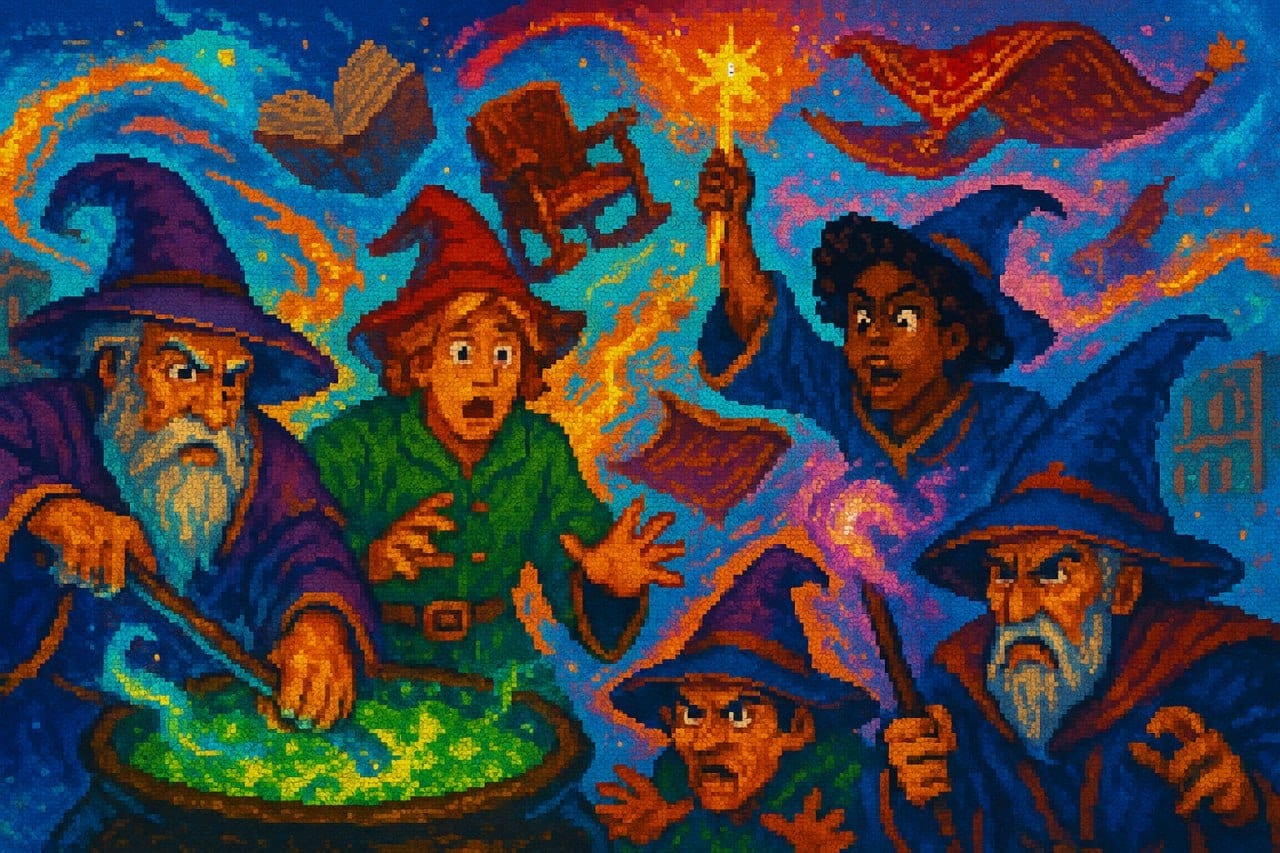
Bureau of Magical Affairs is the game we'd describe, if pressed, as The Office working a case for a magical investigation bureau. Professor Brum's cauldron leaked and every object in his mansion has developed strong opinions. The furniture is debating philosophy. Time anomalies are pulling mages into the wrong eras. Bureau No. 7 has assigned your team four open cases.
The chaos mirrors the first-week onboarding experience in a way that isn't metaphorical. It's the actual premise, and we've had clients run it for 100+ new-hire orientation cohorts. By Case 3, a group of strangers coordinates like a team that's worked together for months. The four-case structure makes pacing predictable; the event ends when it's supposed to, which matters considerably more than it sounds when you have 200 people with back-to-back calendars.
The Story customization tier has a specific use here. A technology company rewrote the Bureau's case files around their actual operational situation: Bureau agents were dispatched to extract 30 employees trapped in spreadsheet purgatory during an HRIS migration. The inside-joke credibility that creates is different in kind from a stock event. Onboarding cohorts, year-round, groups of 75-500: this is the game that lands best when you need strangers to feel like a team by Thursday.
Apocalypse
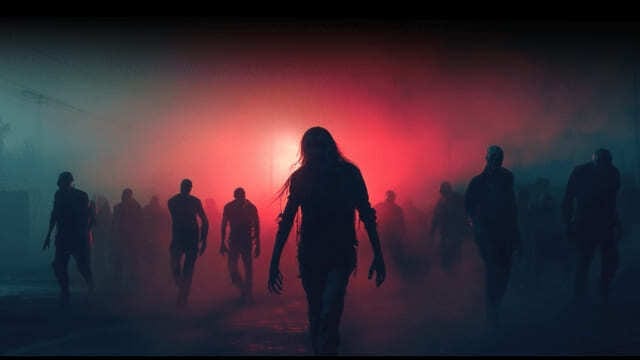
Apocalypse is the highest-energy game in the catalog and the most frequently misbooked. Teams pick it for the Halloween name. The game's mechanics, however, are built for sustained coordination under real pressure, not just thematic atmosphere, and teams that don't have their coordination footing yet often find that gap exposed at the worst possible moment.
When Apocalypse lands with the right team, it genuinely lands. A vaccine race against an overnight outbreak, four locations between the team and a cure, a countdown clock that isn't decorative. Engineering and fintech groups report that Stages 2 and 3 surface who leads in a crisis versus who assumes they do. That's useful data for HR leaders who want something real from an engagement event rather than a NPS score and a leaderboard photo. The game is stylized throughout: 2D art, no graphic content, closer in tone to World War Z the film than to anything that would need a sensitivity review.
For teams that are new to each other, or enterprise cultures where high-pressure mechanics feel out of register, starting with Last Temple Mystery or Bureau of Magical Affairs is the right call. Apocalypse fits tech, engineering, and fintech teams best, particularly for Halloween, Q4 events, and sales kickoffs built around a "we solve hard things under pressure" narrative.
Mission 8-Bit
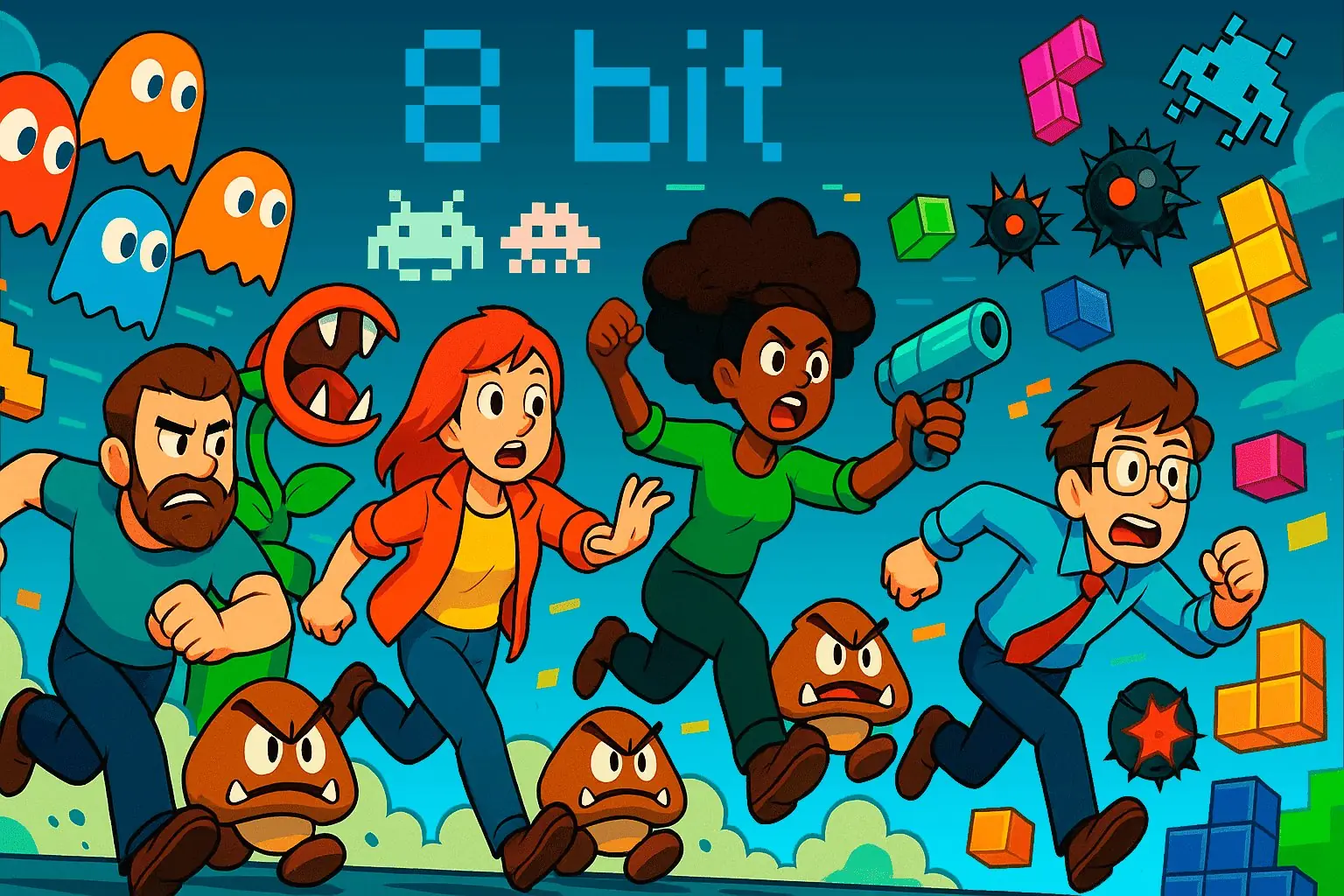
The best-in-catalog game for Q1 kickoffs, and the three-stage arc explains why: Mission 8-Bit compresses a quarterly project cycle into 90 minutes in a way that isn't a metaphor stretched thin. A modern virus has hijacked every digital device. The team starts locked in a corporate office where the equipment is actively hostile, escapes to a retro electronics shop the virus can't reach, rebuilds an 1980s computer, enters the 8-bit digital world, and assembles a killcode from the source while competing against other squads.
The three-act structure maps onto setup → build → ship at exactly the pace that a team planning its quarter recognizes. That recognition is the mechanism; the game doesn't have to explain itself. The retro-tech aesthetic lands well with engineering-leaning cultures, and the 8-bit sprite sheets of team members (delivered as an asset pack after the event) have a genuine second life as Slack avatars, stickers, and anniversary slides. We've run it with HR teams that haven't touched a video game in years; the arcade segments use minimal controls specifically because not everyone is a gamer.
Engineering, fintech, and SaaS teams use it most. Q1 kickoffs and quarterly all-hands openers are the occasions it fits best, though it holds year-round.
Book of Awakened Nightmares
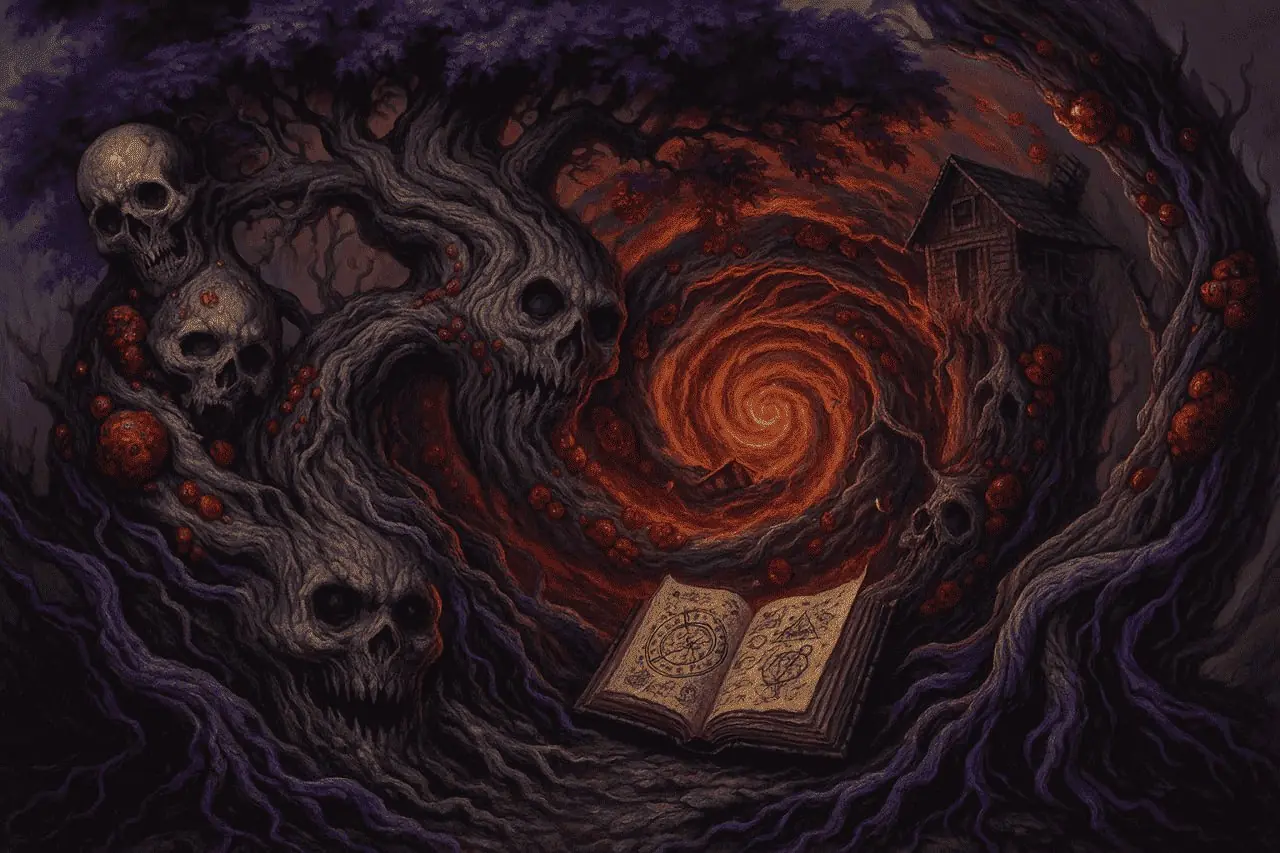
Book of Awakened Nightmares is the game we recommend when a prospect says "we want something seasonal but our CEO genuinely doesn't like anything scary". It's the atmospheric October option where horror is explicitly off the table. A cabin weekend goes wrong when the team assembles a researcher's leather-bound book and wakes something inside it. Three folkloric worlds pull the team in (despair, rage, surreality), each one requiring a genuinely different approach to navigate.
The pacing is slower than Apocalypse deliberately, and that's both the game's strength and its real audience filter. Teams with a preference for atmospheric storytelling over competitive urgency rate it at the top of the catalog. Teams that want kinetic competition find it too contemplative. We're transparent about this distinction on prospect calls because the only failure mode that doesn't recover is booking the wrong game for the team's actual culture.
What consistently surprises us: the international reach. The folklore composite draws from multiple traditions with no single dominant cultural frame: no US-specific Halloween tropes, no culturally-loaded mythology. We've run it across 15+ countries without a comfort complaint, and international teams often respond to it more warmly than to games with culturally-specific premises. Mid-size groups (50-200) are the sweet spot.
Wintervald Hotel Mystery

Wintervald Hotel Mystery is the game we book for legal teams, finance functions, and C-suite events where "escape room" as a descriptor would land wrong. It's the most enterprise-appropriate mystery in the catalog. An isolated luxury hotel, a murder before sunrise, a snowstorm trapping the team with the killer until morning. Three stages of Agatha Christie-style deduction through a cast of suspects whose alibis contradict each other in satisfying ways.
The murder is a stylized premise, not a graphic event. The tone is Knives Out, not anything that would generate a complaint. It works precisely because it doesn't try to perform fun in the way escape rooms are typically marketed. It commits to being sophisticated, and it usually succeeds. The game's most reliably HR-Slack-able moment: the reveal that the obvious killer was a misdirect, and watching which teams caught it.
Stage 2 (the interview and alibi phase) needs time to breathe. We've run Wintervald Hotel Mystery 200+ times and compressing it below 75 minutes breaks the deduction arc in a way that doesn't recover. Budget the full 90 minutes. December events at formal enterprise cultures, anniversary events, and mid-size groups (50-300) are where it delivers.
Under the Big Top
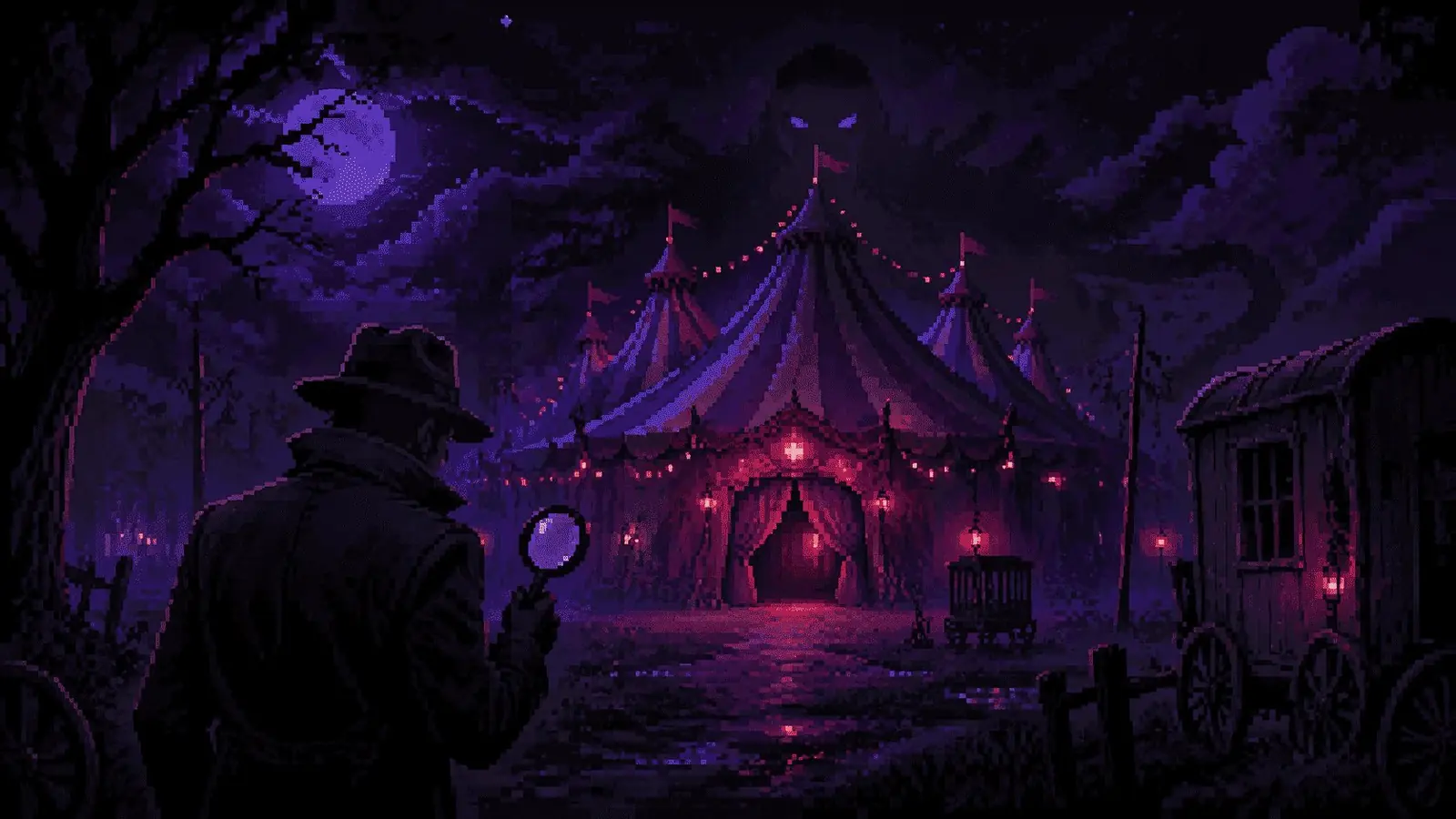
Under the Big Top uses the same deduction mechanic as Wintervald Hotel Mystery with a completely different aesthetic: vintage traveling circus, missing headlining act, a wonderfully strange cast of suspects. The strongman is surprisingly gentle. The trapeze couple haven't spoken in a year. The ringmaster knows considerably more than he says.
Hospitality companies tend to choose this game because the circus-mystery framing mirrors how guest experience actually works in their industry: incomplete information, competing accounts, needing to read a room accurately under time pressure. Beyond hospitality, it works for creative or theatrical cultures that find Wintervald Hotel Mystery too formal for the occasion they're planning. Marathon format suits the investigation rhythm particularly well for international teams. Gathering clues across days, cross-referencing accounts overnight, building toward a final deduction on Day 3 matches detective fiction pacing more naturally than a compressed single session.
Summer events, anniversary celebrations at whimsy-friendly cultures, and mid-size groups (50-300) are where Under the Big Top consistently lands.
Stolen Hours

Stolen Hours is the December game for teams who find generic holiday formats predictable, the choice for a group that would rather chase Santa's clock hands across four fantastical worlds than play another Christmas trivia set. Postapocalypse, cyberpunk, steampunk, and biopunk, each world distorting time differently and requiring a different approach to navigate.
The multi-genre structure surfaces different player strengths in each world. Players who lead the gritty postapocalypse stage often don't lead the cyberpunk decode section, and that reshuffling exposes people to each other in configurations they don't encounter in ordinary work, a useful side effect for larger teams where certain groups rarely interact directly. The art style is Pixar-adjacent throughout: no grimdark, no body horror, consistent comfort feedback from international runs.
The "time restarting" premise also rethemes naturally for January kickoffs, which makes it a December booking with carry-over utility into Q1 conversations. Mid-size to large groups (50-500) are the target range.
What the data says about virtual team engagement
The business case for structured virtual escape rooms has strengthened since 2022, and the most relevant research isn't about "fun at work" in a general sense. It's about the connection gap, format preference in distributed teams, and what separates a shared structured experience from an ad-hoc social event.
McKinsey's 2023 Some employees are destroying value, others are building it analysis found that employee disengagement and attrition cost a median S&P 500 company $228M–$355M annually in lost productivity, totaling $1.1B+ over five years. The more actionable finding from the same report: only 4% of employees are "thriving stars" delivering disproportionate value — and they cluster in distributed work, with 45% remote, 36% hybrid, and 19% in-person. A shared experience that gives a manager observational data about their team's coordination under novel conditions — and that fits the working modes top performers actually choose — is a categorically different kind of spend than a catered lunch or a Zoom happy hour. Every HeySparko event delivers a by-team analytics report within 24 hours — participation rate, coordination scores by stage, NPS — designed for exactly that manager conversation.
Microsoft's 2024 Work Trend Index found that 57% of distributed workers prefer asynchronous engagement options over live ones. The forced-synchronous problem is real and measurable: when a live event requires someone in Tokyo to join at 11pm, it generates resentment rather than connection, and resentment is precisely the opposite of what a good team event is supposed to produce. The opt-in completion rates we see in Marathon events across our portfolio — 78-92% — hold up against whatever attendance number a forced-synchronous alternative would produce for a globally distributed group.
Deloitte's 2023 Human Capital Trends report found that 46% of employees felt less connected to their colleagues than before the pandemic. That gap has narrowed since, but distributed teams still report connection as a persistent background problem — not because they dislike each other, but because digital work generates fewer ambient interactions where relationship context accumulates. What structured escape rooms produce that social hours don't is a shared story. "Remember when we completely failed Stage 2 and had to rebuild from scratch in the last 20 minutes" travels for weeks. "Remember when we were on a Zoom happy hour" usually doesn't make it to Monday.
The research case for recurring programs is clearer than most HR leaders realize. An SSRN review from 2023 — Anog et al., covering more than 60 team-building studies — put numbers on something we see in our own client data: the satisfaction and retention effects were measurably larger when activities were embedded in an ongoing development strategy rather than treated as isolated events. One escape room creates a good story. Four across the year tends to show up in the survey data.
We ran BGaming's multi-year company anniversary as a fully customized Big Game — 89% participation across their ~400-person distributed team, with cross-functional dynamics their HR lead noticed in the weeks that followed. The outcome made sense in retrospect. Format, game, and customization had been chosen to point in the same direction. Events where all three decisions are made carefully tend to feel qualitatively different from events where only the venue was chosen carefully.
Frequently asked questions
Which virtual escape room vendor should we choose?
It depends on headcount more than on puzzle quality. Below roughly 30 people, per-player vendors such as The Escape Game ($30-35 per player) or Puzzle Break (from $25 per person) are usually cheaper, and several of them cap a game at about ten players, which suits a small team well. Above 100, flat per-event pricing wins on arithmetic: our own ladder is $1,800 for up to 100 against $3,000 or more on per-player models at the same size. The other split is structural: a room capped at ten players turns a group of eighty into eight parallel rooms with eight separate stories, which is a different event from eighty people inside one. Decide which of those two you are actually buying, then compare prices.
How do we choose between a Big Game and Marathon format for a virtual escape room?
The deciding factor is time zone spread, and the answer usually makes itself. For teams within a six-hour window, a Big Game delivers shared real-time energy that's genuinely hard to replicate in any other format, where everyone watching the same leaderboard shift at the same moment creates something different from an async event. Past eight time zones, the live event window becomes someone's midnight. Marathon is the format that solves that: players engage when their schedule opens, the leaderboard is always visible, and we see completion rates in the 78-92% range across our portfolio — consistently higher than what forced-synchronous alternatives achieve from globally distributed participants.
Do participants need to download software or create accounts to play?
Every HeySparko game runs in a standard browser: players receive a link, click it before the event, and join directly. There is no install, no account creation, no IT permissions required. This matters operationally: corporate laptops frequently block executable installs, and requiring a download before a team event is a reliable way to start the session with a chunk of participants on a help-desk call instead of playing. The HeySparko platform was built browser-first specifically for enterprise environments where IT friction is a real planning variable.
What's the best virtual escape room for a large team of 200 or more people?
Last Temple Mystery scales to 10,000 players in a single Big Game session. At 200+, participants split into competing squads of 5-8 on a shared leaderboard, which creates cross-team rivalry without losing the small-group coordination that makes escape rooms work in the first place. For 500+ players spread across multiple time zones, Marathon typically outperforms a single Big Game on participation depth — multiple touchpoints across the week are easier for distributed participants than a single high-stakes window some will inevitably miss.
Are virtual escape rooms suitable for global teams with diverse cultural backgrounds?
Book of Awakened Nightmares was built specifically around this constraint — the folklore composite draws from multiple traditions with no single dominant cultural frame, and we've run it across 15+ countries without a comfort issue. Most other games in our catalog have been tested in 12+ countries with consistent feedback. The main cultural variable to check is leaderboard competition comfort: some team cultures respond better to collaborative completion than to direct ranking, and several of these games can be facilitated with either emphasis depending on the group.
How far in advance do we need to book a virtual escape room for work?
A standard Big Game without customization needs a minimum of ten days, though four weeks is the comfortable window. Logo integration (brand colors and logo woven into the game), NPC customization (character dialogue written to your company's voice and internal references), and Story customization (the full game narrative rewritten for your specific situation, with a briefing call) each need 10 business days. For groups at 500+ players or stacking multiple tiers, starting four to six weeks out avoids timeline pressure. See HeySparko pricing for full configuration details.
How do we measure whether the virtual escape room actually worked?
Every HeySparko event delivers an analytics report within 24 hours: participation rate by team, coordination scores by game stage, NPS from the post-event pulse, and a leaderboard breakdown showing which teams led at each stage rather than just who won overall. For HR leaders building an ROI case, the number executives care about most is participation rate per invited player — it drives the cost-per-engaged-employee calculation. For ongoing programs, tracking NPS and participation across quarterly events shows whether engagement is compounding. A three-question pre/post pulse captures self-reported connection scores if you need that layer for the board deck.