
Over the last decade, Halloween at work has stopped being a fringe US holiday tradition and turned into one of the two biggest engagement windows in the year for distributed teams. October bookings for company events now sit right behind December's holiday-party rush, and HR teams plan for it as a budget line item rather than as a "maybe we will do something" afterthought. The shift happened during the pandemic and never reversed. The companies treating Halloween as a real program — not a Slack-poll for costumes — are the ones whose Q4 engagement survey scores hold up against the rest of the year.
Five years into running virtual team building as a category — 1,500+ events for 700+ companies across 50+ countries — we've watched the failure modes repeat enough to predict most of them. The most common one is straightforward: somebody picks a horror-forward event for a team where half the company does not celebrate Halloween, half does, and nobody on the planning side asked. The other half either skips, dials in with cameras off, or files a quiet HR complaint. That outcome is fully avoidable with about thirty minutes of intent and one good format decision.
So the question worth answering before the booking goes in: how do you plan a Halloween team event for work that the costume-skeptics on a distributed team will still join?
Why Halloween at work is a different planning problem than the office party
For an in-person office, Halloween is mostly logistical. Costumes, snacks, a contest, a moment for the team. For distributed teams, the planning problem reshapes itself. October falls during Q4 budget defense season, costume traditions do not translate cleanly through Zoom, and any single event has to bridge time zones where some people are at 2pm local and others are at 10pm. Horror appetite varies wildly: some teams want jump scares and gore, others want soft folklore, and many global teams want nothing on the spookier end at all.
We've seen what works when teams approach the planning intentionally rather than defaulting to last year's pattern. The decision usually breaks into four questions. What is the team's real horror tolerance? Are people spread across time zones that make one live event awkward? Does the company want a single Halloween moment, or a week-long Spirit Week buildup? And is the budget defending a recurring program, or a one-off?
Big Game vs Marathon: the format decision that solves time zones
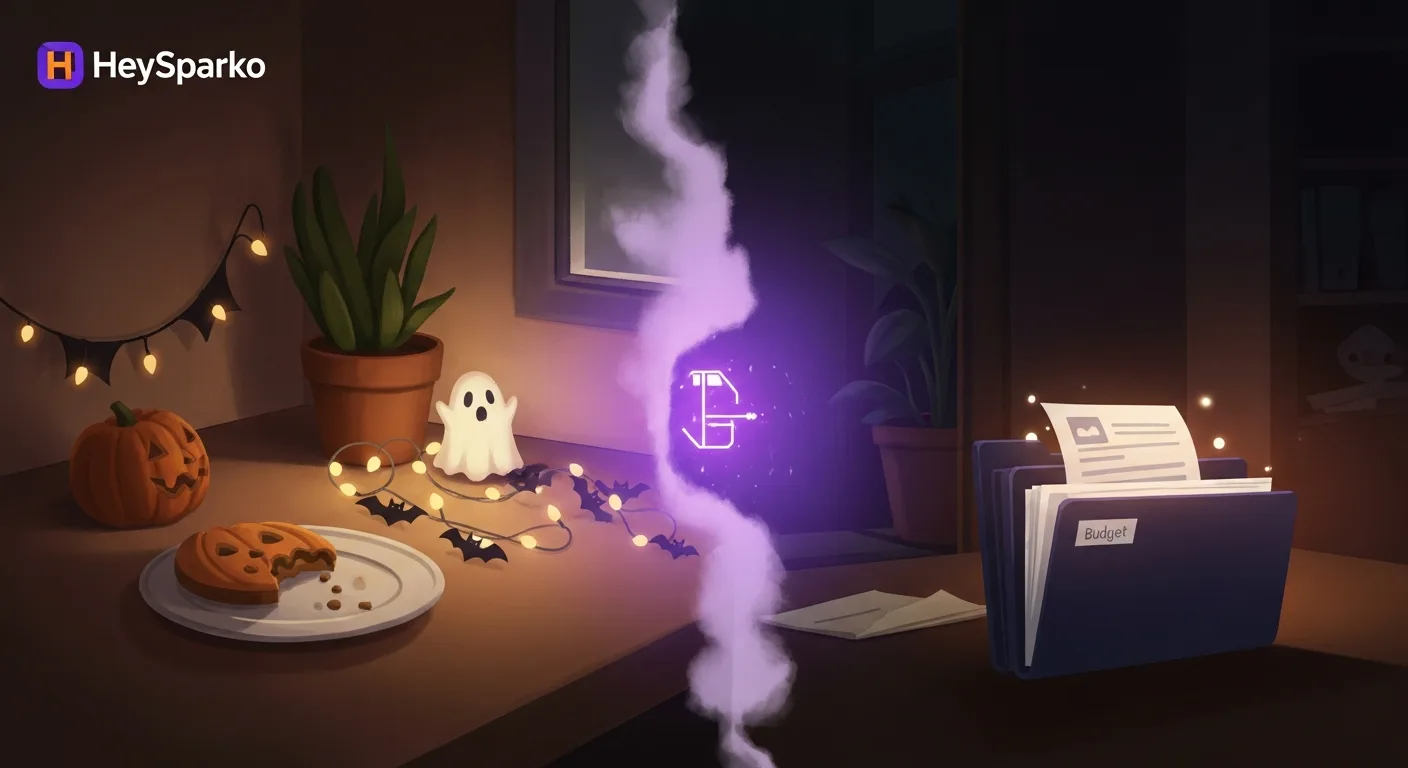
The format choice usually makes itself once you map the team. Big Game is the single live event with everyone in the same call for 60-90 minutes, a HeySparko Game Host running the narrative, breakout teams of four to eight people solving puzzles together. It works when the team can share a live window (generally a six-hour time-zone spread or less) and when people want the energy of a synchronous room watching the leaderboard shift in real time. The room hears the same plot twist at the same second. That shared moment is the product.
Marathon runs over 1-5 days with asynchronous daily episodes. People engage on their own schedule, the shared leaderboard creates pull instead of obligation, and nobody on a global team gets pushed into a 6am call to celebrate Halloween. Completion rates in our data sit between 78% and 92% at 500+ companies for opt-in Marathon programs, and roughly 35% of typical Zoom-fatigue lurkers participate because they no longer have to perform engagement on camera.
For a Halloween-week activation on a distributed team, Marathon is the safer call. For a single-office or contained-time-zone team with high social density, Big Game has more visceral payoff. The decision is not about which product is better. It is about which audience you have.
Game choices that bridge the costume-skeptic and costume-lover gap
The four Halloween-window games in our catalog hit different points on the horror-tolerance spectrum. The trick is matching the game to the team, not to an abstract sense of "spooky."
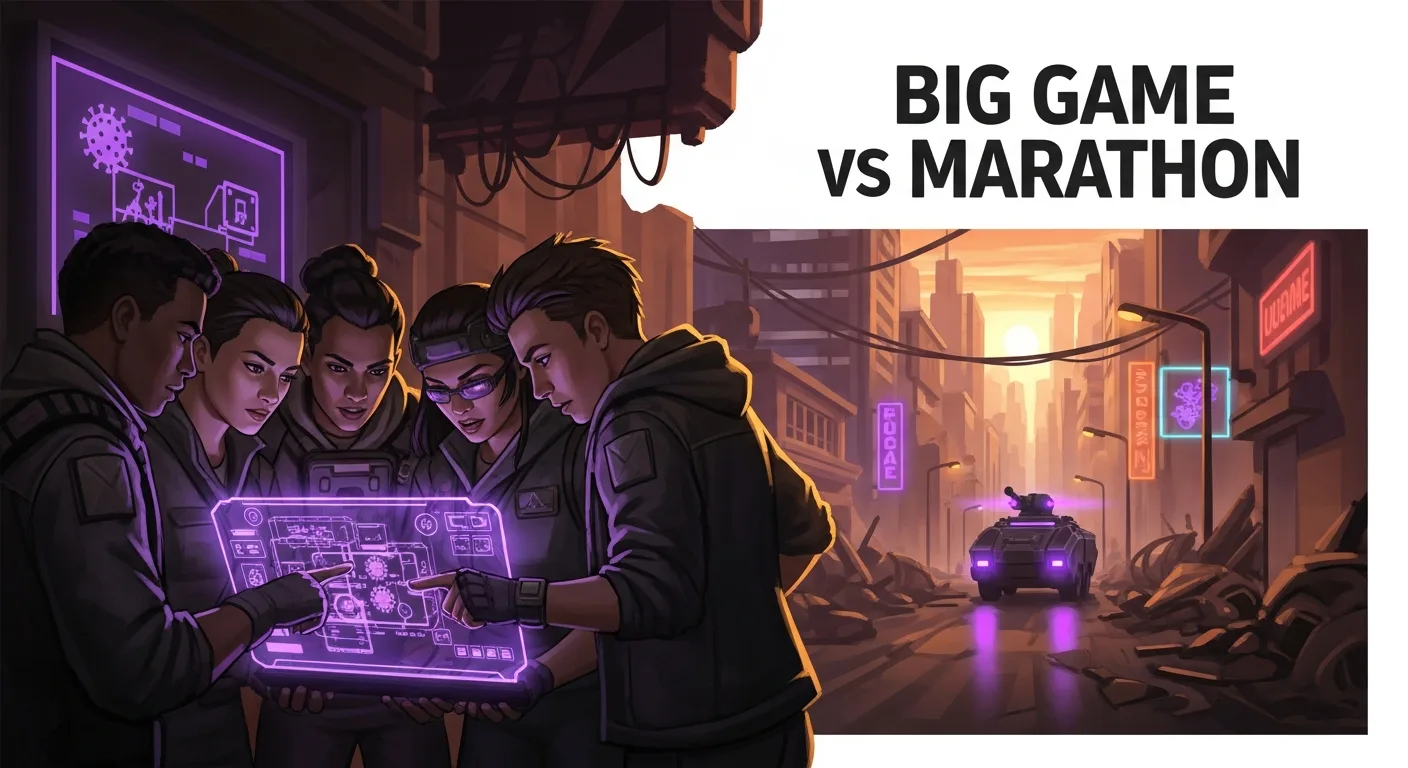
Apocalypse is the highest-energy option, a stylized vaccine-race adventure where four locations stand between the team and a working cure. The aesthetic borrows from genre cinema rather than horror: no gore, no jump scares, no body imagery. We've watched 25-person engineering teams find their natural ICs and project managers in Stage 2 once the time pressure forces delegation. Best fit for tech, fintech, and startup cultures where time-pressure mechanics feel energizing rather than draining.
Book of Awakened Nightmares sits on the atmospheric end of the spectrum. Cabin-in-the-woods setup, a leather-bound book pulling players into three folklore worlds, Tim Burton tones rather than horror. We've run it for global teams across 15+ countries without a single comfort complaint because the folklore is composite — no single tradition dominates, so nobody's culture gets reduced to a costume. Good fit for mid-size groups where slow-paced atmosphere creates real conversation in team chats.
Wintervald Hotel Mystery is the enterprise-appropriate pick. Snow-bound luxury hotel, a guest murdered after dinner, three stages of deduction in an Agatha Christie register. The murder is a premise, not a graphic event; no body imagery; nothing that would trip a buttoned-up enterprise audience. We book this one most often for finance, legal, and C-suite Halloween events where the office-parody tone of something more whimsical would feel off. Teams like Miro and Home Credit Bank have used mystery formats this way.
Under the Big Top brings vintage circus mystery with a vanishing performer and a quirky cast of suspects. The whimsy is warm rather than goofy, closer to Big Fish than to slapstick, and works for hospitality and consumer-brand cultures that want October atmosphere without horror. Anniversary teams who want a "we have been on the road together" metaphor land here too.
For mixed teams where horror is genuinely off the table, Bureau of Magical Affairs is the year-round flagship that still reads as appropriate to October without leaning hard on Halloween tropes. Whimsical bureaucracy meets magic; closer to The Office crossed with Men in Black than to Tolkien. We recommend it for onboarding cohorts whose first impression of the company shouldn't be horror anyway.
December teams sometimes ask whether Stolen Hours, a genre-bending December game where Santa's clock hands scatter across four worlds, can work in October with a reframe. Yes, but the seasonal narrative loses force. Save Stolen Hours for the end-of-year window where the time-restart premise lands.
For teams that want a 60-minute trivia closer instead of a full adventure, Pop Culture Trivia is the safe default for cross-functional groups, and History Trivia works for academic and consulting cultures whose CEOs name their dogs after Roman generals. Trivia is the wrong call as a first-impression HeySparko event (light surface, no narrative arc) but lands as a recurring monthly cadence.
Customization for Halloween-week events
When the event needs to feel like the company's, not the vendor's, the three customization tiers stack onto either format. NPC customization rewrites character dialogue in the company's voice and weaves in internal language; Logo integration carries brand colors and the company mark across the game environment; Story customization rewrites the narrative arc to fit a specific company situation, like a Halloween-week launch where the in-game stakes mirror the launch the team is racing.
Customize for your team
TYPE 1
Your team as in-game characters
Real team members, mascots, or characters from your games as NPCs.
TYPE 2
Your brand integrated natively
Logo and brand elements native to game environments — locations, items, UI.
TYPE 3
Your story woven into the game
Company milestones, products, and inside references woven into puzzles, dialogues, and tasks.
For Halloween Spirit Week Marathon events, customization compounds. Players encounter the brand and the character voice repeatedly across 3-5 days, and the brand-recall lift outpaces what one 90-minute Big Game delivers. About 15% of our clients pick at least one tier; roughly 5% take all three. The math is straightforward: a fully branded event costs less than the year-end recruiting marketing spend most companies budget for, and the asset has a six-month internal afterlife in Slack threads and survey free-response fields.
Timing: when Halloween calendars fill up
For Halloween 2026, the booking window has its own rhythm. Demand peaks August 15 through September 30; the calendar slots between October 28 and 31 fill first; everything else cascades from there. If you are reading this in mid-October hoping to run something on the 31st, the conversation needs to start this week. For Marathon Spirit Week formats across October 27-31, four to six weeks of lead time is the minimum for clean episode comms and pre-event anticipation. Customized events need 10 business days for the NPC brief and the Story-tier alignment call. We have run last-minute Halloween events that landed well, but the format options narrow sharply once you hit the three-week window.
What the data says about Halloween-window engagement
The case for spending the budget on a structured Halloween event is rarely emotional inside an HR-Finance conversation. It is a retention and engagement-program argument. The numbers that matter sit in three places: baseline engagement, the cost of disengagement, and the academic evidence on whether team-building interventions move retention at all.
The baseline is the Gallup 2025 State of the Global Workplace report. Gallup's reading: only 21% of employees worldwide are engaged in their work, with disengagement costing the global economy $438 billion annually in lost productivity, and 70% of variance in team engagement is attributable to the direct manager. The headline number is worth pausing on. Fewer than one in four workers shows up engaged. That is not a problem a Halloween event solves in 75 minutes, but it is the backdrop against which every engagement budget gets defended in front of Finance. The 70% manager-variance figure matters here too: a Halloween event is not a manager-replacement strategy, but it functions as a data-collection mechanism that exposes which team pods are doing the work of connection and which are not.
The retention math anchors this on the spend side. SHRM's 2024 cost-per-hire calculations put non-executive departure cost in the five-figure range per person once recruiting time, hiring manager attention, and ramp time get included. For a 200-person distributed team, even a one-point reduction in annual attrition (typical industry baseline runs 14-22%) recoups multiples of a Halloween-week event budget several times over. The CFO conversation gets easier when the budget request is framed as an engagement instrument with measurable retention impact rather than as a costume party with snacks.
The distributed-team angle has its own structural data. Microsoft's 2024 Work Trend Index, surveying 31,000+ workers across 31 countries, found 64% of workers say they are struggling with the pace and volume of work, and 57% of distributed workers would prefer async-engagement options to live ones. That second figure is the empirical foundation for picking Marathon over Big Game on globally distributed teams: more than half of the audience does not want a video call as their celebration mode. The Halloween version of this insight is concrete. The Tokyo engineer does not want to take an 11pm call to attend the New York office's Halloween moment.
The academic evidence backs the structural argument. Anog et al. (SSRN, 2023) ran a systematic review of 60+ studies on team-building interventions and found that structured activities increase team satisfaction and reduce voluntary turnover, with effects amplified when the activities sit inside a broader development strategy rather than appearing as one-off events. That last clause is the part People Ops teams who have run Halloween events for years already know: a single Halloween Big Game without a follow-up program returns less than the same event embedded inside a quarterly engagement cadence. The numbers we see in Marathon programs match this. 78-92% completion rates over 1-5 days, NPS pulse averaging 8.4, and roughly 35% of typical Zoom-fatigue lurkers participate who would not have joined a forced-synchronous alternative.
Our own portfolio data lines up with the third-party research at the structural level even when the specific percentages differ. Across the events we've facilitated since 2020, the gap between best and worst manager pods at the same company runs three to four times in voluntary participation rate. The same event in the same company can show 90% participation on one team and 30% on another, and the leading variable is the manager's communication around the event. The Halloween event is the moment; the manager's Slack message a week before it is the work that earned the moment.
Frequently asked questions
How early should we book a Halloween team event for a distributed team?
For a Big Game on October 28-31, four weeks of lead time is the comfortable minimum. For a Marathon Spirit Week across October 27-31, allow five to six weeks so episode comms and the leaderboard preview reach people before Day 1. Any customization (character dialogue in your voice, brand integration, or a custom narrative) needs 10 business days. Bookings inside that window get squeezed because the late-October calendar fills first; the September 1 commitment usually makes the difference between picking the format you want and taking what is open. We've seen this pattern hold every year since 2020.
What if half our team does not celebrate Halloween at all?
Frame the event as "October team event" in the calendar invite rather than as a Halloween party, make costume participation explicitly optional in the welcome message, and pick a game where the October atmosphere supports the experience without requiring belief in the holiday. Apocalypse carries October energy without leaning into trick-or-treat tropes, and Bureau of Magical Affairs reads as appropriate to mixed-culture teams year-round. The framing change matters more than people expect; same event, different invitation, very different participation rate from the half of the team that would otherwise opt out quietly.
Is Apocalypse too intense for a corporate team?
Not in our experience. The aesthetic is closer to genre cinema than horror: stylized 2D art throughout, no blood, no gore, no jump scares. The time pressure is calibrated to energize rather than exhaust; most teams finish wanting an immediate replay. We've run Apocalypse for engineering teams at fintechs, SaaS companies, and consumer-tech organizations across 12+ countries without comfort complaints. The threshold is the team's appetite for time-pressure mechanics rather than horror tolerance. Buttoned-up enterprise audiences are a better fit for Wintervald Hotel Mystery, which keeps the murder as premise rather than graphic event.
How do we run a Halloween event for a team spread across 12 time zones?
Marathon format. A single live Big Game across 12 time zones forces somebody onto a 6am or 11pm call, which produces the opposite of engagement. Book of Awakened Nightmares as a 3-day Marathon during the week of October 28 lets the Tokyo team play at 3pm local, the San Francisco team play at 3pm local, and the shared leaderboard provide the social glue across the time gap. Our completion rates on opt-in Marathon programs run 78-92%, including teams that historically skip live events entirely because the calendar math punished them in the past.
What does a typical Halloween Big Game look like in practice?
A live 60-90 minute Zoom (or equivalent) where a HeySparko Game Host runs the narrative; players join breakout teams of four to eight; everyone solves puzzles together; a shared leaderboard updates in real time as teams score points. No app install, no account creation, browser link only. For Wintervald Hotel Mystery the cast of suspects gets interviewed in Stage 2; for Under the Big Top the circus backstage holds the evidence; for Apocalypse the team races through four locations against a working clock. The host carries the show; the client team participates as players.
How do we measure whether the Halloween event was worth the budget?
Three numbers are worth pulling for the post-event review. Participation rate (above 70% for live, 65% for opt-in Marathon is healthy); a 3-question pre/post pulse measuring connection-to-team and willingness-to-recommend; and the analytics dashboard we send within 24 hours that breaks out participation, scoring, and chat engagement by team and manager. Pair that with the SHRM cost-per-hire framing — even a one-point retention improvement on a 200-person distributed team typically recoups multiples of the event spend. Finance conversations land more easily when the budget request frames the event as a retention instrument.