
Halloween has become the second-biggest virtual-event booking window of the calendar year, behind only the December holiday party. The People Ops question every August is no longer "should we do something" but "what should we do, and will it land for the half of our team that doesn't culturally celebrate the holiday?" Halloween trivia is the answer most teams reach for first because it's the lowest-friction option: no costume pressure, no horror content, no narrative arc to brief, and a familiar format that survives a global Zoom call. For a real subset of teams it's the right call. For others, it's the wrong format dressed in pumpkin emoji.
Since 2020, we've delivered virtual team events to 700+ companies across 50+ countries — 1,500+ events in the portfolio so far. About 30% of those have fallen in the September-to-November booking window, and "Halloween trivia for work" is one of the most common briefs we receive in August. The pattern we've watched repeat is straightforward: trivia works under specific conditions and falls flat outside them, and the conditions are easy to recognize once you know what to look for.
How do you run a Halloween trivia event for work that holds attention through all three rounds, instead of producing the polite-but-empty leaderboard reaction every People Ops lead has had at least once?
When Halloween trivia is the right call (and when it isn't)

A few patterns predict which teams genuinely enjoy Halloween trivia and which find it forgettable by Tuesday. The clearest one we see: teams that have already run three or more virtual escape rooms in the past two years are usually puzzle-fatigued. For them, trivia lands as a relief. The other pattern is the quarterly-cadence team where October falls on the calendar by accident — those teams prefer trivia because the seasonal layer is light and doesn't demand a separate design conversation. Or take the case of a 60-minute all-hands closer that just needs to be a social moment, no briefing involved. Trivia is the lowest-friction shape we know for that.
Where trivia falls flat is when the brief is "we want real atmosphere" or "this is the event of the year, make it count." Trivia is a strong category, but a surface format. The narrative arc is shallow by design, the energy comes from competitive banter rather than story momentum, and the lasting memory tends to fade by the next Slack standup. For a team running its first virtual event with us, we usually steer the conversation toward something with more presence: Apocalypse, Book of Awakened Nightmares, or Wintervald Hotel Mystery. Trivia is the fourth or fifth event with us, rarely the first.
The other condition that matters is how culturally mixed the room is. Halloween framing carries weight in the US, the UK, Ireland, and tech-heavy Latin American cities — those are the four geographies where booking demand visibly spikes in our pipeline every August. Continental Europe is a softer signal. Most of Asia barely registers as a Halloween market for us. Trivia with a Halloween skin reads as performatively cute to a participant joining the call from Tokyo or Mumbai. So we recommend "October team event" in calendar invites rather than "Halloween party" whenever the room is genuinely global. The calendar window justifies itself; no one has to opt into Halloween mythology to show up.
Big Game versus Marathon — the format question that comes first
Before picking which trivia pack to run, decide the format. We see teams pick a pack first and a format second, then discover the format makes the pack work or fall apart.
Big Game is the live synchronous trivia event most people picture. Everyone joins the same Zoom call, a HeySparko Game Host runs three rounds across 60-75 minutes, breakout teams of four to eight players coordinate on answers, and the leaderboard updates in real time. The energy of a live trivia event is its core asset. Hearing a breakout shout the wrong answer 30 seconds before the reveal, watching a 2,000-person leaderboard reshuffle live, the genuine surprise when a team thought they were winning and someone else passed them — those moments don't replicate async. Big Game trivia is right for groups within a six-hour time zone spread, or for groups large enough that running 2-3 regional Big Games makes operational sense.
Marathon runs the same three-round trivia structure across two to five days as daily episodes. Round 1 unlocks Monday, Round 2 Wednesday, Round 3 Friday. Players engage on their own schedule, the leaderboard stays live throughout, and completion rates land in the 78-92% band across our portfolio. Marathon trivia is the answer for global teams who can't share a synchronous window, and for "spirit week" formats where October energy is meant to span days rather than 75 minutes. It also works when the budget conversation has to justify "ongoing engagement" rather than "one-time event."
A fintech we worked with last October had about 340 people split between Lisbon, Cape Town, Dubai, and Singapore. Their previous October trivia event was a single live Big Game at 4pm UTC, and APAC attendance came in at 38%. We ran Pop Culture Trivia as a 3-day Marathon instead. Completion rate at end of Friday: 71% globally, 68% in APAC. Same trivia content, different format, different outcome. For teams with that distribution, Marathon isn't a compromise. It's the format where the whole company shows up.
The two trivia packs that hold up in October
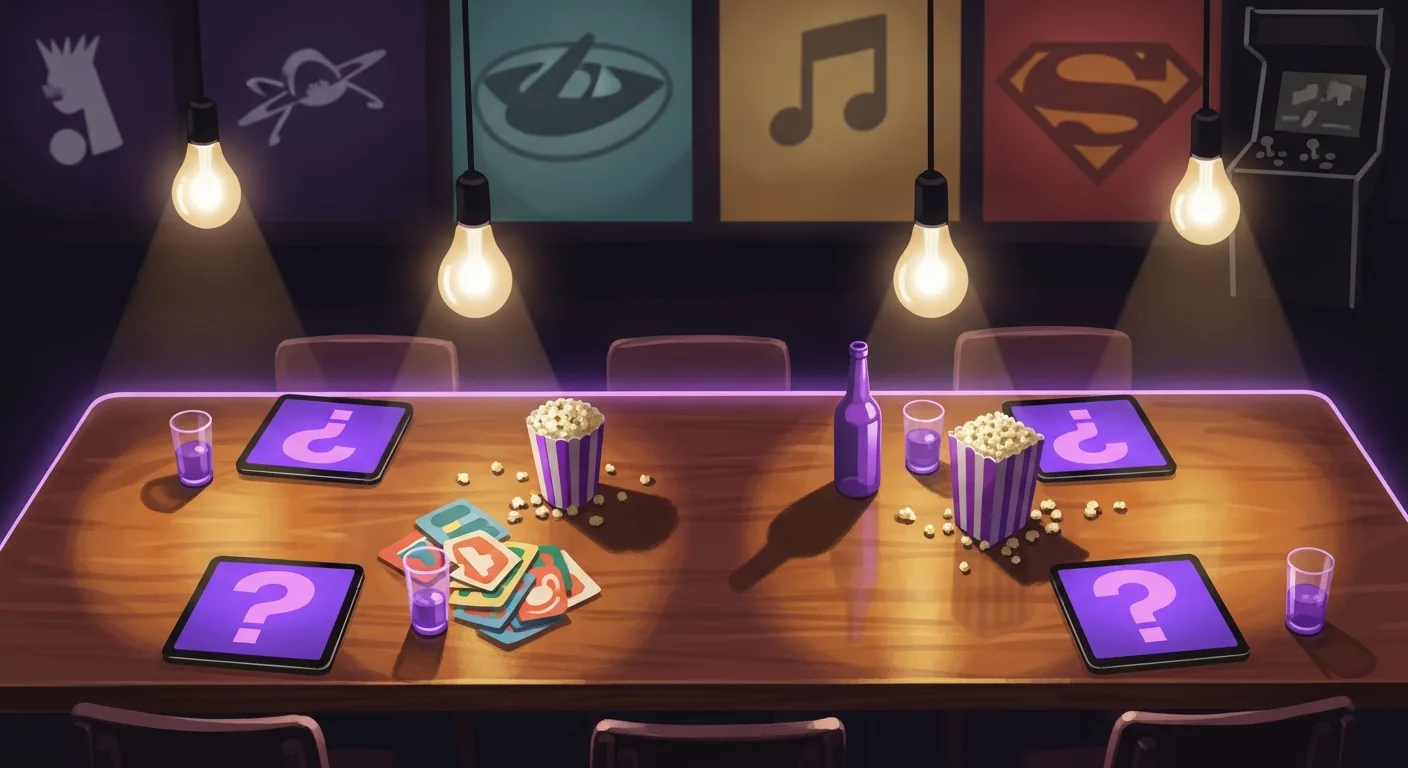
Our catalogue has ten themed trivia packs plus a custom-built option. Most of them work fine in any month, but two earn the October booking more reliably than the others.
Pop Culture Trivia is the safer universal pick. Three rounds — Mainstream Mix, Visual Iconography, Cultural Crossroads — covering five decades of music, film, TV, celebrity culture, and viral moments. The Halloween texture comes through on its own because pop culture is already saturated with horror-and-comedy crossovers. Every Halloween costume your team has worn in the last decade lives somewhere in the deck. We refresh it quarterly. Roughly 20% of questions reference the last 18-24 months. Want your brand colors on the leaderboard and the completion certificate? Add a Logo customization tier and it's done.
Cartoons & Animation Trivia is the one that surprises People Ops leads most often. Three rounds across Saturday-morning classics, the Disney-Pixar catalogue, the anime canon, and streaming-era originals reshaping animation today. Why it lands in October specifically: villains, monsters, and stylized horror are a core slice of what the medium does well. The visual round leans into iconic imagery — the Bride of Frankenstein, Studio Ghibli witches, the Tim Burton stop-motion catalogue. We've watched senior engineers who haven't posted in the company Slack in months come alive over a question about Avatar: The Last Airbender and lead the audio round. Every adult has cartoon memory. Most teams don't realize how much.
A practical note on Custom Trivia in this window. About one in seven booking conversations turns to whether the team should build a bespoke pack around its own company history. Our standard answer for October is no. October trivia rewards content the team already knows. The surprise factor of bespoke company content lands better in January as a Year-in-Review pack, or at a milestone — anniversary, leadership transition, major product launch. Pop Culture and Cartoons & Animation stay surface-level on purpose in October.
When to skip trivia entirely and pick an adventure or mystery
Some Halloween briefs are wrong for trivia from the start. If the team has done virtual trivia three times in the past 18 months, another round of trivia content (even excellent trivia content) produces the polite-engagement dynamic where everyone shows up dutifully and forgets the event by the next Slack standup. The signal that you've hit this point: the People Ops lead can't get more than 60% of survey respondents to remember the last event without prompting.
For those teams, October is the right moment to pick an adventure or mystery. Bureau of Magical Affairs handles the "culturally mixed team that wants something light and competent" brief well. The premise is bureaucratic magical-emergency response. The tone sits somewhere between The Office and Men in Black. Four cases, mapping cleanly onto a Marathon daily-episode structure. We book it most often for new-hire cohorts whose orientation window happens to land in October.
Under the Big Top is the alternative when atmospheric Halloween energy matters more than literal horror. The vintage-circus mystery carries a warm-melancholic register, somewhere closer to Big Fish than to anything dark. It holds up as a 3-day Marathon for distributed teams.
Stolen Hours is the engineering-team and creative-studio favorite. The premise: Santa's clock hands have been stolen. Your team chases them across genre fiction — postapocalyptic wasteland one stage, cyberpunk neon the next, then steampunk gears, then biopunk. The October aesthetic is built in without the trick-or-treat baggage. December framing needs a brief contextual note from the host if you're running it in October. That's a small operational ask.
Once a team has done their fourth or fifth Halloween event with us, the conversation changes. What worked last year is the bar. What's new this year is the ask. Trivia rarely answers that ask. Adventures and mysteries do.
What the data says about Halloween team events
People Ops leaders justifying a Halloween event budget end up running two arguments at once: the cost case for finance, and the engagement case for the leadership team they report to. The research that holds up under scrutiny on both fronts is more limited than the LinkedIn-quote economy suggests, but a few citations earn their place.
The case for connection events as a category, not just Halloween events, has its clearest defensible anchor in the Buffer State of Remote Work 2023 report. Among remote workers who say they feel connected to their colleagues, 46% attribute that connection specifically to having met in person at some point. The more striking number is the converse: among remote workers who do not feel connected, 56% cite "no opportunity to connect socially" as the reason. Buffer's data covers both in-person off-sites and virtual social events under the connection umbrella, which is the framing we'd defend if asked. An October team event addresses a specific reported pain point in remote workplace culture, not a feel-good extra.
The cost-of-disengagement-versus-cost-of-event math is the budget-defense argument. SHRM's 2024 cost-per-hire calculation puts the all-in cost of a non-executive departure at $15-21 thousand once recruiting, ramp time, and lost productivity are accounted for. A 200-person virtual event typically lands in the mid-five-figure range with light customization. The directional math gets straightforward fast: if a recurring engagement program (Halloween trivia included) reduces voluntary turnover by even one person per year against the alternative of zero engagement events, the event has paid for itself with margin. We're not selling that argument as airtight; engagement-and-retention causation is complicated. But it's one of the cleaner cases the budget conversation supports.
The burnout angle matters in October because Q3 closes are brutal and the Halloween window arrives as people are still decompressing. Deloitte's 2024 Burnout in the Workplace report puts current-job burnout at 77% of US professionals, with lack of recognition (31%) overtaking workload as the leading driver in their data. The same report tracks a 23% reduction in burnout symptoms among workers attending two or more company-sponsored events per quarter. That's not a direct argument for Halloween trivia. It's an argument for cadence: a quarterly engagement rhythm shows up in retention math, Q4 mood surveys, and the willingness of senior leaders to renew the line item the following year.
There's also a meta-review worth citing for the academic side. Anog et al. (SSRN, 2023) looked at 60+ studies on team-building interventions. The headline finding: structured activities increase satisfaction and reduce turnover. The clause People Ops leads tend to miss is the qualifier on that finding. Effects amplify only when the activities sit inside a broader people-development strategy. A standalone October event lands flat. Pair Halloween trivia with a Q4 survey debrief, a Q1 manager-development session, and a monthly recognition cadence already running in Slack. Now the trivia event is a data point in a pattern. That's the version that gets renewed.
Where we'd be careful: the literature does not back a claim that any one trivia format moves measurable engagement lift. Don't promise leadership that one event will move survey scores. Do tell them the event makes the rhythm visible and creates a calendar moment that sustains the broader program. The more honest pitch is the one that gets renewals.
Frequently asked questions about Halloween trivia for work
How far in advance should we book a Halloween trivia event?
October bookings fill from mid-August through end of September every year, with the most-requested dates (October 27-31) locking by mid-September. Four to six weeks of lead time is the standard recommendation for a Big Game trivia event, including with Logo customization, and eight to ten weeks if you want a Marathon program with daily content drops. Last-minute bookings under two weeks are possible but the recommended games may already be unavailable. Off-the-shelf packs have more date flexibility than custom-built options because no scripting time is required.
How many people can join a Halloween trivia event at once?
Big Game trivia scales from 15 to 10,000 players in a single session. The format is built to handle ranges most virtual-event platforms can't. The sweet spot for shared-energy events is 50-500 players where leaderboard updates feel personal and the Game Host can call out individual breakout teams by name. Above 1,000 we usually recommend Marathon format because async play maintains leaderboard energy without forcing thousands of people into one Zoom. For sub-30 groups, Big Game works fine, but the energy economics shift: small-group trivia is more intimate than competitive.
Can we customize the trivia content with our company's brand?
Yes, at two levels. Logo customization adds your brand colors and logo to the leaderboard, intro splash, and completion certificate as a flat add-on that runs across any of our trivia packs. For deeper branding, our Custom Trivia option builds a 30-question pack written around your company's history, products, and inside jokes; pricing runs per-event with a 12-month re-run license. Logo is the most-booked option for one-off October events. Custom is the answer when the trivia event also marks a milestone, anniversary, or major team moment that benefits from bespoke content.
Do participants need to install any software?
No installs, no account creation, no app downloads. HeySparko trivia runs entirely in the browser. Players join via a shared link, type a team name, and start playing. We've tested with Cisco, Crowdstrike, and Zscaler corporate security configurations across multiple Fortune 500 clients, and the player experience works on all of them. The only real requirement is a modern browser and a stable connection. For teams with corporate-managed laptops that block external sites, we provide an IT-friendly URL that finance and security teams can review and whitelist in advance of the event.
How do we run Halloween trivia for a global team where not everyone celebrates?
Frame the event as "October team event" in calendar invites rather than "Halloween party," make any costume participation explicitly optional in the welcome message, and pick a trivia pack where October aesthetics enhance the content rather than carry the whole event. Pop Culture Trivia handles this gracefully because its content is globally recognized rather than US-Halloween-specific. For teams where even the "October" framing feels off, Bureau of Magical Affairs or Under the Big Top carry atmospheric register without Halloween framing at all.
What kind of reporting do we get after the event for our leadership team?
Within 24 hours we send a participation breakdown by team, a leaderboard with team rankings, an NPS pulse score from the post-event survey, and a free-response highlight of player reactions. For Marathon events, we include daily participation curves showing engagement patterns across the days, useful intelligence for the People Ops lead's broader engagement program. The analytics dashboard typically gives the HR Leader the kind of numbers Finance asks about: participation rate, NPS, and by-manager breakdown. Most October trivia events land in the 7.8-8.6 NPS range across our portfolio.