


A HeySparko virtual team building game costs a flat price per event, set by headcount: $550 for up to 15 people, $1,800 for up to 100, $3,000 for up to 200 and $5,300 for up to 500. Per person, that runs from $36.67 at the smallest tier down to $2.25 at 10,000 players.
Those are our published prices as of September 2026. They come from the same price table the calculator on our pricing page runs on, so nothing in this article needs a sales call to confirm. A multi-day Marathon multiplies the base price, customization adds a fixed amount per layer, and that is the whole price model. This page used to be three separate articles about cost, budget and justification; they are one now, because they were answering the same question.
How much does virtual team building cost for a team of 50, 200, 500 or 2,000 people?
The full price ladder, per event and per person
Every price below is for one Big Game: a live, hosted session of 70-90 minutes, with a professional facilitator on Zoom and the game itself running in the browser. The host is included. There is no per-seat licence and no platform fee on top.
| Team size (up to) | Price per event | Cost per person at that size |
|---|---|---|
| 15 | $550 | $36.67 |
| 30 | $850 | $28.33 |
| 40 | $1,050 | $26.25 |
| 50 | $1,300 | $26.00 |
| 70 | $1,500 | $21.43 |
| 100 | $1,800 | $18.00 |
| 150 | $2,500 | $16.67 |
| 200 | $3,000 | $15.00 |
| 300 | $3,800 | $12.67 |
| 400 | $4,500 | $11.25 |
| 500 | $5,300 | $10.60 |
| 1,000 | $6,800 | $6.80 |
| 3,000 | $11,300 | $3.77 |
| 5,000 | $14,300 | $2.86 |
| 10,000 | $22,500 | $2.25 |
Each price covers every team up to that size. A team of 101 pays the 150-person price, $2,500, which is $24.75 a head; the same invoice at 150 people is $16.67 a head. So the cost per person is lowest at the top of each tier, and a headcount sitting a few people over a ceiling is worth a second look before you book.
The per-person column is the one to take into a budget meeting. It is the number Finance compares against every other line it approves, and it moves in the direction people do not expect: the larger the team, the less each person costs.
How the price is built: three inputs and nothing else
A HeySparko quote has exactly three inputs. Change one and the total changes in a way you can predict; change none and the price is the same whichever game you pick.
- Headcount picks the tier. The table above.
- Format multiplies it. A Big Game is the tier price. A Game Marathon, which runs the same game over one to five days, is the tier price × (1 + 0.5 × (days − 1)), rounded up to the nearest $10. That is ×1.0 for one day, ×1.5 for two, ×2.0 for three, ×2.5 for four and ×3.0 for five.
- Customization is added last. $1,000 for your logo, $2,500 for custom characters (NPCs), $5,000 for a custom story, or $7,500 for all three. It is added after the format multiplier and is never multiplied by the number of days.
A worked example: 200 people on a three-day Marathon with the logo layer is $3,000 × 2.0 = $6,000, plus $1,000, for a total of $7,000. The same team on a one-off Big Game with no customization is $3,000.
Big Game or Marathon: what each costs at common sizes
| Team size | Big Game | 3-day Marathon | 5-day Marathon |
|---|---|---|---|
| 50 | $1,300 | $2,600 | $3,900 |
| 100 | $1,800 | $3,600 | $5,400 |
| 200 | $3,000 | $6,000 | $9,000 |
| 500 | $5,300 | $10,600 | $15,900 |
| 1,000 | $6,800 | $13,600 | $20,400 |
The two formats are not a cheap and an expensive version of one product. A Big Game is one live hour and a half: everyone on the same call at the same time, a host running the story, a single result at the end. A Game Marathon has no call and no host; the game opens for one to five days, each person plays 25-45 minutes when their own day allows, and the results build up on one shared leaderboard.
For the same team, the Marathon invoice is always larger. What it buys is reach. If your people are spread across time zones that no single hour suits, a live session quietly excludes whoever would be joining at dawn or at midnight, and a lower invoice for an event a third of the team cannot attend is not the cheaper option. If one live hour works for nearly everyone, the Big Game is the lower total and the simpler line in the budget.
The practical rule we give People teams: decide the format from your calendar before you look at the price, then read the price off the table.
Customization: fixed prices per layer
Customization does not make a stock game better or worse. It changes whose event it feels like. Each layer is priced as a fixed amount, whatever the headcount:
- Logo, $1,000. Your brand across the game screens, the leaderboard and the completion certificate.
- Custom NPCs, $2,500. The game's characters speak your company's language: internal names, references, the jokes that only land inside your team.
- Custom story, $5,000. The narrative rewritten around your situation, such as a launch, an anniversary or a merger.
- All three, $7,500, which is $1,000 less than the layers bought separately.
Customize for your team
TYPE 1
Your team as in-game characters
Real team members, mascots, or characters from your games as NPCs.
TYPE 2
Your brand integrated natively
Logo and brand elements native to game environments — locations, items, UI.
TYPE 3
Your story woven into the game
Company milestones, products, and inside references woven into puzzles, dialogues, and tasks.
The contrast between a stock event and a customized one is most visible in the player's screen:
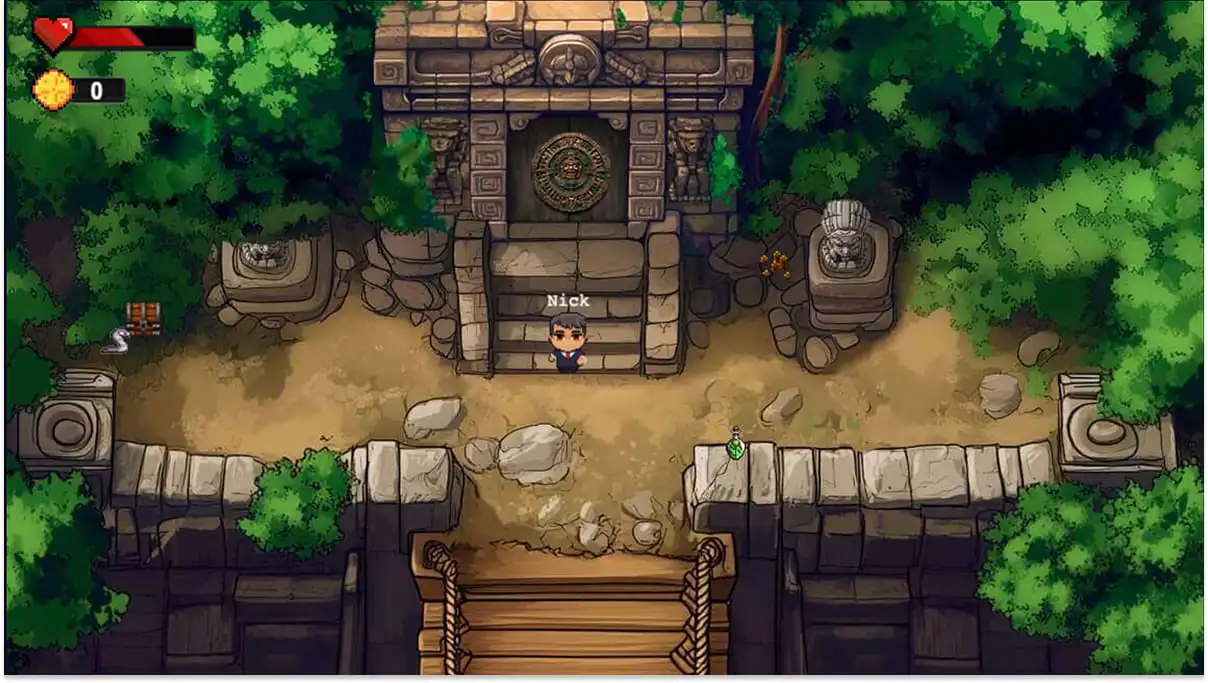
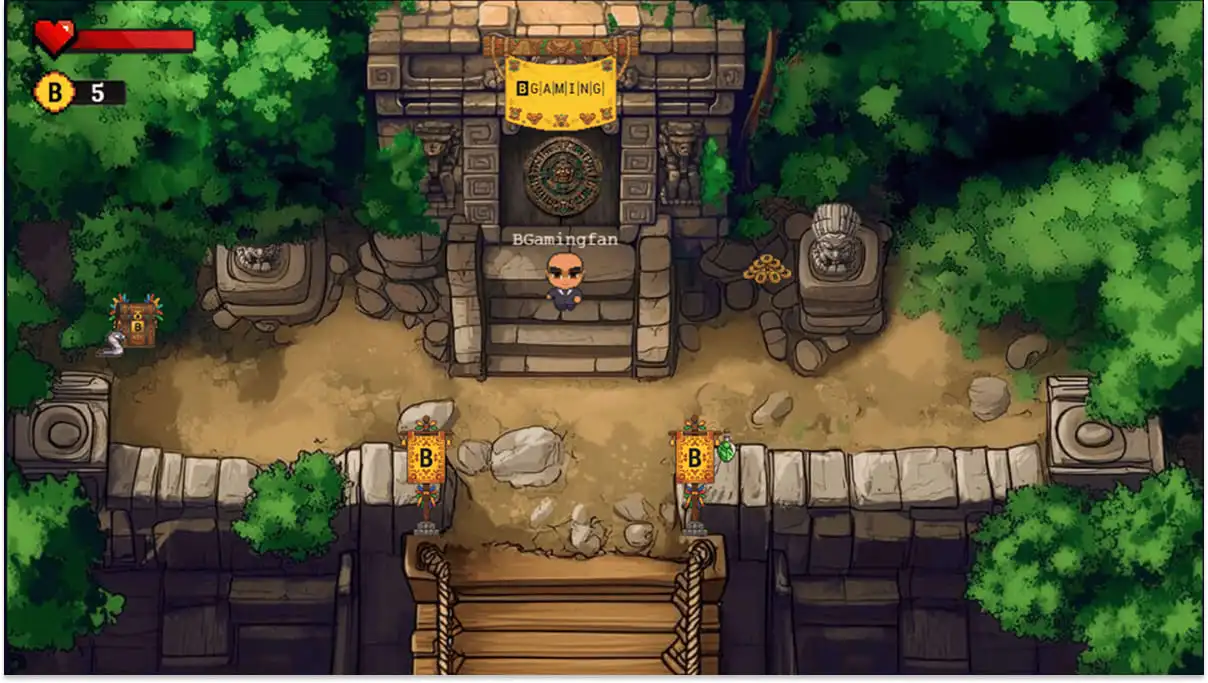
Because the layers are fixed, they weigh very differently by headcount. The $1,000 logo layer adds 77% to a 50-person Big Game ($1,300) and 15% to a 1,000-person one ($6,800). Small teams should buy customization only when it carries the point of the event; large teams can treat the logo layer as close to free.
Timing is the other constraint. Any customization needs 10 business days from booking to event. Without customization, a Big Game can be booked three business days ahead and a Marathon two. A game built from scratch, as opposed to a customized existing one, starts at $25,000 and is quoted per project on the build-your-own page.
Does the game you pick change the price?
No. Every game in the catalog runs on the same ladder, from the adventures to the trivia sets. What the game changes is whether the event lands with your team, and a poorly matched game is the most common source of regret after the event, not the invoice.
- Last Temple Mystery is the safe default: an ancient temple to decode before time runs out, with puzzles that reward observation and coordination.
- Wintervald Hotel Mystery suits formal audiences, such as finance, legal or leadership teams: a snowed-in hotel, a missing guest, an investigation with no forced humor.
- Mission 8-Bit is the one engineering teams book for kickoffs: a team trapped inside a retro arcade.
- Bureau of Magical Affairs is built for onboarding: a secret office that regulates magic, and your players are the new hires.
- Apocalypse is the high-pressure option: the world is ending and the team has 90 minutes.
- Stolen Hours is the December pick for teams tired of standard holiday events.
How to compare quotes from different vendors
Vendor prices in this category are hard to compare because they are built differently, not because they are secret. Before you put two quotes side by side, ask each vendor the same five questions.
| Question to ask | Why it changes the number | HeySparko's answer |
|---|---|---|
| Is the price per person or per event? | Per-person quotes grow in a straight line with headcount; a flat event price falls per head as the team grows. | Per event, by tier |
| Is the host included? | Some quotes price the platform and bill the facilitator separately. | Included in every Big Game |
| Is there a minimum headcount or minimum spend? | A minimum turns a small team's per-person price into a floor. | The smallest tier is 15 people, $550 |
| How is customization priced? | Branding priced per participant becomes the largest line at scale. | Fixed per layer, never per person or per day |
| What do you deliver afterwards, and what is it calculated from? | A report you cannot trace back to data is a slide, not a measurement. | Ask us, and hold us to the same standard |
The last row matters more than it looks. Plenty of vendors promise a report after the event; far fewer say what it is built from. Whoever you book, ask to see the inputs behind any number they give you.
How to take the number to Finance
A team building request fails with Finance when it is framed as morale. It survives when it is framed as a small cost set against a large, measurable one that Finance already carries.
Lead with cost per person. Four quarterly Big Games for a 200-person company cost $12,000 a year, $60 per employee. That is the unit Finance compares every other people program against.
Set it against the cost of losing people, using your own data. Pull voluntary attrition from your HRIS, and look hardest at the 6-18 month tenure band, where weak team connection tends to show up first. For an external floor, SHRM's benchmarking put the average cost per hire at $4,129, and that figure counts recruiting only, not the vacancy, onboarding or ramp time. A 200-person company replacing 20 people a year spends at least $82,580 on recruiting alone by that measure, against $12,000 for a year of quarterly events.
Say where the lever actually is. Gallup's State of the Global Workplace 2025 found that only 21% of employees worldwide were engaged in 2024, and that managers account for 70% of the variance in team engagement. The unit that moves is the team, which is also where Deloitte's 2024 Human Capital Trends found 71% of business and HR leaders want culture built. At the scale Finance thinks in, McKinsey estimated in 2023 that disengagement and attrition cost a median-size S&P 500 company $228 million to $355 million a year in lost productivity.
Be honest about what that evidence is. None of this research measures team building, and all of it is correlational. The case to make is not that an event will prevent a specific resignation; it is that a small, bounded cost is aimed at a lever the research does identify.
Ask for a pilot, with the measures agreed before the event. One event, three numbers: participation by team rather than a company average, a three-question pulse survey two weeks before and two weeks after, and attrition in the at-risk tenure band 90 days later. A defined experiment with a contained cost is a faster yes than an annual program, and it produces the data the renewal conversation will need.
Frequently asked questions
How much does virtual team building cost for 50 people?
A Big Game for up to 50 people is $1,300, or $26 per person. A three-day Marathon for the same team is $2,600 and a five-day Marathon is $3,900. Customization is added on top at a fixed price per layer: $1,000 for the logo, $2,500 for custom characters, $5,000 for a custom story or $7,500 for all three. The pricing calculator shows your exact configuration.
How much does virtual team building cost for 100 people?
A Big Game for up to 100 people is $1,800, which is $18 per person, with the host included. A three-day Marathon is $3,600 and a five-day Marathon is $5,400. If your team is slightly over 100, you move to the 150-person tier at $2,500, so it is worth confirming the final headcount before booking.
What does virtual team building cost for 500 to 2,000 people?
A Big Game is $5,300 for up to 500 people ($10.60 each) and $6,800 for up to 1,000 ($6.80 each). A team of 2,000 falls in the 3,000-person tier at $11,300, or $5.65 per person. Large distributed organizations often choose a Marathon instead, because no single live hour suits people across many time zones; a three-day Marathon doubles the base price.
Why does a Marathon cost more than a Big Game for the same team?
A Marathon runs the same game over one to five days instead of one live session, and its price scales with the length: the base price × (1 + 0.5 × (days − 1)). Three days is double the Big Game price and five days is triple. The invoice is larger, but for a team spread across time zones it is often the only format everyone can actually play.
Is customization priced per person?
No. Each layer is a fixed amount whatever the headcount: $1,000 for the logo, $2,500 for custom characters, $5,000 for a custom story, or $7,500 for all three. Customization is added after the format price and is never multiplied by the number of Marathon days. Any customization needs 10 business days between booking and the event.
How far in advance do we need to book?
Without customization, a Big Game can be booked three business days before the event and a Marathon two. Any customization layer needs 10 business days, and events above 1,000 people need five to seven days so the hosting can be staffed. You pay by card when you book, or ask for an invoice, which adds a few days. Bookings are confirmed within two business hours.
How do we justify the team building budget to our CFO?
Lead with cost per person, set it against your own attrition data, and propose a pilot with measures agreed in advance. As an external floor, SHRM puts the average cost per hire at $4,129 for recruiting alone; four quarterly events for 200 people cost $12,000 a year. Be clear that the research linking engagement to retention is correlational, and let the pilot produce your own evidence.