


Team building budget requests land in a particular kind of finance silence. The numbers on the proposal look like discretionary spend, the outcome is described as "improved morale," and the CFO responds with something like: "Can you show me the return on this?" — which most HR leaders can't, because no one built the financial case before asking. Over the past five years, Finance functions have grown sharper at scrutinizing people programs, and "team building" sits near the top of their soft-spend list. Getting it approved, and keeping it approved through quarterly reviews, requires framing the request the way Finance thinks rather than the way People Ops thinks.
We've run 1,500+ virtual team events for 300+ companies across 50+ countries since 2020. The most common reason a repeat event doesn't get funded isn't that the first event failed; it's that no one built a defensible business case the first time, so there's nothing to point to when the budget cycle comes around again.
How do you justify team building budget to a CFO in a way that survives quarterly review?
The financial argument Finance actually accepts
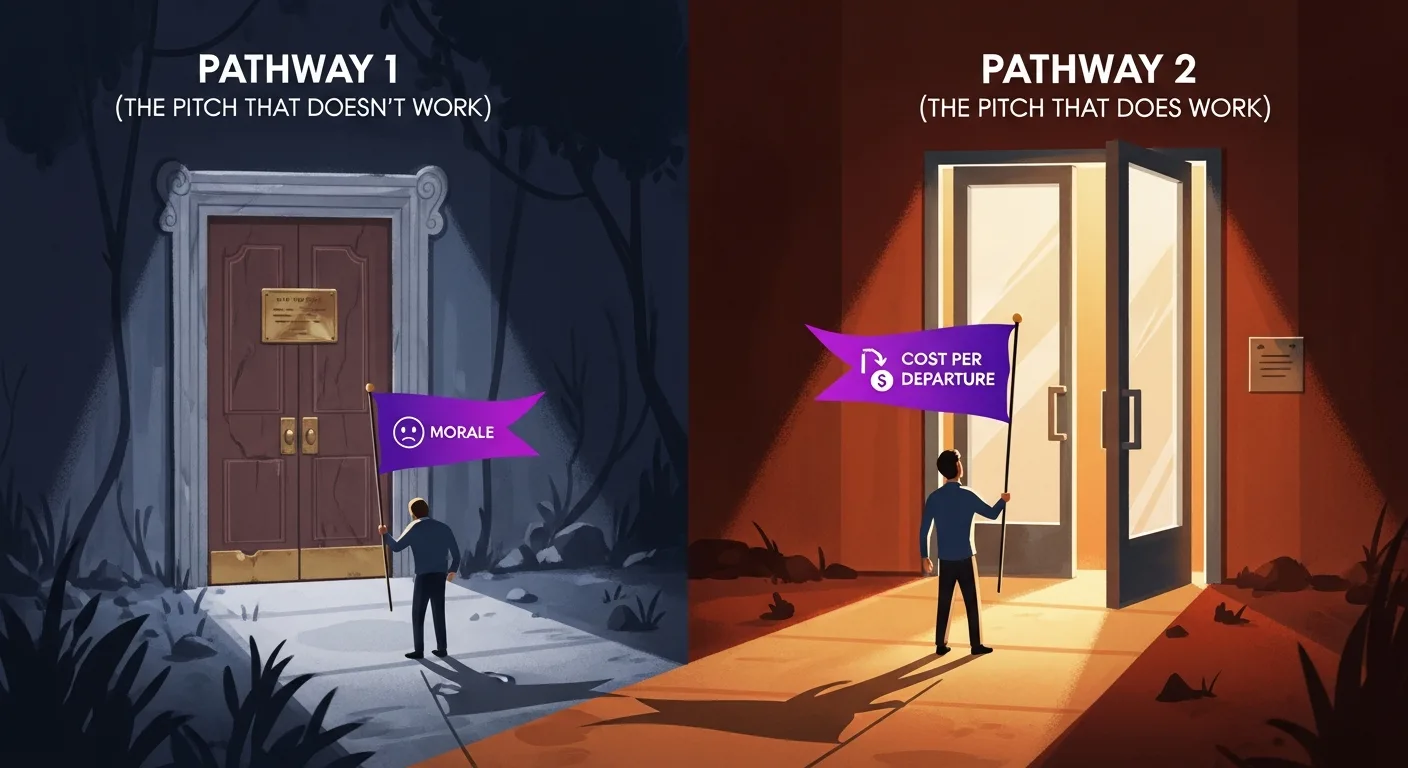
The pitch that doesn't work: "This improves morale." Finance translates that to "this is a cost." The pitch that does work starts from what Finance already has in the model — cost per departure.
SHRM's 2024 cost-per-hire calculation puts the cost of a non-executive departure in the range of fifteen to twenty-one thousand dollars when you include recruiting fees, onboarding time, and the productivity gap during ramp. For a 300-person company with a 20% annual voluntary turnover rate, that's close to $1 million in annual departure exposure. A twenty-to-thirty-thousand-dollar annual engagement program represents 2–3% of that figure. Finance doesn't reject a 3% spend when it's reducing a much larger cost — provided you've populated the math with your company's actual numbers, not industry averages.
That's the reframe that matters: you're not asking for morale budget; you're asking for a retention intervention with a favorable cost-to-exposure ratio.
Here's a scenario we walked through with a SaaS company of 220 employees that was spending nothing on structured engagement. Their voluntary turnover in the 12–18 month tenure band was 34%, running 12 points above their sector benchmark. That represented roughly 75 departures per year. At SHRM's low-end estimate, the departure exposure was $1.1 million annually. The People Ops lead brought that number to Finance alongside a thirty-thousand-dollar Marathon program proposal — 2.7% of their departure exposure. The CFO approved it the same quarter. The framing that unlocked it was reclassifying the program from "engagement event" to "retention intervention."
The four-stage playbook

The presentation to Finance is the last 20% of this process. The work happens in the three weeks before you walk into that room.
Stage 1: Pull your own retention data
Owner: HR Leader with HRIS access
Timing: Two weeks before the budget ask
Your HRIS has the numbers you need. What's your voluntary turnover rate by tenure band? Most HR leaders know the annual company average; fewer know the 6–18 month rate, which is where connection deficits show up first. Pull that cohort and compare it against BLS 2025 benchmarks for your sector: tech attrition at 1.8% monthly, financial services at 1.5%, healthcare at 3.1%. A gap above benchmark is the gap you're arguing you can close.
Pull your engagement survey variance by team and manager as well — not the company average, but the spread between your highest and lowest scoring pods. Where manager scores are lowest, attrition is highest. That variance is where the financial argument lives, because it shows the problem is measurable and addressable rather than a vague cultural feeling.
Stage 2: Build the financial model
Owner: HR Leader; optionally the Finance business partner
Timing: One week before the ask
Use SHRM's low-end estimate as your floor. Run the departure math for your actual headcount and attrition rate. Then build a scenario: if a structured engagement program improved retention in the at-risk cohort by 10%, how many fewer departures would you see? What does that save?
You don't need to promise a 10% retention improvement. You need to show that even a fraction of that improvement pays for the program many times over. The directional relationship between engagement investment and retention outcomes is well-documented — and the math is in your favor at a fraction of the improvement you'd need for the program to break even.
Stage 3: Choose the format deliberately
Owner: HR Leader
Timing: One week before, in parallel with Stage 2
The format choice isn't just an operational preference. It determines your expected participation rate, your cost structure, and your post-event reporting depth — all three things Finance will want to know about.
A Big Game is a single synchronous event: 60–90 minutes, everyone in one session, high shared energy. For teams under about 400 people in a manageable time zone spread, a Big Game gives you a clean, contained experience that's easy to report on. Something like Apocalypse or Bureau of Magical Affairs delivers an 80–90 minute arc with a defined outcome, a leaderboard, and a post-event NPS score you can take back to Finance. For a first-time budget pitch, the simplicity of Big Game works in your favor.
A Marathon runs 1–5 days asynchronously, with daily episodes players engage with on their own schedule. For any team with significant time zone spread — or where forced live windows produce resentment rather than participation — Marathon is both more humane and more financially defensible. We see 65–78% completion rates on opt-in Marathons at 500+ companies, and those numbers hold without reminders. A Wintervald Hotel Mystery or Under the Big Top in Marathon format gives you a multi-day engagement arc with daily participation data and team-by-team analytics. That reporting depth is what converts a one-time event conversation into a recurring program the next budget cycle.
The format decision usually makes itself. More than six time zones? Marathon is the only option that doesn't force someone into a 5am session. Single shared-energy moment for a kickoff or holiday? Big Game is the right call. Present both to Finance alongside their respective participation estimates and cost-per-engaged-employee calculations.
Stage 4: Frame the ask as a pilot
Owner: HR Leader
Timing: Writing the proposal
A three-month pilot with defined success metrics is a faster yes than an annual commitment. Finance appreciates bounded experiments because the downside is contained. Set your success metrics before the event, not after: target participation rate (60%+ for a first event is realistic), post-event NPS, and a 60-day engagement survey comparison. Building the proof framework into the original proposal signals rigor, which matters more than the dollar amount for most CFOs reviewing a category of spend they've never approved before.
What could go wrong

The financial justification chain above is solid. It still fails about 30% of the time. Here's where it breaks down in practice.
Showing up with industry stats but not your own data. The multi-trillion-dollar global cost of disengagement is useful context-setting. It doesn't close a budget conversation with a CFO who wants to know about your company. Come with your own attrition rate by tenure band and your own engagement variance by manager. Use industry benchmarks as context for your internal numbers, not as the argument itself.
Asking for a full annual program on the first ask. A fifty-thousand-dollar annual engagement commitment is a harder sell than a twelve-thousand-dollar pilot with three defined metrics. If the CFO is new to this category of spend, they want to see the experiment before committing to the program. The pilot framing costs you nothing and generates the data you need for the renewal.
Choosing the wrong format for the team's actual situation. We've seen HR leaders pitch a Big Game for Mission 8-Bit to a 2,000-person company with a third of employees in Southeast Asia and South America, then struggle to explain 38% participation. The format required a shared live window, which translated to a 3am local session for a large portion of the audience. Participation projections that assume everyone can attend a synchronous event will fail on distributed teams. For a globally distributed company, Marathon is the only format where you can honestly project 65–70%+ completion rates.
Skipping the post-event proof plan. You run the event. It goes well. Three months later, Finance asks how it went and you have anecdotes. The HeySparko analytics dashboard gives you participation rate, NPS, and team-by-team breakdowns within 24 hours. That's the event-level data. The retention signal requires more work: a pre/post three-question pulse through your own survey tool, and HRIS attrition data pulled 60–90 days post-event. If you don't build that data collection into the plan before the event, you won't have it when the renewal conversation arrives.
Picking a game the audience won't connect with. A high-intensity adventure for a team already under relentless deadline pressure can backfire on the NPS score. Stolen Hours works for teams that enjoy genre-fiction and want something imaginative. Wintervald Hotel Mystery works for enterprise audiences that want sophistication without silliness. Mismatching the game to the audience affects the NPS score you take back to the renewal conversation — so the operational question of which game to run is not separate from the budget justification question.
Framing it as a reward rather than an investment. "The team deserves some fun" doesn't move Finance. "This is the most cost-effective retention intervention I have for the at-risk cohort" does. Both can be true. Only one belongs in the budget meeting.
What the research backs
Owl Labs' State of Hybrid Work 2025 report found that a supportive manager remains a top workplace factor, with 89% of US employees in agreement. That's a specific data point for the case Finance wants to see: manager effectiveness is the lever, and team-level shared experiences give managers something to build on. Without the event, the manager has 1:1s and performance reviews. With it, they have a shared story the team built together — which is what sustained engagement is actually made of.
The academic literature reinforces the mechanism. A systematic review by Anog et al. (SSRN, 2023) examined 60+ studies and found that structured team-building activities increase satisfaction and reduce turnover — with effects amplified when events are integrated into a broader development strategy rather than run as isolated one-off moments. That's the cadence argument: a single Big Game won't move your six-month attrition numbers. A quarterly Marathon program with manager follow-through will create the conditions where it can.
Gallup's 2025 State of the Global Workplace report estimates the cost of disengagement at $8.8 trillion in global productivity losses annually — which reframes the conversation from "can we afford this program?" to "can we afford not to have it?" At the company level, an engagement program at twenty to forty thousand dollars per year runs 2–4% of the departure exposure a 300-person company carries at a 20% voluntary turnover rate.
Deloitte's 2024 Burnout in the Workplace research found that workers who attend two or more company-sponsored events per quarter report 23% lower burnout symptoms — a wellness outcome HR can measure independently of engagement scores and present to Finance as a secondary productivity benefit.
Against those numbers, the HeySparko data is operationally grounding. We see 65–78% completion rates on opt-in Marathon events at 500+ companies. Big Game scales to 10,000 players in a single session. BGaming ran a fully customized Big Game for their ~400-person distributed team and saw 89% participation with an 8.7 NPS — data their People Ops team used in the following budget cycle to justify a recurring annual engagement program. Those are the numbers an HR leader can take to Finance: a real event, a measurable outcome, a renewal case that writes itself.
Frequently asked questions
How do you calculate the ROI of a team building event?
Start with SHRM's 2024 benchmark of fifteen to twenty-one thousand dollars per non-executive departure — then multiply by your voluntary turnover count in the at-risk tenure band. A fifteen-thousand-dollar event that prevents two departures in the 12–18 month cohort breaks even on paper alone. For a more rigorous model, run a pre/post three-question pulse and compare team-level engagement scores from your HRIS 60–90 days before and after. That before/after comparison is what you bring to the renewal conversation.
What's the difference between pitching a one-off event and pitching a full engagement program?
A one-off event is a pilot — a bounded experiment with a defined cost and a measurable output. A full program is a recurring quarterly commitment with higher annual spend but lower cost-per-touchpoint. The fastest path to budget approval is almost always the pilot first. You get a yes faster, generate real data, and use that data to justify the recurring program. See the HeySparko pricing page for format options and what they look like at different team sizes.
Which format has better ROI for a budget pitch — Big Game or Marathon?
They answer different problems. Big Game gives you a single shared-energy event that's easy to budget-predict and report on. Marathon gives you multi-day participation data, 65–78% completion rates for distributed teams, and team-by-team analytics useful for HR reporting. For the CFO conversation, Marathon has an advantage: more data points to show post-event. Big Game is better for one-off cultural moments. Marathon is better for building the quarterly engagement program case.
What specific data should I bring to the CFO meeting?
Three things matter most: your voluntary attrition rate segmented by tenure band (especially the 6–18 month cohort), your engagement survey variance by team and manager rather than just the company average, and a cost-per-departure estimate anchored in SHRM's research applied to your actual headcount. Generic industry stats support the argument. Your own company numbers close it. Come with a specific dollar gap the program addresses and the math on what a 10% retention improvement in the at-risk cohort would save.
How do I measure whether a team building event improved engagement?
The HeySparko analytics dashboard delivers participation rate, NPS by team, and engagement breakdown within 24 hours of the event. For the retention signal, run a three-question pre/post pulse through your own survey tool — sense of connection, likelihood to recommend, whether they'd participate again. Pull your HRIS engagement scores 60 days before and 60 days after, segmented by team. The before/after comparison at the team level is what you bring to the renewal conversation, not the company-wide average.
Can team building events actually affect retention, or is the connection just correlational?
The research is directional, not causal, and any vendor claiming precise causality is overstating it. Anog et al. (SSRN, 2023) reviewed 60+ studies and found structured team-building activities reduce turnover when integrated into a broader development strategy — not run as isolated moments. The honest case for Finance: you're buying a measurable intervention with a favorable cost-to-exposure ratio, not a guaranteed outcome. A single Bureau of Magical Affairs event won't shift your attrition numbers. A quarterly cadence with manager follow-through over two or three quarters will.