
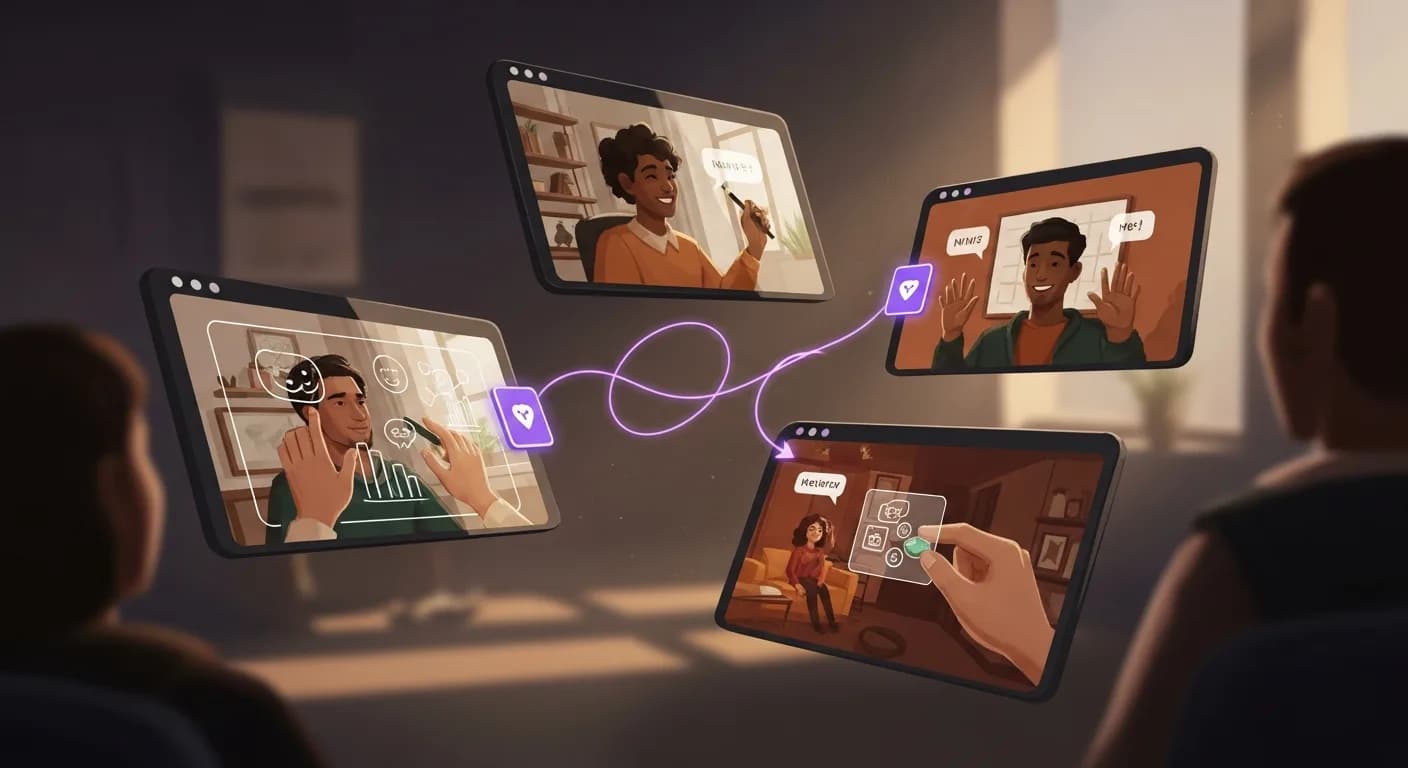

There's a specific failure mode we see repeatedly when companies try to run their first virtual team building event, and it isn't the game. The game is usually fine. What fails is the order of decisions: pick something that looks engaging, book it, send a calendar invite with no context, and hope the team shows up with energy. We've run 2,000+ virtual team events for 700+ companies across 50+ countries since 2020, and the difference between events people remember and events they endure comes down almost entirely to a few decisions made before the booking confirmation goes out.
How do you run a virtual team building event that people show up for and talk about the following week?
The format decision that determines everything else

Before you look at a game catalog, you have one question to answer: synchronous or asynchronous? This isn't an aesthetic preference. It's determined almost entirely by your team's time-zone spread, and getting it wrong produces a structurally broken event that no amount of game selection will fix.
Big Game is a single live 60-90 minute synchronous event. Everyone joins the same session, a HeySparko Game Host runs the entire experience, and teams play in breakout groups of 4-8. The format's core value is the shared real-time moment: watching the leaderboard shift, competing against the team in the other department, the collective reaction when Finance turns out to be beating Engineering. That energy doesn't replicate async.
Marathon runs over 1-5 days. Daily game episodes unlock in the morning and stay open through the evening. Players engage when it fits their schedule; a shared leaderboard creates the pull, and people check it the way they check sports scores between meetings. No MC required on any given day. Our Marathon completion rates run 78-92% at 500+ companies, and about 35% of that participation comes from people who would never have shown up to a mandatory live event.
The decision rule is simple. If your team fits within a 6-hour time-zone window, Big Game. If you span 8+ time zones, Marathon, because forcing a 400-person company to pick a live window that works for Singapore, London, and Chicago simultaneously means a meaningful fraction of your team is joining at 11pm local time and resenting you for it.
A hospitality client we worked with last year had this exact problem: around 600 employees, three EMEA offices plus a large US presence, and their previous "team building" was a quarterly all-hands that half the company attended live while the other half caught a replay with no real engagement. We ran Marathon format over four days. Seventy-one percent of the company finished it voluntarily. The CFO finished it from a hotel bar in Dubai.
Matching the game to your team's culture
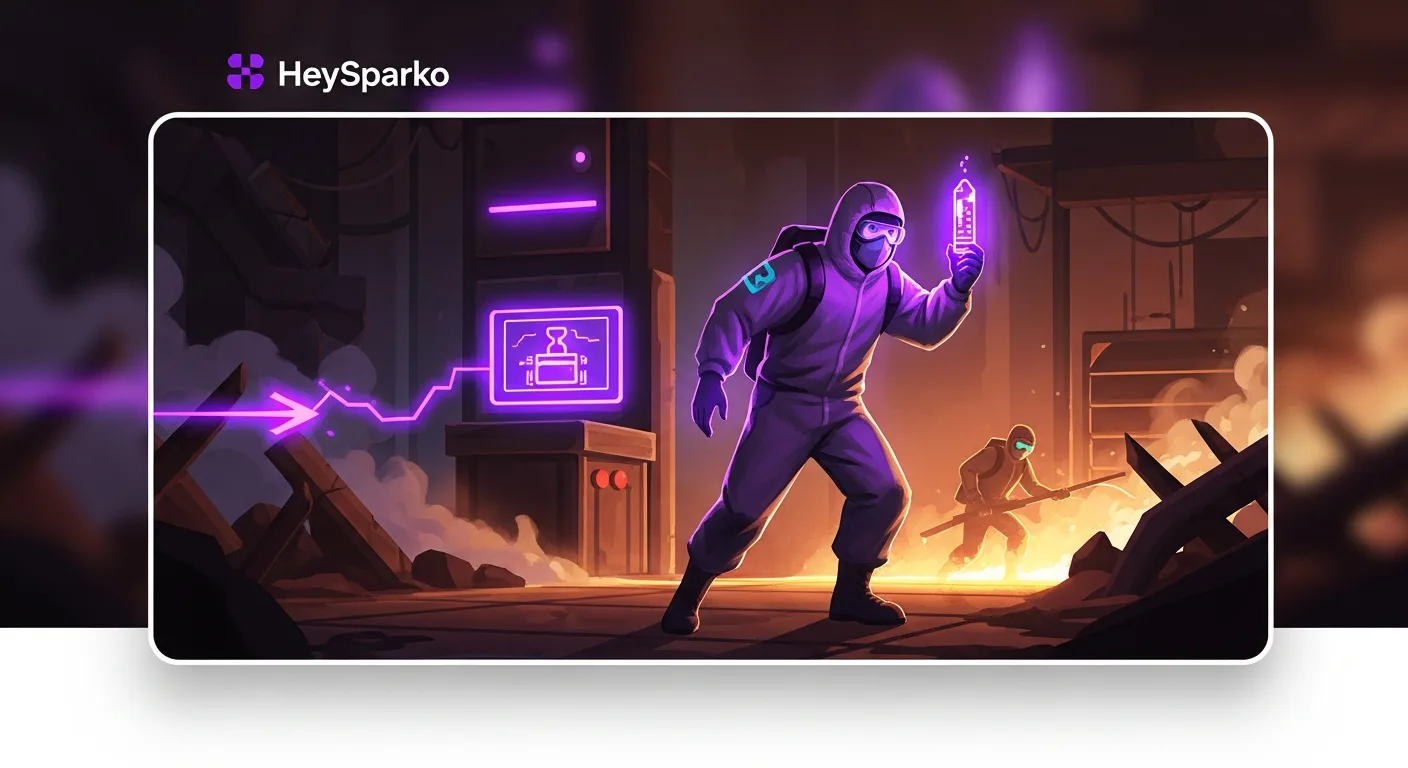
The game selection conversation trips up most organizers because the catalog options feel numerous and the failure risk feels high. In practice, the failure mode at the game-selection stage is almost always a cultural mismatch, not a theme mismatch. There are three useful axes to think along.
Energy vs. atmosphere. High-energy engineering and fintech teams generally prefer adventure formats where there's a clock running and decisions carry consequences. Apocalypse — where the team races to develop a vaccine before the last research center falls — is the highest-energy game in our catalog, and it reads very differently for a 60-person startup than it does for a 400-person enterprise compliance function. Mission 8-Bit lands particularly well for quarterly kickoffs: its three-stage arc (escape the hijacked office, rebuild a 1980s computer, ship the killcode) maps onto how a quarter works in ways that are almost too on-the-nose. Bureau of Magical Affairs tends to be the right call for onboarding cohorts, because the chaos-meets-bureaucratic-paperwork premise is so close to the new-hire experience that the "this IS my Monday" reaction is common.
Formal vs. whimsical. Enterprise and finance teams often want something that feels sophisticated. Wintervald Hotel Mystery — a snow-bound whodunit in an isolated hotel with an Agatha Christie-style cast of suspects — is the most enterprise-appropriate game in our catalog. Legal and finance functions book it at roughly twice the rate of other teams. On the other end, companies with a warmer internal culture respond well to Under the Big Top, where a traveling circus's missing performer becomes a deduction exercise across a wonderfully strange cast of suspects. For teams that respond to slow-burn tension rather than urgency, Book of Awakened Nightmares is an atmospheric mystery-adventure with ensemble narrative beats that build quieter intensity than the high-pressure formats. The question isn't "formal or fun" — it's "what kind of engagement fits this specific group's self-image."
Seasonal vs. year-round. Some games carry a strong contextual resonance at specific times of year. Stolen Hours — a genre-bending December adventure where the team chases stolen clock hands across cyberpunk, steampunk, and post-apocalyptic worlds — works for year-end events because the "time stops, the team has to restart it" premise lands emotionally in December in a way it doesn't in March. Apocalypse peaks around Halloween but runs as a high-energy kickoff year-round for tech and fintech teams that appreciate the pressure mechanics regardless of season.
One pattern we've seen across game selection calls with hundreds of companies: organizers default to "what sounds fun to me" rather than "what fits this team's cultural self-model." A fintech team we worked with last fall was convinced they wanted something high-energy for a Q4 kickoff. After a 20-minute conversation about their team's dynamics and how their previous events had landed, we suggested Mission 8-Bit rather than Apocalypse. The three-stage project-arc structure was a better mirror for how that team thinks about their work. NPS came back at 8.9. The game fit matters, but it's secondary to the cultural fit question.
How to run virtual team building: the step-by-step
This is where the format and game decisions get operationalized. The mechanics are straightforward, but the sequence matters more than People Ops teams typically expect.
Step 1: Define the goal before you touch the catalog
"Team building" is a category, not a goal. The actual goal is usually one of three things: connection between people who don't interact naturally across the org chart, recognition for a team that just delivered something difficult, or momentum before a new quarter or initiative starts. Each of those calls for a different event shape.
A cross-functional connection event needs a game where people from different teams end up in breakout rooms together and have to coordinate fast. A recognition event benefits from customization (custom characters, the team's name embedded in the narrative, references to their actual work) to make the event feel specifically theirs rather than a vendor event the organizer bought. A pre-quarter kickoff works best when the game's narrative arc mirrors what the team is about to do. When we run briefing calls with new clients, this question comes first, and the answer usually makes the game choice obvious.
Step 2: Configure the logistics that actually determine the experience
Three operational details ruin otherwise-good events with consistent reliability.
Breakout group size. Don't put 12-15 people in a breakout room. Engagement craters above 8; the sweet spot is 5-7 players per team. At 100 players, that's 15-20 competing teams playing in parallel. The shared leaderboard keeps the company-wide cohesion while the breakouts preserve the intimacy that makes people open up.
Tech requirements. HeySparko runs browser-based. No install, no app, no IT clearance ticket. For a 500-person event, even a 10% login failure rate means 50 people starting the event frustrated before the game begins. We've tested this on corporate-locked laptops running Cisco and CrowdStrike enterprise security, because login failures at the start of a live event tank the energy in a way that's very hard to recover from.
Timing within the week. Tuesday and Wednesday between 2pm and 4pm local consistently capture the highest engagement. Monday events get postponed. Thursday and Friday events lose attendance when any travel is in play. For Marathon format, starting Monday morning and running through Thursday captures most of the engagement window before the end-of-week attention drop.
Lead time. For a standard Big Game with no customization, two weeks is comfortable. NPC customization (custom characters written in your company's voice) requires 10 business days, and so does Story customization, where the game's narrative arc gets rewritten around your specific situation. If you're adding a branded event, start earlier than feels necessary.
Step 3: Build the pre-event communication with intention
Events fail in the calendar invite. We've seen identical games produce 40-percentage-point differences in participation based purely on how the organizer introduced the event to the team.
A pre-event communication that lands does three things: tells people concretely what they're doing (not "team event," but a one-line description of the premise), tells them what to expect in the first five minutes (so no one joins anxious about what "virtual team building" means today), and signals that leadership cares. That last piece doesn't require a CEO video. A three-sentence Slack message from a VP that says "I'll be there, my money's on Data Analytics winning" changes the social calculus.
For Marathon events specifically, the Day 2 nudge is the most underrated communication in the format. Day 1 completion rates are typically strong. Day 2 drops without a prompt. A Slack message with the current leaderboard screenshot and a single sentence about who's currently winning is usually enough to pull Day 1 participants back for Episode 2.
Step 4: Get out of the way during the event itself
For Big Game, this is operationally simple: your team participates as players. The HeySparko Game Host handles all MC work, pacing, technical questions, and energy management. There is no "host" role for the organizer; your job on the day is to join as a player and enjoy it.
For Marathon, there's no daily MC required at all. Daily content drops automatically. The organizer's job on each day is to post the leaderboard screenshot in Slack and respond to the "wait, how does team scoring work exactly" question that appears in every company on Day 2.
BGaming ran their company anniversary as a fully customized Big Game with about 400 employees, custom characters, and a custom narrative arc tied to their founding story. Their People Ops lead said afterward that the hardest part of the day was resisting the urge to manage the event. The host was handling it. Their job was to play.
Step 5: Close the loop with data deliberately
The analytics come automatically: participation rate, team scores, NPS pulse, by-manager breakdown. Don't let them sit unread. The two-minute executive summary ("87% of the company participated; Finance placed first; NPS was 8.4; here's what the open-response feedback said") takes five minutes to write and turns a one-off expense into a defensible recurring line item.
If you're running Marathon, a pre/post engagement pulse — three questions before, the same three questions two weeks after — is worth setting up. The delta is the most direct evidence you have that the event moved something measurable. Most People Ops teams skip this step and then struggle to justify the renewal conversation six months later.
Step 6: Book the next one before the energy fades
This is the step most teams treat as optional, and it's the one that correlates most strongly with long-term engagement improvement. A one-off virtual team building event is entertainment. A quarterly cadence — even when the format alternates between Big Game and Marathon, even when the game changes each time — is an engagement program.
The lead time for a standard repeat booking is shorter than the first: you know the format, the team knows what to expect, and the calibration call goes from 60 minutes to 20. The second event almost always outperforms the first on NPS, because the team arrives knowing what they're about to enjoy rather than wondering if this will be another awkward Zoom activity.
What the data says about virtual team engagement

The case for structured virtual team events isn't just intuitive. The research supporting it is recent and consistent across methodological approaches, which matters when you're making the budget case to someone who thinks "team building" is a euphemism for "nice-to-have."
Atlassian's 2024 Teamwork Lab Intentional Togetherness research found that intentional team gatherings boost team-connection scores by an average 27%; for new graduates the lift is from 74% pre-gathering to 96% post (+22 points); the effect decays to baseline over ~4 months, implying ~3 gatherings per year is optimal. That decay curve is the quietly important finding for People Ops work — it reframes the cadence question Step 6 raises. Quarterly isn't a nice-to-have rhythm; it's the rhythm that matches the actual half-life of connection lift from a single event. Three to four intentional gatherings per year keeps the team above the baseline that one-off December events drift back to by spring.
For the distributed-team argument specifically, Microsoft's 2024 Work Trend Index found that 57% of distributed workers prefer asynchronous engagement options over synchronous ones. That preference isn't for less engagement — it's for engagement that doesn't disadvantage people based on their time zone. Our Marathon completion rates of 78-92% are consistent with that signal: when you give people a format that doesn't require a 6am session in Auckland or an 11pm session in Dublin, participation goes up, not down.
The academic case is grounded in Anog et al.'s 2023 systematic review (SSRN) of 60+ studies on team-building interventions. Their finding: structured team-building activities increase satisfaction and reduce turnover, with effects amplified when they're integrated into a broader development strategy rather than run as isolated one-off events. We see exactly this pattern in our own portfolio — companies that treat events as a quarterly program show engagement trajectories that companies running one December event and going quiet for the rest of the year don't replicate.
Deloitte's 2023 Human Capital Trends found that 46% of employees felt less connected to colleagues compared to pre-pandemic. That gap is still real, particularly in distributed teams where "working together" for most people means a Slack thread and a quarterly all-hands. The structural problem — distributed work removes the passive social glue of shared office time — doesn't resolve itself through better tooling or more async communication channels. Virtual team events are the most scalable intentional intervention available at the cost-per-employee point that People Ops budgets work with.
What we know from 2,000+ events across 700+ companies: the teams that see durable engagement lift are the ones where the People Ops lead closes the loop with intention. An event that ends with a leaderboard and a "thanks for playing" produces a weaker signal than one followed by a manager Slack shout-out for the winning team, an analytics summary to leadership, and a scheduled repeat next quarter. The event is the moment. What happens around it determines whether it compounds into something the team looks forward to, or becomes just another thing that happened last November.
Frequently asked questions
How far in advance do I need to book a virtual team building event?
For a standard Big Game with no customization, two weeks is enough; you need a 30-minute briefing call, but there's no extended discovery process. NPC customization (custom characters in your company's voice) requires 10 business days, as does Story customization, where the game narrative gets rewritten around your specific situation. For Marathon format, building the pre-event communications week into the timeline means booking 3-4 weeks out gets you the best participation results.
What's the difference between Big Game and Marathon format, and how do I choose?
Big Game is a single live 60-90 minute event where everyone joins at the same time, with a Game Host running the whole experience. Marathon is 1-5 days async: daily episodes unlock and players engage when they want. The deciding variable is almost always time-zone spread. Teams within a 6-hour window can do Big Game comfortably. Teams spanning 8+ time zones should use Marathon, because forcing a live window that works globally means someone is joining at 11pm their time, which undermines the engagement goal you're trying to hit.
How many people can participate in a virtual team building event?
Both Big Game and Marathon scale to 10,000 players. For Big Game, larger groups split into competing squad teams on a shared leaderboard, and the live energy scales well because teams are competing across the company in parallel. For Marathon, scaling is operationally lighter; 2,000 people can engage across five days without any MC managing the room. The sweet spot for breakout intimacy in Big Game is 5-7 players per team; the breakout configuration is set based on your total headcount.
Does my team need to download any software to participate?
Nothing. HeySparko games run in a browser: no app, no install, no IT ticket. Players join via a link with only a modern browser and a stable connection. We've tested this on corporate-locked laptops running enterprise security software including Cisco and CrowdStrike, because login failures at the start of a live event tank the energy fast and are very hard to recover from mid-session. The only additional tool needed for Big Game is the video-conferencing platform your company already uses for the Game Host screen feed.
How do I measure whether the virtual team building event actually worked?
Three signals matter: participation rate, post-event NPS pulse (auto-delivered within 24 hours), and the by-team breakdown showing which manager's pod had the highest engagement. For Marathon, day-over-day completion rates tell you whether your Day 2 nudge landed. For the longer view, a 3-question engagement pulse before and two weeks after the event gives you a delta you can show leadership — the difference between "we ran a team event" and "here's what moved."
My team is tired of virtual activities — will they actually engage with this?
The jaded team is almost always tired of format repetition, not virtual engagement itself. Generic escape rooms and quizzes have trained your team to expect mild awkwardness for 45 minutes. Narrative-driven games with real escalation land differently. Bureau of Magical Affairs surfaces unexpected strengths in quieter team members — the analyst who dominates the Stage 3 puzzle becomes a conversation piece afterward. Wintervald Hotel Mystery generates Slack debates about suspect theories the next morning, which doesn't happen after trivia nights.