
Most companies run quarterly kickoffs the way they run quarterly board meetings: one tradition shaped slightly differently four times a year, with the Q1 sales kickoff getting the venue and the keynote budget, and the Q3 version reduced to a leadership town hall and a Slack thread inviting people to a virtual coffee on Thursday. The HR Leaders we talk to in discovery calls describe the same pattern across industries. Leadership wants the team to feel a shift at the start of each quarter, but the kickoff event becomes an artifact of the calendar rather than a deliberate intervention. The engagement survey six weeks later shows a flat line where the quarter-opening lift should be. Then the cycle repeats next quarter.
Since 2020, we've delivered virtual team events to 700+ companies across 50+ countries — 1,500+ events in the portfolio so far. The kickoffs that compound across quarters, the ones we see clients re-book without procurement second-guessing, share a small set of design choices the one-and-done versions miss. They treat the quarterly kickoff as a recurring program with its own rhythm, not as four discrete events that happen to share a name. They pick formats that respect how distributed teams already work, and they vary the game and customization tier to match what each quarter is supposed to feel like for the team.
How should distributed teams run quarterly kickoff team building as a recurring program instead of a one-off event each quarter?
Quarterly kickoffs as a program, not four separate events
The pattern we see at companies running this well isn't four heroic productions across the year. It's a deliberate operating rhythm where each quarter's kickoff inherits structure from the last, and where the HR team isn't redesigning the wheel every twelve weeks. The kickoff becomes a thing the company does, like the all-hands or the performance cycle, not a special event the People Ops manager has to negotiate from scratch each January, April, July, and October.
In our work with mid-size SaaS and finance teams running this as a program, three structural decisions usually get made up front and reused across the year. The team picks a default format, Big Game or Marathon, and only revisits it if circumstances change. The HR Leader picks a roster of two or three games rotated across quarters so the team doesn't repeat the same experience back-to-back. The customization budget gets allocated annually, not negotiated per event. By the third quarter of year one the procurement friction is almost gone. The kickoff stops being a Slack-channel debate every twelve weeks and becomes a date on the calendar.
A growth-stage fintech we worked with last year ran their quarterly kickoff program with the same HeySparko Game Host across all four quarters. The same person hosting Q1 and Q4 builds continuity the team comments on in survey responses. By Q3 the host knew the company's running jokes, knew which leadership names triggered the loudest cheers, knew which regional teams were on a hot streak. That kind of texture doesn't show up in a one-off booking. It compounds when the program is treated as a program.
Big Game or Marathon: picking the format clock for the year

The format choice usually gets revisited every quarter when it shouldn't be. Most distributed teams should pick a default format for the year and revisit only if the company's shape changes. A major reorg, a regional office shutdown, a substantial M&A integration. Switching back and forth between Big Game and Marathon every twelve weeks trains the team to treat each kickoff as a fresh experiment, which is the opposite of the cadence value you're trying to build.
Big Game is a single live event of sixty to ninety minutes, hosted by a HeySparko Game Host, and it scales from fifteen to ten thousand players in one session without breaking. The format works cleanly when the team can coordinate a single window inside a six-hour time-zone spread. For US-only companies across PT and ET, or for European teams with a UK-to-Eastern-Europe spread, Big Game runs without operational friction. The energy of a shared real-time room is the format's defining payoff, and that energy compounds when the team experiences it four times across a year. Quarter four's Big Game lands differently because the team remembers the leaderboard moment from Q1, Q2, and Q3.
Marathon runs the same narrative arc across one to five days, with daily episodes that players engage with on their own schedule. The leaderboard stays live the entire week. Completion rates across our data land in the 78 to 92 percent range at 500-plus companies, strong enough that many distributed clients have moved away from running mandatory live kickoffs at all. The Marathon version we see most for quarterly programs is a three-day midweek format, Tuesday through Thursday of kickoff week, with a Friday wrap-up email. It suits teams across eight or more time zones, opt-in cultures, and any company where forced live events have already triggered calendar friction once.
The dynamic that pushes most HR Leaders toward Marathon over a year of quarterly programming is the cohort coverage math. In our work with one distributed consulting firm across nine time zones, the previous year's Big Game kickoffs had averaged 62 percent attendance, with the APAC team almost entirely absent. The Marathon equivalent over the same calendar of quarters hit 81 percent completion across all regions. Same kickoff calendar, different format, different downstream cultural artifact.
Picking games to fit each quarter's narrative
This is where the recurring-program logic earns its keep. A roster of two or three games rotated across quarters keeps the experience fresh without exhausting the catalog or making each quarter's decision a referendum. The right rotation depends on what the company narrative for the year wants to land for the team.
Mission 8-Bit is the most-booked kickoff game in our catalog, and the reason is the three-stage arc: escape, build, ship. It maps so cleanly onto a quarterly project rhythm that engineering managers tend to book it without much internal debate. Teams escape a hostile office where their devices are turned against them, rebuild a 1980s computer in a retro shop, then enter the digital world as 8-bit avatars to take down the virus. Each player gets a personal pixel sprite delivered after the event, and the sprite tends to live on as a Slack avatar through the next quarter. Companies running it as their Q1 kickoff game often re-book it for Q3 with a different narrative frame and a re-themed Story tier.
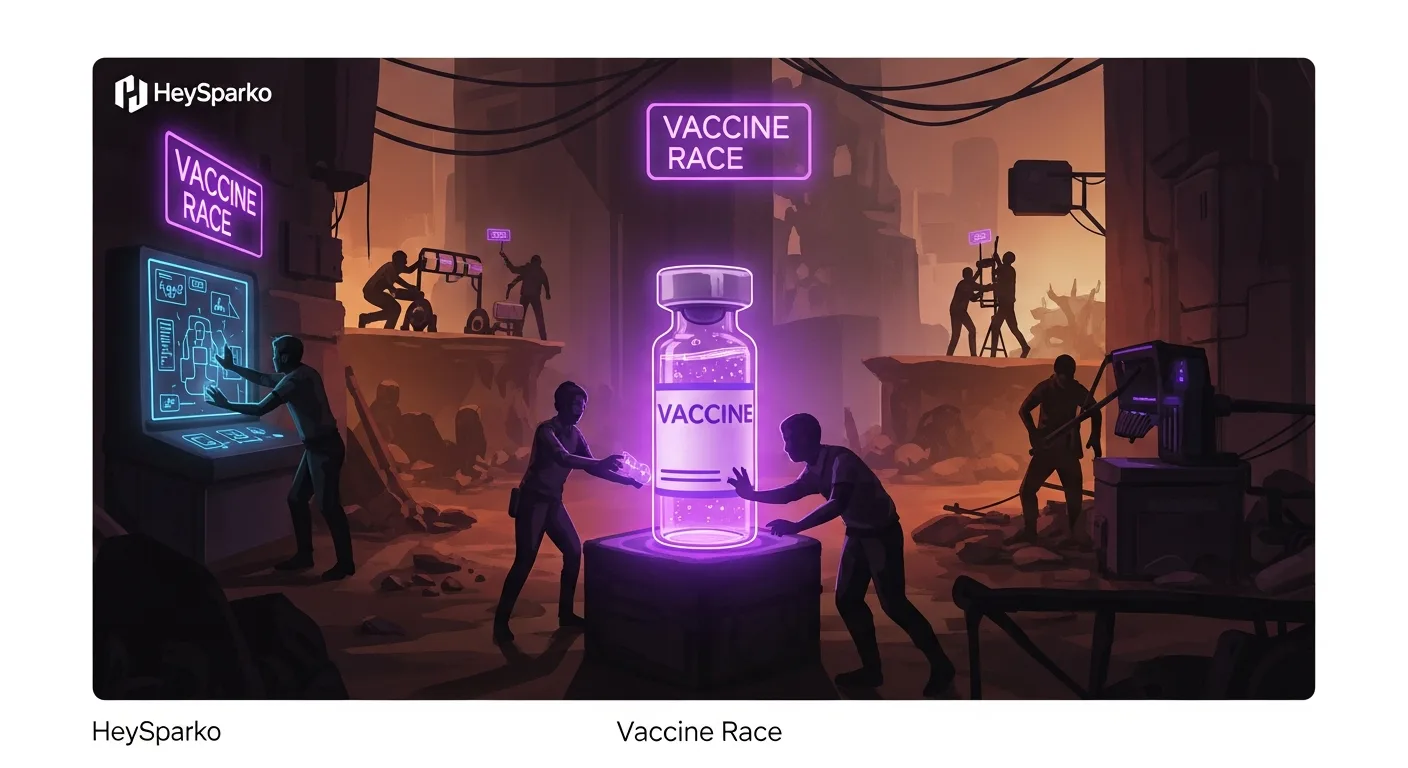
Apocalypse is the high-stakes alternative for tech and fintech teams running an aggressive H2 push. The premise of an overnight outbreak and a race to develop a vaccine before the last research lab falls borrows the stakes of a real crisis and gives the team eighty minutes to find their natural coordinators. We've watched twenty-five-person engineering teams find their natural ICs and project managers in Stage 2, with the post-event manager 1:1 conversations referencing what unfolded in-game rather than the slide deck. Best fit for Q3 or Q4 kickoffs when the company narrative is "we have to ship this thing before the window closes."
Last Temple Mystery suits Q1 and Q3 kickoffs at companies hitting a milestone year. A multi-year anniversary, a funding round closing, a leadership transition. The Mayan-temple expedition arc lets the quarter frame itself as the next chapter of an ongoing story rather than a fresh start. Strongest seller for SaaS and consulting teams with puzzle-mechanics appetites, and the deduction style holds up well at the 200 to 500 player range where most mid-size kickoffs sit.
Bureau of Magical Affairs is our year-round flagship adventure. Whimsical bureaucracy-meets-magic, closer to The Office crossed with Men in Black than to Tolkien. Strong fit for Q1 kickoffs that double as onboarding for the recent-hire cohort, because the premise of newly-deputized Bureau agents handling four open cases back-to-back mirrors how the first weeks of work feel for someone new. We book it for Q1 kickoffs more than any other game in the catalog.
Wintervald Hotel Mystery is the enterprise-friendly mystery in the rotation. Sophisticated, Knives Out in tone, and the most comfortable fit for finance and legal cultures that don't want whimsy in the kickoff. Companies that run a buttoned-up Q4 kickoff before the holiday-season disruption often pair it with a lighter Q1 or Q3 game to vary the tone across the year.
Under the Big Top is the summer-energy companion in the mystery category. A vintage circus where the headlining act has vanished before the biggest performance, with three stages of deduction across an intentionally memorable cast. Best suited to Q3 kickoffs for hospitality, consumer brands, and any company with a whimsy-friendly culture that wants the summer kickoff to feel different from the January one.
Stolen Hours is built for December but re-themes naturally for any quarter-opening reset frame. The premise of Santa's clock hands scattered across postapocalypse, cyberpunk, steampunk, and biopunk worlds gives genre-fiction-friendly cultures the variety they want in a single event. A January reset version with the "time restarts" premise gets booked by a couple of clients each Q1.
For kickoffs where the team-building piece is a 60-minute closer rather than the main event, Pop Culture Trivia is the safest universal pick. Three rounds, leaderboard energy, the host carries the room. It's the right call when leadership content takes up most of the kickoff agenda and the team-building slot needs to land in an hour without preamble.
Customization across recurring kickoffs
For a one-off event, customization can feel like a luxury add-on. For a quarterly program, it's the lever that keeps the cadence from going stale by Q3 of year two. The customization tiers — NPC, Logo, and Story — work differently when the event recurs four times a year than they do for a one-time anniversary moment. NPC customization lets the game's characters speak in your company's internal voice. Logo customization integrates the visual brand across the game UI. Story customization rewrites the narrative arc to fit the quarter's situation.
A growth-stage SaaS team we worked with ran Mission 8-Bit with full Story customization for their Q1 kickoff. The virus crisis became a customer-retention emergency the team had to navigate, the killcode they had to assemble was their renewal-cycle motion, and the leaderboard tracked which squad shipped the patch fastest. Engagement scores on the post-event pulse came in well above their prior quarter's baseline, and the manager 1:1 conversations the following week referenced the game's narrative rather than the leadership opening slide.
Customize for your team
TYPE 1
Your team as in-game characters
Real team members, mascots, or characters from your games as NPCs.
TYPE 2
Your brand integrated natively
Logo and brand elements native to game environments — locations, items, UI.
TYPE 3
Your story woven into the game
Company milestones, products, and inside references woven into puzzles, dialogues, and tasks.
The pattern we see at companies running customization across a year is one fully customized event (the Q1 sales kickoff usually) paired with three stock events using rotation of the same default game. The annual cost stays predictable, the highest-stakes event of the year, the one with the most leadership attention and the most strategic narrative weight, gets the full production. The other three quarters carry the cadence without needing every quarter to be a hero moment. That allocation also matches how the company's attention budget already works.
What the data says about kickoffs that compound
The case for treating quarterly kickoffs as a deliberate program comes from a few independent angles. Atlassian's State of Teams 2024 report, surveying 5,000 knowledge workers plus 100 Fortune 500 executives, estimates that 25 billion work hours are lost annually to ineffective collaboration within the Fortune 500, with 93 percent of executives saying teams could deliver similar outcomes in half the time if collaborating more effectively. The hours figure is an extrapolation from executive opinion rather than a measured number, but the executive consensus is sharp: the people approving event budgets believe collaboration is the bottleneck. A quarterly kickoff designed as a collaboration-tuning intervention rather than as a morale event lands inside the frame these executives already hold.
The academic anchor on whether team-building events meaningfully shift team-level outcomes comes from Anog et al. (SSRN, 2023), whose systematic review of 60-plus studies found that structured team-building activities increase satisfaction and reduce turnover, with effects amplified when integrated into a broader development strategy. The qualifier on "broader development strategy" is the operational detail that quarterly cadence directly addresses. A single kickoff in July is a moment. Four kickoffs across the year, each reinforcing the same H1-to-H2 throughline, are an articulated rhythm. The research says the second one moves the needle on retention; the first one moves it briefly.
On the format-decision side of the case, Microsoft's 2024 Work Trend Index, drawing on a 31,000-knowledge-worker survey across 31 countries, found that 57 percent of distributed workers prefer async engagement options to live ones, and that 64 percent of workers say they're struggling with the pace and volume of work overall. The async preference number is the single cleanest signal for HR Leaders making the Marathon-versus-Big-Game call: a majority of distributed workers will engage more, not less, when the program respects their calendar. Forced live events at quarterly cadence are running against the grain that the survey data describes.
Deloitte's 2024 Burnout in the Workplace report, surveying 1,000-plus US full-time workers, found that 77 percent of professionals report burnout at their current job, with 31 percent naming lack of recognition as the primary driver. The same report found that workers attending two or more company-sponsored events per quarter report 23 percent lower burnout symptoms. The quarterly cadence fits the threshold the data implies almost exactly. At the recurring-program level, the kickoff becomes one of the two or more events that produces the burnout-reduction effect, rather than a standalone production that gets lost in the noise.
Across our own portfolio, the engagement signal we watch most closely on quarterly programs is the gap between Q1 and Q3 attendance. The companies running quarterly kickoffs well close that gap to within five percentage points across the year. The ones using kickoffs as an annual one-off see it widen to twenty points by Q3 as the novelty wears off. The cadence is what compounds. The individual events don't, no matter how well produced any single one of them was.
Frequently asked questions
How often should a quarterly kickoff event run if it's part of a recurring program?
The cadence the data supports is one substantial event per quarter, four per year, with optional smaller touchpoints in between. Deloitte's research found that workers attending two or more company-sponsored events per quarter report 23 percent lower burnout symptoms, so the quarterly anchor plus one mid-quarter recognition moment fits the threshold cleanly. Many of our clients pair a quarterly Big Game with a smaller Marathon mid-quarter for the off-months.
What's the difference between a quarterly kickoff and a one-off team event?
A one-off event is a calendar item the People Ops team negotiates from scratch each time it runs. Vendor selection, format debate, game choice, internal comms plan. A quarterly kickoff program reuses those decisions across the year. The format and Game Host stay constant, the game rotates across a roster of two or three, the customization budget gets allocated annually. By year two the procurement friction approaches zero, which is the part that compounds for the HR Leader's time.
How far in advance should we book a quarterly kickoff?
For a stock Big Game with no customization, two weeks is the practical floor, with availability narrowing on the most popular games. For customization with NPC, Logo, or Story, plan on 10 business days. For a Marathon with internal communications support layered in, six weeks gives the cleaner timeline. Companies running this as a quarterly program book the full year in January, locking dates and games at once. That single calendar block removes per-quarter procurement debate from the rest of the year.
Can the same game work for multiple quarters or does the team get bored?
The roster pattern we see clients land on is two or three games rotated across the year, with one game often repeated across Q1 and Q3 (Mission 8-Bit for engineering-led cultures is the typical pick) and different games for Q2 and Q4. Customization carries the variety. The Q1 and Q3 versions of the same game with different Story-tier customization read as distinct experiences because the in-game narrative changes even when the underlying mechanics don't.
How do we measure if a quarterly kickoff program is working over time?
The signals we track most reliably are the gap between Q1 and Q3 attendance (a closing gap means the cadence is compounding, a widening gap means novelty fade), post-event NPS held steady across quarters rather than spiking and falling, and the qualitative manager 1:1 references to in-game moments six weeks after the event. Engagement survey scores trail the kickoff by two to three months, so trust the leading indicators over a single survey reading from one quarter.