
Halloween has quietly become the second-largest engagement window on the US work calendar, sitting behind only the December holiday parties in booking volume. Over the past five years we've watched HR teams move from "do we even do anything for Halloween?" to a real October-event budget line with its own RFP cycle. The bar has risen along with it. Streaming-era horror raised the atmospheric reference point. Costume-Instagram culture made the visual side count. And a workforce that survived seven pandemic-era Halloween Zoom socials now reads "Halloween-themed trivia night" as a placeholder, not an event.
Our portfolio: 1,500+ live virtual team events, 700+ companies served, 50+ countries reached, five years of operating data since 2020. We see the same October pattern every year. Companies book early (peak booking window is Aug 15 – Sept 30), then panic in early October when the People Ops lead who ran last year's event has moved on and nobody remembers what worked. So we put this together as a working filter — the eight formats out of our catalog of 32 that we book repeatedly in the Oct 15 – Nov 1 window, with what we've seen each one do best and where each one breaks.
So which spooky team-building ideas land for distributed corporate teams in 2026, given that real horror doesn't work at work and themed trivia isn't enough?
What "spooky" has to mean to land for a distributed team in 2026
Two things have changed about Halloween team events since 2020. The first is the audience. In our work running October events for global teams, we see consistent pushback against "horror" as a content axis. Roughly half of any given international team is spooky-tolerant; the other half is uninterested, culturally distant, or quietly uncomfortable. Forcing the whole company into "horror night" loses the second half before the event begins. We've watched it happen at companies on their first Halloween booking and at companies on their fifth.
The second change is the format. A live 60-minute event used to be the safe default — everyone in a single Zoom, costumes on camera, leaderboard at the end. That still works for teams within a contained time-zone spread. We call this Big Game: one synchronous event, 60-90 minutes, 5-10,000 players, hosted by a HeySparko Game Host while your team plays. But when the team spans Tokyo to San Francisco, somebody is taking a 6am call to participate, and forced Halloween fun at sunrise is the opposite of engagement.
That's the case for Marathon, our async format. Daily episodes drop across 1-5 days; players engage on their own schedule; a single shared leaderboard creates pull without forcing a synchronous window. Across the Marathon events we run for opt-in distributed teams, 78-92% of players finish all episodes. That tends to be higher than the live-attendance rate we see for forced-synchronous Halloween parties at the same companies. The lurkers (the people who skip optional Zoom socials) participate in Marathon at meaningfully higher rates because async gives them a face-saving way to show up.
The format choice usually makes itself. Contained time zones plus shared energy in the room means Big Game. Distributed teams plus respect for people's calendars means Marathon. The harder choice is the game itself. None of the eight below lean into horror; all of them carry October-appropriate atmosphere that lands for the spooky-tolerant half without losing the other half.
8 spooky team-building ideas worth your October calendar slot
1. Apocalypse — the flagship Halloween adventure
Our most-booked Halloween game by a wide margin is Apocalypse. The premise: an overnight outbreak, four stages between your team and a vaccine, 80 minutes of stylized urgency. No blood, no jump-scares, no horror — closer to World War Z (the film) than The Last of Us. The menace is in the clock, not the imagery.
What we've watched it do best is surface the natural ICs and project managers on a team under time pressure. Most engineering groups of 20-35 self-organize into specialists by Stage 3, the Power Station resource-management phase. The HR analytics dashboard captures the exact moment the team pivots from chaos to coordination, and that's the by-team data People Ops takes back to leadership. We recommend the game for tech, fintech, and engineering-heavy startup cultures who want urgency without horror. We've tested it across 12+ countries with near-zero discomfort feedback. We avoid it for new teams under 90 days old; the stress mechanics need an existing coordination baseline to land.
2. Book of Awakened Nightmares — atmospheric, Tim Burton vibes
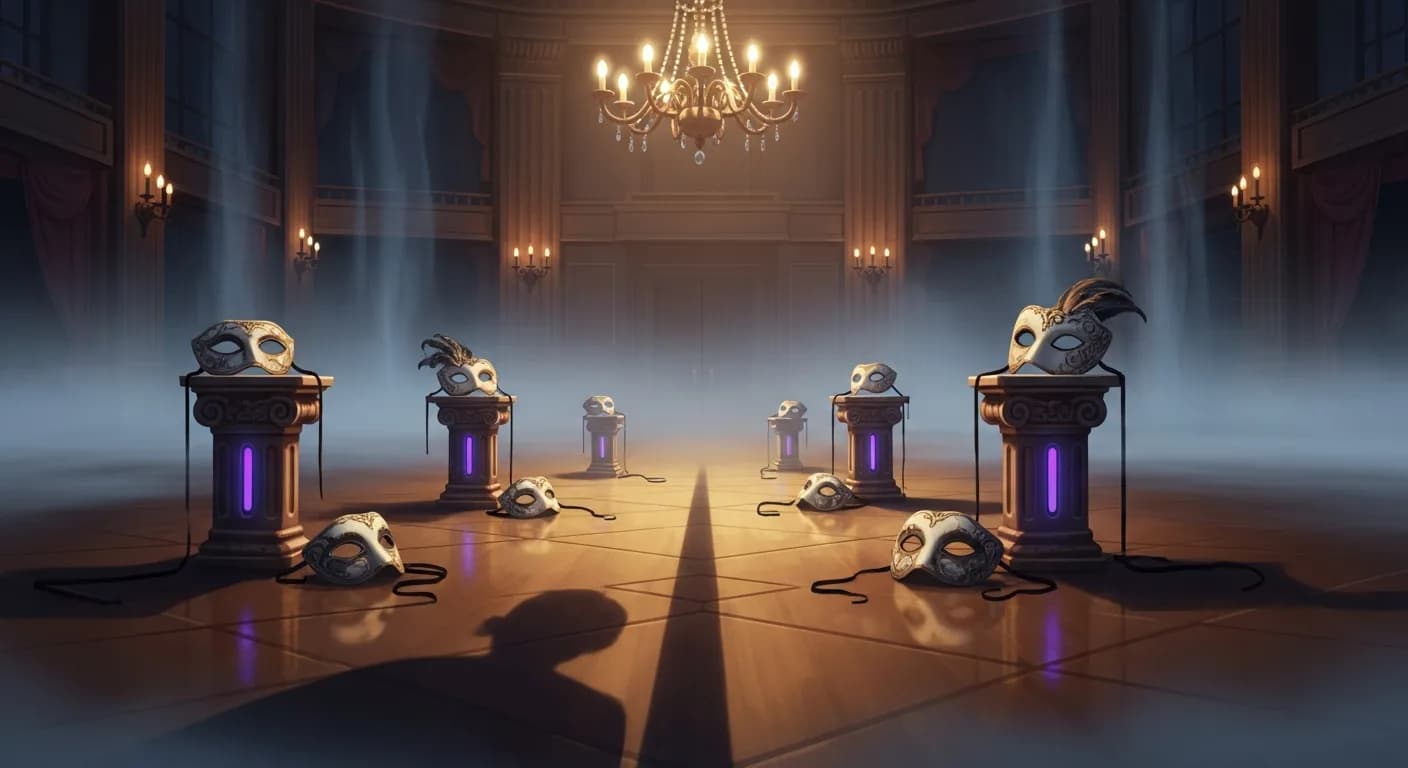
The October game for teams that want mood without menace is Book of Awakened Nightmares. A leather-bound diary wakes up something inside it, and the team is pulled chapter by chapter into three folklore worlds: Despair, Rage, Madness. Each world has its own pacing and emotional register. 90 minutes total. Aesthetic reference point: early Tim Burton, Coraline, Pan's Labyrinth. Cameras-off works fine, since the storytelling carries the social weight through chat and shared screen.
Where it shines is mid-size groups of 50-200, where the slower pacing creates real debate in team channels, and international teams where horror-forward content would alienate half the room. We've booked it for hospitality clients, design agencies, and a global RevOps team last October that wanted October atmosphere without their senior banking partners feeling like they'd walked into a horror movie. The composite folklore is intentionally non-culture-specific — no single tradition dominates.
3. Wintervald Hotel Mystery — for the buttoned-up enterprise
A snow-bound luxury hotel, a guest murdered after a private dinner, a storm closing the only road for the night. The team plays detectives. Three stages of deduction in Wintervald Hotel Mystery, an Agatha-Christie-flavored whodunit running 75-90 minutes. Tone reference: Knives Out, Glass Onion, And Then There Were None. The murder is a premise, not a graphic event; no body imagery, no horror beats.
When we get the question "we want a Halloween event but our culture is too formal for an apocalypse-themed game," this is the answer. We've booked it for enterprise legal teams, in-house finance functions, and large banking clients that wanted October atmosphere without anything that could read as horror to senior partners. The snow-and-isolated-hotel framing carries a colder atmosphere that lands for the spooky-tolerant half without alienating the formal half. October is the peak month even though the game works year-round.
4. Under the Big Top — vintage circus mystery
A traveling circus rolls into town. On the night of the biggest show, the headlining act vanishes. The team plays roving investigators staying with the troupe — the strongman who's surprisingly gentle, the trapeze couple who haven't spoken in a year, the ringmaster who knows more than he says. Under the Big Top uses the same three-stage deduction mechanic as Wintervald but a completely different aesthetic. Tone reference: Big Fish, Water for Elephants, The Greatest Showman.
We see this one book strongly for hospitality companies — the vanishing-performer-before-the-show framing mirrors how guest experiences unfold in their day jobs, and the warm whimsy lands better than horror-adjacent content for client-facing teams. Marathon format suits it beautifully; the multi-day investigation rhythm fits async, and the leaderboard pulls people back between days to debate their suspect theory. The whimsy is melancholic and warm, not goofy. We've checked the comfort-level question on multinational teams in 12+ countries and feedback has been consistent.
5. Stolen Hours — for genre-fiction-friendly teams
A genre-bending option that bridges Halloween and the December holiday window. Stolen Hours opens with Santa's clock hands stolen and scattered across four genre worlds: postapocalypse, cyberpunk, steampunk, biopunk. The team chases through all four in 90 minutes. The cyberpunk and biopunk worlds are stylized like a Pixar film, not Blade Runner. No body horror, no grimdark.
We recommend it for October bookings when the team has a genre-fiction appetite — startup engineering cultures, gaming companies, design agencies. Each world surfaces different player strengths: gritty-survival types lead in postapocalypse; pattern-decoders take over in cyberpunk. By the Time Maze finale, leadership has rotated three times naturally. The game also bridges into December if you'd rather run one event across the season instead of two. We've seen culture-week programs at distributed-tech companies pick it for that reason.
6. Bureau of Magical Affairs — magical bureaucracy
Professor Brum's magical cauldron sprung a leak. Furniture is staging philosophical debates. Time anomalies are pulling mages into the wrong eras. Sleepfrogs in the forest are knocking field naturalists into hypnotic comas. Bureau No. 7 has called your team in to handle four cases in 90 minutes. Bureau of Magical Affairs reads as The Office crossed with Men in Black, not Lord of the Rings. Whimsical bureaucracy with magic.
The reason this makes a Halloween list is the witchy-bureaucracy aesthetic lands for October without leaning on horror, and the four-case structure is one of the easiest formats we run for international teams (no single folklore dominates). It's also our most-recommended onboarding-cohort game; the chaos-meets-paperwork premise mirrors the new-hire feeling. For a People Ops team running both a Halloween event and an October onboarding kickoff, it's a clean two-birds-one-stone booking.
7. Pop Culture Trivia — the lighter Halloween option
For teams that want October atmosphere without committing 90 minutes to an adventure, Pop Culture Trivia runs as a 60-75 minute hosted event with three rounds: Mainstream Mix (music, film, TV, celebrity), Visual Iconography (album covers, movie posters, viral photos), and Cultural Crossroads (cross-category connections). We theme the Halloween version around horror media, classic monsters, Halloween-themed episodes of popular shows, and the cultural moments that became costume tropes.
We recommend trivia as the Halloween pick for first-time HeySparko clients who haven't piloted an adventure yet, or for cross-functional events where the theme can't go too narrow. A live Game Host runs the whole event; the format is browser-based with no install, works on corporate-locked machines, and scales to 5-10,000 players in a single session. The pack also pairs naturally as the 60-minute closer to a half-day virtual culture event when the budget calls for something tighter.
8. History Trivia — the Halloween folklore angle
The unexpected Halloween pick for academic, consulting, and policy cultures is History Trivia, themed for the Halloween-adjacent corners of world history: Celtic Samhain origins, the Salem trials, the medical history behind vampire folklore, the Gothic literature surge of the 1800s, the rise of Halloween in 20th-century America. Three rounds: Across the Centuries, Witness Marks (visual recognition of artifacts and paintings), and Connecting Lines (the round that surfaces unexpected links between eras).
We've run it for law firms, think tanks, and a research consultancy that wanted a Halloween event without "spooky" as the surface promise. The history-as-detective frame fits a culture that takes its craft seriously, and the Connecting Lines round rewards lateral thinking rather than memorization, so casual interest is enough. The pack is intentionally pan-civilizational; Celtic, Mexican Día de Muertos, and Asian and African folkloric traditions all surface, not just Eurocentric horror tropes.
What the research says about distributed Halloween team events
McKinsey's Quarterly research (September 2023, "Some employees are destroying value—others are building it") puts the financial picture in sharp terms. At the median S&P 500 company, employee disengagement and attrition cost between 228 million and 355 million dollars annually in lost productivity, totaling more than 1.1 billion dollars over five years. The same study identified a "thriving stars" cohort — the 4% of employees delivering disproportionate value — and found that they cluster in distributed work: 45% remote, 36% hybrid, 19% in-person.
That distribution is the part most People Ops conversations miss. Your highest-performing employees are statistically more likely to be remote or hybrid, which means your engagement programming has to land for distributed teams first and in-office teams second, not the other way around. October is one of the easier tests of whether your engagement calendar is built for that reality. A Halloween event that requires costume-on-camera and a 5pm-Eastern Zoom is a quiet message to your Tokyo and Singapore teammates about whose engagement counts.
Anog et al. (SSRN, 2023), a systematic review of 60+ studies on team-building interventions, found that structured activities increase satisfaction and reduce turnover, with effects amplified when the activity is integrated into a broader development strategy rather than treated as a one-off. The October lesson: a single Halloween Marathon that links to a broader Q4 engagement rhythm — manager 1:1 anchors, recognition cadence, year-end pulse survey — outperforms an isolated event by a meaningful margin in the academic literature. A standalone Halloween Zoom party in the middle of an otherwise quiet quarter sends a thinner signal.
A complementary data point comes from Deloitte's 2024 Global Human Capital Trends research on microcultures: 71% of business and HR leaders say focusing on individual teams and workgroups (not company-wide programs) is the best place to cultivate culture and agility. That maps cleanly to how October events should be measured — by-team, not company-wide. Marathon's analytics dashboard breaks completion, NPS, and coordination heat down by squad and by manager, which is the unit Deloitte's research says matters most.
Microsoft's 2025 Work Trend Index ("Breaking Down the Infinite Workday") adds the format implication. The report found that 30% of meetings now span multiple time zones — an 8-point absolute increase since 2021. The "pick one window for Halloween" assumption that worked in 2019 is structurally harder in 2026. Marathon's async daily-episode format was built for exactly this; every player participates on their own clock, and the leaderboard does the social work the synchronous Zoom used to do.
Our own portfolio data backs the format math. At scale, Marathon events run for opt-in distributed teams finish at 78-92% completion rates across 500+ companies, which tends to be meaningfully higher than the live-attendance rate at the same companies for forced-synchronous parties. People who quietly skip optional Zoom socials often show up to Marathon because async lets them participate on their own clock without performing for the camera. For the spooky-team-building decision, that's the part that matters most: the format choice deserves equal weight to the game choice. A poorly-fitted format makes the best game land badly; a well-fitted format makes a moderately-fitting game land surprisingly well.
Frequently asked questions
How far in advance should we book a virtual Halloween team event?
Booking demand peaks Aug 15 – Sept 30 each year. For Big Game with default branding, four weeks of lead time is workable. For a Marathon Spirit Week running Oct 27-31, six weeks gives you room to seed pre-event comms and let the leaderboard build anticipation. Customization needs 10 business days for NPC or Story tier. If you're reading this in early October, Pop Culture Trivia with default branding is still bookable for the week-of.
What's the difference between Big Game and Marathon for a Halloween event?
Big Game is one live 60-90 minute synchronous event with a HeySparko Game Host, scales from 5 to 10,000 players, and is designed for teams in a contained time-zone spread. Marathon is 1-5 days of async daily episodes — players engage on their own schedule across a shared leaderboard. For a single-time-zone team running a one-shot Halloween party, Apocalypse in Big Game format is the default. For a globally distributed team where someone would take a 6am call to attend live, Marathon is the right call.
Some of our team doesn't celebrate Halloween — what do we do?
Frame the event as "October team event" in the calendar invite, make costume participation explicitly optional in the welcome message, and pick a game where October atmosphere enhances the experience without requiring belief in the holiday. Book of Awakened Nightmares and Wintervald Hotel Mystery both carry a fall mood without leaning hard into trick-or-treat tropes — they work for mixed teams and play year-round, so the cultural cost stays minimal.
How do we measure success after a Halloween team event?
Every HeySparko event ends with an analytics dashboard delivered within 24 hours: participation rate, by-team completion, NPS pulse, coordination heat by squad. For a Halloween event we recommend layering a three-question post-event pulse onto your normal Q4 engagement survey — "I felt connected to my team this month," "I'd recommend this event," "Did the event reflect our culture?" — and watching the by-manager breakdown. Engagement variance by manager is where the data conversation gets sharp at the leadership readout.
Do players need to download anything or install special software?
No install, no account creation, no app-store request to IT. Both Big Game and Marathon run entirely in the browser; a player joins via a link, picks a team name, and plays. We've tested across corporate-locked laptops (Cisco, Crowdstrike, and Zscaler-restricted machines), VDI environments, and the standard mix of Chrome, Safari, Firefox, and Edge. The IT-ticket overhead is the lowest in our catalog, which is one of the operational reasons People Ops teams keep booking us back the following October.