

Virtual escape rooms have become a standard People Ops line item faster than most HR Leaders had time to learn how to buy them well. The category grew from "team event nobody was sure about" to a recognized corporate format in under four years. But the buying behavior hasn't kept pace: HR teams search for "virtual escape room corporate," pull a shortlist of vendors, and evaluate almost entirely by game title and theme. That's the wrong variable to optimize on first. Our portfolio: 1,500+ live virtual team events, 300+ companies served, 50+ countries reached, five years of operating data since 2020. The single most reliable predictor of whether an event succeeds isn't the game, it's whether the format matches the team's actual situation.
How do I choose a virtual escape room for a corporate team event?
What a corporate virtual escape room actually delivers
A corporate virtual escape room, done well, isn't a trivia game rebranded as an "experience." The format centers on a professional Game Host who runs the session from start to finish, while your team participates as players, not co-facilitators. Teams of 4-8 split into breakout rooms, work through narrative-driven puzzles together, watch a shared leaderboard update in real time, and follow a story arc that connects each stage of the game to the next. The event structure creates competitive pull without anyone manufacturing the energy artificially.
What players actually do in a well-designed session is more varied than it looks from the outside. They observe detailed environments for clues, decode logic puzzles that have no Wikipedia answer, submit choices that affect the game's routing, and coordinate in their team channels with competing teams visible on the leaderboard. The browser-based platform requires no install and no account creation, which matters at corporate scale, because install friction and IT restrictions on unknown software reliably kill 10-15% of registered attendance before the event even starts.
Last Temple Mystery is the clearest illustration of the format at scale. Four floors of a Mayan temple, each with a distinct puzzle style: observation, timing, trust-based coordination, and a final synthesis where everything from the earlier floors converges. Teams who have never worked together in person will spend 20 minutes genuinely arguing over a clue interpretation by Floor 2. The competitive structure isn't imposed; it emerges from the game mechanics. That's the distinction from the broader "team activity" category, where a facilitator manufacturers engagement pressure the room may or may not feel.
For teams whose culture runs toward workplace humor over high-stakes adventure, Bureau of Magical Affairs hits the same engagement mechanics with a completely different register: four magical bureaucratic cases, sentient furniture refusing to do its job, and enough whimsy that the engineering team's "I don't do team building" contingent tends to stay in the game until the end. We've run it for onboarding cohorts at companies bringing in 100+ new hires per quarter; the premise of "too many things on fire at once, and there's still paperwork" resonates at a level that goes beyond the game.
Mission 8-Bit maps the game arc directly onto quarterly work structure: escape the hijacked office, rebuild a retro machine, ship the killcode. The three-stage metaphor (setup, build, launch) reads as more than a framing device for engineering managers. It has become the most-booked kickoff event in our catalog specifically because the arc mirrors the quarter's actual narrative rather than interrupting it with something disconnected.
One operational reality worth naming upfront: none of these games require players to create accounts or install software. Players receive a link, land in a browser app, and are assigned to a team. On a 200-person corporate event, keeping the join flow to "click link, pick a team" removes a variable that typically costs a quarter of your registrations before anyone touches a puzzle.
Big Game vs Marathon — and why this question comes before game selection
The format decision shapes everything downstream — not the game choice, not the customization tier, not how good the host is on the day. Format. And it's reliably the question that gets skipped in the buying conversation, which is how teams sometimes run the right game in the wrong format and come away with the wrong read on what went wrong.
Big Game is a single live 60-90 minute synchronous session. Everyone joins at the same time, the Game Host runs it from start to finish, and the energy of a real-time leaderboard connects the room. The format works best for groups where participants are within a 6-hour time zone spread. Anything wider and someone is taking a genuinely unreasonable session time, which quickly transforms what should be a company perk into a scheduling imposition. For one-off corporate events (kickoffs, holiday parties, milestone celebrations) Big Game is usually the natural choice. The contained window, the shared moment, the leaderboard climax at the end: these are things an async format can approximate but not fully replicate.
Marathon runs over 1-5 days, with episodes unlocking daily for participants to complete on their own schedule. The Tokyo team plays at 3pm local. The San Francisco team plays at 3pm local. The shared leaderboard creates pull without any scheduling pressure. In our data, Marathon events at distributed companies reach approximately 35% more participants compared to forced-synchronous alternatives, specifically the people who routinely opt out of mandatory live events tend to complete Marathon rounds because the async design removes the coercion signal they're responding to.
Marathon completion rates in our event data at 500+ company events run 65-78% across the full event. That figure means 65-78% of eligible participants complete all episodes voluntarily, not an attendance count for a Zoom they were calendar-blocked into. For People Ops teams who need to show Finance a participation-rate number, the comparison is meaningful.
A fintech team we worked with (about 600 employees spread across four time zones, with a known culture of checked-out mandatory Zoom events) ran a 3-day Marathon instead of a Big Game for their quarterly engagement program. Seventy-three percent completion without a single reminder push. The People Ops lead noted afterward that the async format was the specific reason the engineering org participated at all. That pattern repeats: the format removes the friction, the leaderboard provides the pull, and the completion rate follows.
The decision table largely writes itself once you know the inputs:
- Same timezone or 1-3 timezone spread, one-off event, want the energy of a shared moment → Big Game
- 4+ timezone spread, distributed culture, want participation breadth over attendance rate → Marathon
- Holiday party, kickoff, quarterly all-hands → Big Game
- Spirit Week, ongoing quarterly engagement program, retention push → Marathon
- Teams that won't show up to mandatory live events → Marathon, not persuasion
Matching the game to your corporate team's culture

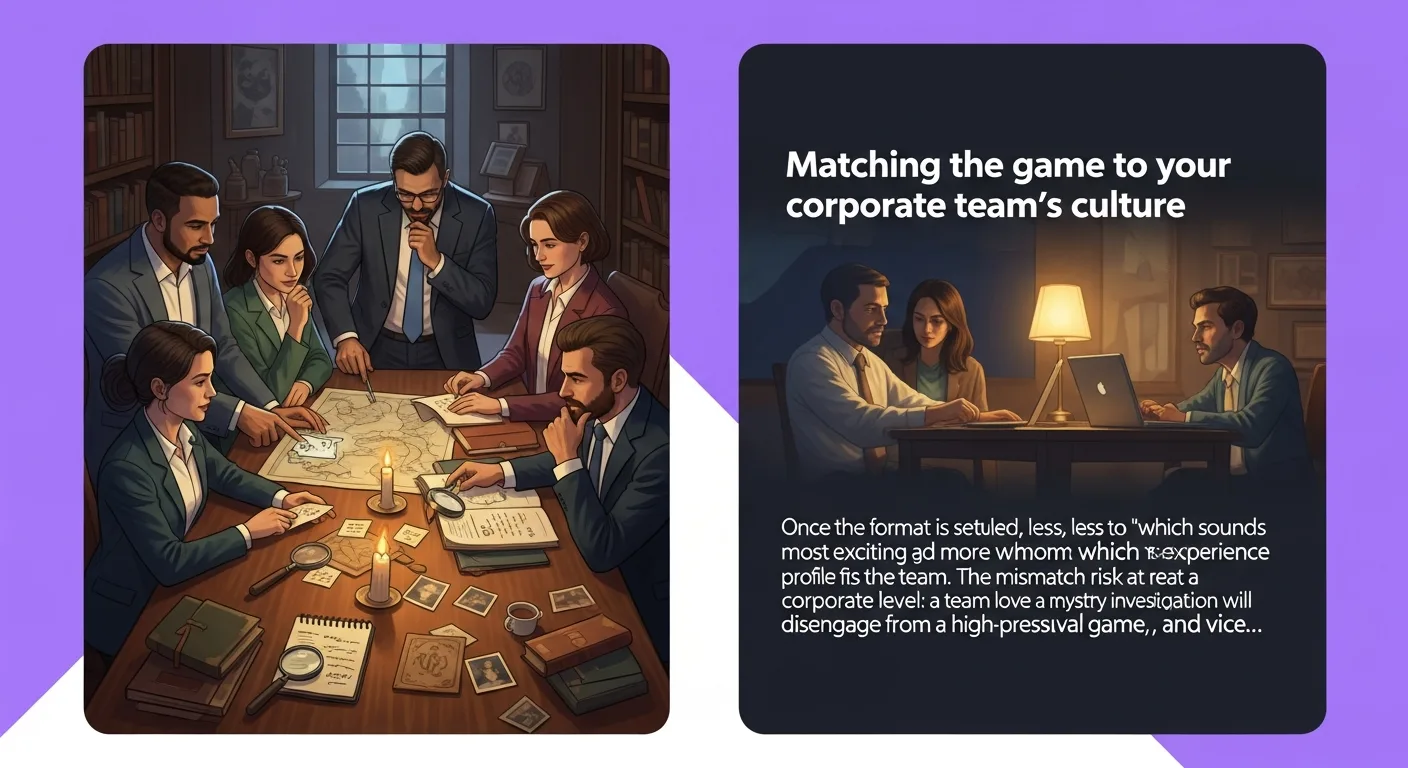
Once the format is settled, game selection is less about "which sounds most exciting" and more about which experience profile fits the team. The mismatch risk is real at the corporate level: a team that would love a mystery investigation will disengage from a high-pressure survival game, and vice versa. "We tried team building and it didn't land" typically traces to a game-culture mismatch rather than a structural category problem, and a bad experience closes the program budget for a year.
For high-energy tech and engineering cultures that respond to urgency mechanics, Apocalypse tends to be the right call. The game is an 80-minute race to develop a vaccine before the last research lab falls, played across four locations with meaningful routing decisions between stages. The time pressure is energizing rather than draining; teams typically want to replay it immediately after. The stylized 2D art reads nothing like horror — we've run it in 12+ countries with near-zero comfort feedback. It's our most-booked Halloween event, but the "under pressure together" narrative makes it equally effective for kickoffs and Q3 launches with a "we can handle hard things" frame.
For enterprise, legal, or finance-function audiences, where "we're doing a mystery" lands better than "we're doing a survival game," Wintervald Hotel Mystery is the consistent choice. An isolated hotel, a snowstorm, a murder at a private dinner, three stages of deduction from initial evidence through suspect interview to crime-scene reconstruction. The tone sits closer to Knives Out than anything frightening, and the deduction mechanic creates the same competitive leaderboard pull as action games, just with a slower burn. Enterprise legal teams, C-suite events, finance functions: these are the groups that book it, and report it was the right call.
Book of Awakened Nightmares fills the space between action and structured mystery — atmospheric, folkloric, Tim-Burton-adjacent without being horror. We recommend it as the standard Halloween alternative for companies where Apocalypse would feel too charged for the audience and Wintervald too structured. The composite folklore design, which draws from multiple cultural traditions without committing to any single one, tests well across international teams precisely because no one culture's iconography dominates.
Under the Big Top is the mystery format with the warmest tone — a vanishing circus performer, a wonderfully strange cast of suspects, a three-stage investigation where deduction matters more than speed. The summer aesthetic makes it a natural pick for June-August events when offices are quieter and the season calls for something breezier. The traveling-troupe frame ("we've been on the road together for years now") lands particularly well for milestone and anniversary events.
For December, Stolen Hours is the alternative to standard holiday-party formats. A genre-bending chase across postapocalyptic, cyberpunk, steampunk, and biopunk worlds to retrieve Santa's stolen clock hands. The premise sounds more unusual than it plays — the Pixar-style art keeps it genuinely warm, and the genre shifts surface different player strengths across stages. Teams with "sci-fi genre play" cultures consistently prefer it over the office-parody Christmas format. We've had teams who'd opted out of every previous December event participate voluntarily because the premise was sufficiently different from anything they'd seen before.
When to customize: NPC, Logo, and Story tiers
About 15% of HeySparko events include at least one customization tier. The three options — NPC, Logo, and Story — each address a different gap between "we bought a vendor event" and "we ran our own event, with some outside help."
The NPC tier rewrites character dialogue to speak in your company's actual voice: internal references, naming conventions, industry language your team uses without explaining. The Logo tier integrates your brand throughout the game environment — leaderboard, intro screens, completion certificates, team-naming conventions. The Story tier rewrites the game's entire narrative to fit your company's situation: a launch coming up, a milestone worth marking, a chapter closing that deserves a ceremony of its own.
For BGaming's multi-year anniversary, we ran a fully customized Big Game with all three tiers — real team members became historical guides for each stage, BGaming's brand integrated into era-appropriate UI, and a hidden fifth chapter revealed the company's actual founding moment as the game's conclusion. Participation was 89% against a 75% target. The following month's engagement survey had 23% of engineering team members reference the event specifically in free-response comments about belonging and cross-functional connection.
Customize for your team
TYPE 1
Your team as in-game characters
Real team members, mascots, or characters from your games as NPCs.
TYPE 2
Your brand integrated natively
Logo and brand elements native to game environments — locations, items, UI.
TYPE 3
Your story woven into the game
Company milestones, products, and inside references woven into puzzles, dialogues, and tasks.
Customization tier pricing is available on our pricing page. The lead time requirements are the piece most teams discover too late: 14 days minimum for NPC, 21 days for Story, 7 days for Logo. If a customized event is on the plan, the production timeline needs to go on the calendar alongside the booking.
What the engagement research actually says
The vendor claims for virtual team events are easy to dismiss. The independent research is harder.
Atlassian's State of Teams 2024 report estimates that 25 billion work hours are lost annually to ineffective collaboration within the Fortune 500, and that 93% of executives say teams could deliver similar outcomes in half the time if they collaborated more effectively. Both figures are extrapolations from executive opinion, not a stopwatch, but the framing matters: at corporate scale, the bottleneck on team performance is collaboration quality, not headcount or tooling. HR teams sometimes read this as "team events don't move the number" — the better reading is that events are one of the few interventions that act directly on how a team coordinates, when they're treated as a tuning mechanism rather than a standalone perk. The events that perform in follow-up surveys are nearly always the ones where the manager was engaged before, during, and after the event, not just in attendance.
Microsoft's 2024 Work Trend Index, surveying 31,000+ workers across 31 countries, found that 57% of distributed workers would prefer async-engagement options over live ones. At corporate scale, that majority preference is invisible in standard live-event data. You see the attendance number; you don't see the preference gap of the people who didn't attend. Marathon format addresses exactly this dynamic — async by design, leaderboard pull rather than calendar obligation, participation that reads as genuine rather than reported.
Deloitte's 2023 Human Capital Trends report found that 46% of employees felt less connected to their colleagues than before the pandemic. "Connected" in this data doesn't mean "likes coworkers" — it means the working familiarity that makes a cross-functional Slack message natural, that makes someone more likely to ask a question than sit on a problem for two weeks. Structured events create the context for that familiarity to form quickly, without the social cost of purely informal bonding attempts that feel uncomfortable at corporate scale.
Anog et al.'s 2023 systematic review, published on SSRN, examined 60+ team-building studies and found that structured activities consistently increase satisfaction and reduce turnover — with effects amplified when events are integrated into a broader development strategy rather than run as isolated one-offs. That recurring-versus-one-off distinction has direct budget implications: a single Big Game generates a connection spike; a Marathon run quarterly builds a pattern that shows up in survey score movement.
CultureAmp's 2024-2025 State of Culture report, drawn from 5,000+ HR practitioners, found companies with above-median engagement scores have 31% lower voluntary turnover compared to below-median companies. At a per-departure replacement cost that SHRM's 2024 data puts in the low five-figures for most non-executive roles, the retention math on recurring engagement programming starts looking like a conservative business case rather than a soft-spend justification.
What we see in our own event data extends this: at distributed companies running Marathon format quarterly rather than as a one-off, the by-team participation analytics begin surfacing manager-performance variance that annual engagement surveys miss entirely. Which teams complete all three episodes? Which ones drop off by Day 2? The participation map consistently resembles the collaboration-quality variance executives describe in their own teams — except it's observable in real time, by manager pod, 48 hours after each episode closes.
Frequently asked questions
How many people can join a corporate virtual escape room at once?
HeySparko events scale from 5 players to 10,000 in a single session. Small groups (15-50) get the close-knit adventure dynamic; large groups (500-10,000) split into competing squads on a unified leaderboard. Breakout teams of 4-8 players stay consistent regardless of overall headcount — that's the mechanics-design choice that keeps engagement from cratering at large scales. For groups over 400 players, Marathon format tends to outperform Big Game on participation breadth, since removing the single-time-window requirement typically reaches 35% more participants at distributed companies.
What's the difference between Big Game and Marathon for a corporate event?
Big Game is a single live 60-90 minute session where everyone participates at the same time — shared leaderboard energy, a contained experience with a clear start and finish. Marathon runs over 1-5 days with daily episodes that players complete on their own schedule. If your team spans 4+ time zones, or has a culture of opting out of mandatory live events, Marathon typically produces higher participation — we see 65-78% completion rates at distributed companies, compared to the 40-60% typical for mandatory synchronous events at similar organizations.
Do players need to download anything or create an account?
No. HeySparko events are fully browser-based — players receive a link, join directly in a browser tab, and are assigned to a team automatically. No downloads, no account creation, no IT approval process for new software. At corporate scale this matters practically: install friction is one of the most reliable killers of live attendance. On a 200-person event, keeping the join flow to "click link, see your team" removes a variable that typically costs 10-15% of registrations before the first puzzle loads.
How long does a corporate virtual escape room typically run?
Big Game format runs 75-90 minutes for most games; multi-stage adventures like Apocalypse and Mission 8-Bit run closer to 90 minutes because the stage-to-stage routing decisions need time to land. Marathon format is designed for 30-45 minutes of engagement per day across 3-5 days — lower daily commitment, higher total touchpoints. For a one-time corporate event, budget 90 minutes total including the pre-game setup window. For Marathon, budget the planning calendar for the full week plus a Day+1 analytics review call.
How do we measure success after a corporate virtual escape room?
HeySparko delivers a post-event analytics report within 24 hours: participation rate, team-by-team engagement scores, coordination heat maps, and an NPS pulse. For Marathon, you get daily episode completion rates and a full post-event breakdown by team and time zone. If you want to connect the event to engagement survey movement, a 3-question pre/post pulse is the most defensible method. McKinsey's 2024 research puts the typical re-engagement window at 6-9 months for measurable retention impact — set that expectation with leadership before the event, not after.
Which virtual escape room works best for a buttoned-up enterprise audience?
For enterprise audiences (legal functions, finance teams, C-suite events) we recommend Wintervald Hotel Mystery. The deduction-based mystery holds the competitive engagement of action games without the survival-game aesthetic that occasionally misreads in formal cultures. Bureau of Magical Affairs is a close second for enterprise teams with a drier sense of humor; the bureaucratic-whimsy premise tends to land better in the room than it sounds in a pitch. Both run in Big Game or Marathon format and support full customization if the event needs to carry your brand.