

Enterprise People teams source virtual team events under a specific set of constraints that mid-market vendors rarely handle cleanly. Procurement asks for tenant-model documentation. Legal reviews the DPA before InfoSec approves the browser experience. The CHRO wants one event that reaches the entire company, and the entire company is 4,000 employees distributed across nineteen countries. The calendar-holder is asking whether a single live window can even exist for a workforce that spans Auckland through San Francisco without disadvantaging the regions on either end.
We've run 1,500+ virtual team events for 700+ companies across 50+ countries since 2020. Across that portfolio, the enterprise pattern is distinct — companies at 1,000+ headcount don't fail at engagement events because they picked the wrong game, they fail because they carried the format assumption that worked at 200 headcount into a workforce three orders of magnitude more complex. A single live window that comfortably reached everyone at 200 employees quietly excludes an entire hemisphere at 3,000, and that exclusion becomes the story the excluded regions tell each other in Slack the week after.
This article answers the question enterprise HR leaders ask us most often when they first look at running a company-wide virtual event: How do you run one virtual team building event for a 3,000-person enterprise without fragmenting the audience or asking half the company to sacrifice their calendar?
The format decision — where 1,000+ headcount changes the math
Enterprise events have to answer a scheduling question that smaller events can dodge by luck. Below 500 employees, most companies still have enough regional concentration that "a live 3pm ET window" reaches most people at a defensible local hour. Above 1,000, that assumption breaks. The mean time-zone spread of enterprise clients we work with sits around 8 hours, and roughly a third of the workforce typically sits outside any single practical live window.
Big Game — HeySparko's synchronous format — is built for teams that genuinely share a time-zone spread of about six hours or less. One live 60-90 minute session, a HeySparko Game Host running everything from welcome to leaderboard reveal, players in breakout teams of 4-8, and a shared moment when the whole company sees the same standings shift together. When it fits, it produces energy no other format matches. What it can't do is honestly reach a workforce distributed across 12 hours without asking someone to take a 2am call.
Marathon is the format we built for the other shape. It runs asynchronously across 1-5 days with daily content unlocks and a persistent leaderboard, and players engage whenever fits their local afternoon. The Tokyo team at their 3pm, the Chicago team at their 3pm — both appear on the same standings. There's no live window to negotiate. There's no host required during the play window. The leaderboard itself pulls people back between tasks because they want to see if their team moved. Across opt-in Marathon events in our portfolio spanning 500+ companies, we see 78-92% of enrolled employees complete all three episodes, a rate that frequently beats mandatory live-event attendance at the same organizations.
When we ran the closing event for Coca-Cola HBC's LearnFest 2021 — 6,000 employees across 28 countries — the design constraint that mattered most wasn't audience size. It was that employees needed to be able to enter and exit the shared experience at their local hours across all 28 zones. No synchronous format resolves 28-country participation without either fragmenting the company into regional shifts or accepting that a substantial portion of employees will functionally opt out. Marathon handles it structurally, and participation held across time zones rather than concentrating in the Western-majority window.
The practical rule from our data: below 1,000 headcount, either format is defensible depending on the actual time-zone spread. At 1,000-3,000 headcount, Marathon is usually the right answer unless the company's regional concentration is unusual (a US-only enterprise with negligible EMEA presence, for instance). Above 3,000, Marathon is nearly always the right answer, because the scheduling constraint compounds with the "shared reference experience" requirement — and only an async persistent leaderboard preserves the "we all did this" feeling without fragmenting the audience into parallel regional events that nobody remembers as a whole-company moment.
The games we recommend for enterprise cultures
Enterprise cultures span a wider register than any single game handles well, which is why the game-selection question at 1,000+ headcount is really: which two or three games fit the cultural sub-segments we need to bridge across the year? Finance and legal tend to expect sophistication. Engineering wants substance. Marketing and design lean toward whimsy. And the company as a whole needs a shared reference experience that lands across all of it.
For companies whose culture skews formal — enterprise banks, insurance carriers, professional services firms, legal-heavy or compliance-heavy organizations — Wintervald Hotel Mystery is the game we book most. An isolated luxury hotel, a private dinner gone wrong, a snowstorm closing the road until morning. Three stages of Agatha Christie-flavored deduction where evidence contradicts alibis and teams argue their way to a conclusion before the storm clears. The Knives Out aesthetic hits exactly the register buttoned-up enterprise cultures find acceptable, and clients who'd previously written off virtual team events as "too playful" have run and rebooked this one. At Marathon scale, each three-day episode releases new interview material and the leaderboard maintains deduction momentum without any live-window requirement.
Last Temple Mystery is our workhorse for enterprises with a strong technology function. Four floors of a Mayan expedition — Village, Earth Floor, Storm Floor, Heavens Floor — with logic and observation puzzles at each stage. Engineering-heavy cultures find the mechanics recognizably like debugging: pattern recognition, constraint propagation, coordination when the state gets complex. In Marathon format each floor releases as a daily episode, and by Day 3 teams have stopped asking whether they'll finish and started arguing about whether they'll place top-10 on the leaderboard.
Bureau of Magical Affairs is where we send enterprises running an onboarding cohort event, a Q1 kickoff, or any moment where the audience mixes long-tenured employees and newer hires. The premise is bureaucratic magic — a Bureau tasked with resolving four supernatural cases involving sentient furniture, time anomalies, sleeping frogs, and a spirit-occupied observatory — and the running joke that the paperwork still has to be filed lands for organizations that just are, at some level, bureaucratic themselves. Enterprise clients have run Bureau of Magical Affairs for cohorts of 100+ new hires during orientation weeks with participation rates in the 90s.
Apocalypse is the game we recommend for high-energy engineering, fintech, and startup-adjacent enterprise groups — sometimes the software subsidiary of a larger enterprise, sometimes a technology team inside a traditional company that wants to run its own event under the enterprise umbrella. Four escalating locations, a countdown clock, a race to develop and distribute a vaccine before the last research center falls. The urgency mechanics feel less like performed fun and more like a simulation of the kind of coordination problems these teams solve day-to-day. What we've observed at enterprise scale: Stage 2 is where role specialization surfaces, and teams that have never worked together in a live coordination scenario discover their natural coordinators in a way that carries into the following weeks of real work.
For creative, marketing, and design-adjacent functions inside enterprise — advertising, brand, product design, editorial — Under the Big Top uses the same three-stage deduction mechanic with a vintage circus premise. A traveling troupe, a headlining performer who vanished before the show, suspects whose backstories generate the kind of team argument that Slack channels are still referencing a week later. The tone is warm rather than goofy, closer to Big Fish than to circus clichés. Enterprise creative teams have consistently rated it their favorite game in our catalog when the alternative was a more corporate option.
For December events at enterprise scale, Stolen Hours handles the holiday moment without the office-parody framing a lot of December games default to. Santa's clock hands are stolen and scattered across postapocalypse, cyberpunk, steampunk, and biopunk worlds, and the team chases them across three stages of genre-shifting play. The Pixar-style stylization keeps the tone warm, and the four-world structure surfaces different player strengths across stages — a Marathon runs the four worlds as four episodes over a working week, and the team's collective sense of the year ending gets to breathe across the days rather than compress into a single 90-minute window.
The practical question we ask enterprise HR leaders in discovery: which two or three of these fit your cultural sub-segments this year? Very rarely does one game answer for a whole enterprise. Rotating across quarters — Wintervald Hotel Mystery or Stolen Hours in Q4, Last Temple Mystery in Q1, Bureau of Magical Affairs for Q2 onboarding, Apocalypse for a summer product-launch push — builds the recurring cadence that shows up in the retention data and gives finance a program to fund rather than a series of one-offs to argue about every quarter.
Customization at enterprise scale — the multi-day multiplier
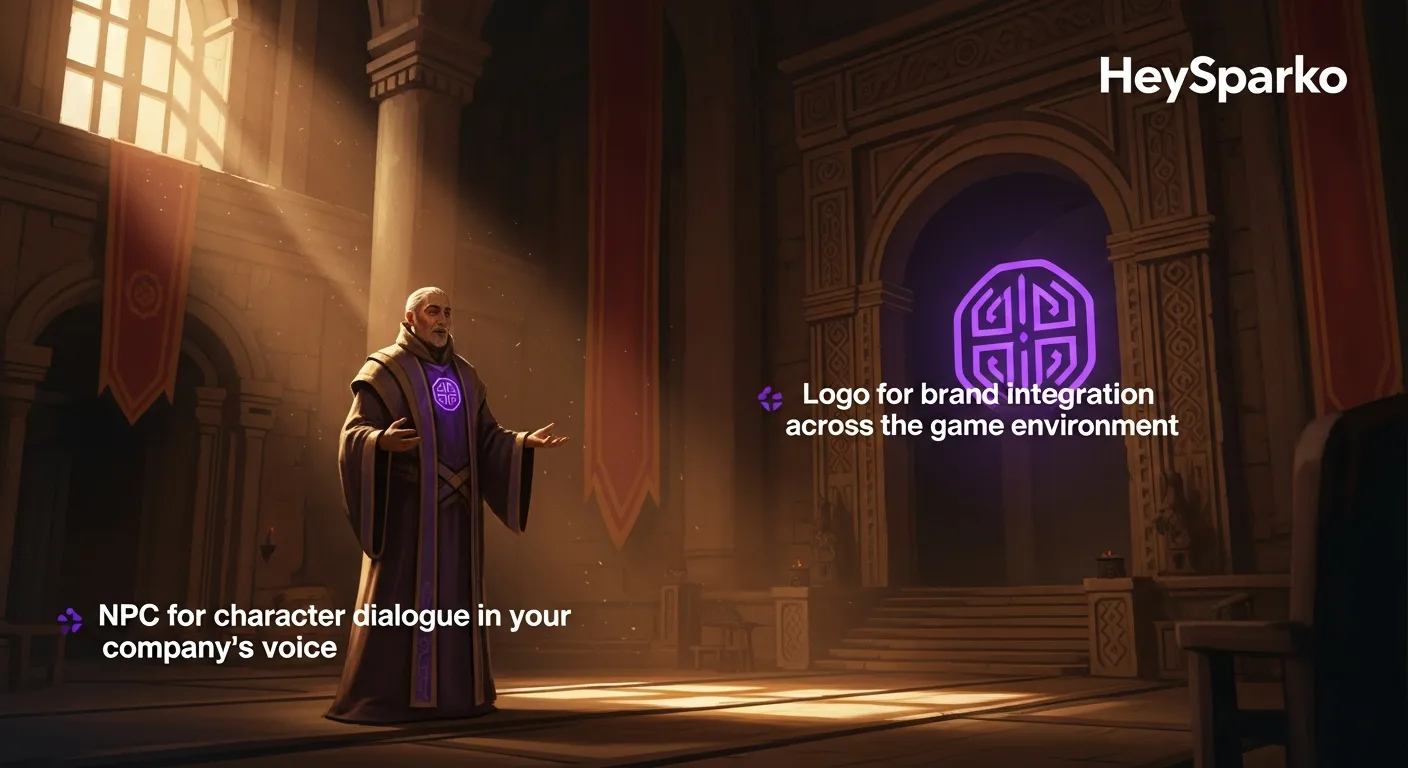
Enterprise events benefit from customization in a way mid-market events don't quite match, and it's worth being specific about the mechanism. HeySparko offers three customization tiers — NPC for character dialogue in your company's voice, Logo for brand integration across the game environment, Story for a fully rewritten narrative arc tied to a company-specific situation. At a single 90-minute Big Game, customization produces one elevated brand moment. At a multi-day Marathon, players encounter the customization repeatedly across three or five days of content, and the brand recall compounds.
Customize for your team
TYPE 1
Your team as in-game characters
Real team members, mascots, or characters from your games as NPCs.
TYPE 2
Your brand integrated natively
Logo and brand elements native to game environments — locations, items, UI.
TYPE 3
Your story woven into the game
Company milestones, products, and inside references woven into puzzles, dialogues, and tasks.
We saw this pattern clearly with BGaming's multi-year company anniversary event: NPC, Logo, and Story tiers together, and the customization threaded across a Big Game arc that mapped their growth story onto four historical eras. Participation landed at 89%, and engineering team members cited the event in the free-response fields of the following month's engagement survey — the kind of unprompted post-event recall that doesn't happen for generic vendor events. At Marathon scale, that compounding effect is even more pronounced: an NPC character who speaks in the company's voice on Day 1, references internal jokes on Day 2, and closes the narrative on Day 3 tied to a real company milestone builds familiarity a single event can't replicate.
For enterprise procurement, one operational note: customization tiers are flat-rate add-ons, not variable-priced consulting engagements. That framing tends to matter for procurement teams who need the line-item structure defensible against baseline vendor benchmarks. Pricing is at /en/pricing — the calculator surfaces the numbers without a discovery-call gate.
The research backing enterprise engagement investment
The academic and industry research on enterprise engagement is worth citing carefully — this is a space where a lot of low-quality vendor content quotes selectively. Here's what's actually well-sourced and what it implies operationally for enterprise HR leaders defending event budgets against finance scrutiny.
Atlassian's State of Teams 2024 report — surveying 5,000 knowledge workers and 100 Fortune 500 executives — estimates that 25 billion work hours are lost annually to ineffective collaboration within the Fortune 500, and that 93% of executives say teams could deliver similar outcomes in half the time if collaborating more effectively. The 25 billion figure is an extrapolation from executive opinion rather than a measured audit, but the executive consensus is the more useful signal for enterprise HR leaders making the budget case. Team-collaboration effectiveness — not headline engagement scores — is where the executive audience is already convinced there's productivity upside. Structured virtual events are one of the few HR interventions that specifically tune the collaboration muscle, giving teams a low-stakes context to practice coordination patterns they'll then transfer to real work back in the day-to-day.
Deloitte's 2024 Global Human Capital Trends report — surveying 14,000 business and HR leaders across 95 countries — found that 71% of business and HR leaders say focusing on individual teams and workgroups is the best place to cultivate culture, agility, and fluidity, and that organizations embracing "microcultures" are 1.8× more likely to achieve positive human outcomes and 1.6× more likely to achieve desired business outcomes. For enterprise HR leaders, that's operational guidance: culture programs run only at the whole-company level rarely land, while team-and-manager-level interventions consistently do. Our Marathon analytics report the team-and-manager breakdown by default, which is what allows enterprise HR leaders to identify which manager pods are participating enthusiastically and which are quietly disengaged — the same signal enterprise culture programs need to target the next intervention with any precision.
Academic research backs the recurring-cadence argument. Anog et al. (SSRN, 2023) published a systematic review of 60+ team-building intervention studies, finding that structured team-building activities increase satisfaction and reduce turnover, with effects amplified when integrated into a broader development strategy rather than run as one-off standalones. That's the retention math enterprise HR leaders can walk into a CFO conversation with: one event moves a survey score marginally; a quarterly program with varied games and consistent cadence moves the retention numbers that matter in the annual review.
The LinkedIn Workplace Learning Report 2024 reinforces the same argument from a career-development angle, identifying learning and development opportunities as one of the strongest retention levers for enterprise workforces. Structured team events sit at the intersection of engagement and skills practice — team coordination, cross-functional communication, decision-making under time pressure — which is why L&D budgets increasingly co-fund what used to be an HR-owned engagement line item.
Our own enterprise portfolio data mirrors the academic finding. The clients who run one event a year rarely renew for a second, and the clients who commit to a quarterly cadence — rotating between the games listed above and varying between Big Game and Marathon — have retention conversations with us that are about which quarter's game to pick, not whether to continue at all. Marathon events also reach approximately 35% more participants than forced-synchronous alternatives for the same team. That differential shows up among engineers running deep on a sprint, employees who find compulsory synchronous socials genuinely taxing, and international team members for whom a fixed window means a personal calendar sacrifice. Getting those employees into a shared experience isn't just a participation metric — it's a signal that the format is doing what enterprise engagement programs are supposed to do.
Frequently asked questions
What's the maximum event size HeySparko can actually run?
Big Game and Marathon are both architected for 5 to 10,000 players in a single event. Big Game keeps everyone in one shared live session with breakout teams of 4-8 and a unified leaderboard; Marathon spreads engagement across 1-5 days without any shared window constraint. We've run the closing event for Coca-Cola HBC's LearnFest for 6,000 employees across 28 countries as a virtual journey format, and the technical envelope has room above that. Above 3,000 headcount, Marathon is nearly always the recommendation — the async structure removes the scheduling constraint entirely rather than requiring regional workarounds that fragment the shared experience.
How do we handle procurement and InfoSec review for an enterprise engagement?
HeySparko provides the documentation enterprise procurement typically asks for: SOC 2 attestation summary, data processing agreement, tenant-model overview, and browser-based delivery details for InfoSec review. The player experience runs in a standard browser with no installation, no account creation, and no persistent data written to player devices — one reason enterprise IT teams tend to approve HeySparko events quickly relative to other engagement vendors. For the initial procurement pass, we typically send the InfoSec pack in the first documentation exchange rather than waiting until procurement asks. Contract terms are standard MSA structure with per-event SOWs, and enterprise pricing is transparent at /en/pricing.
How does the format decision actually get made in practice at 1,000+ headcount?
The most useful conversation we have with enterprise HR leaders in discovery is mapping the actual time-zone distribution of the workforce, not the assumed one. Companies that identify as "US-based" often have 15-25% of the workforce in EMEA and APAC once you include contractors, partners, and international R&D centers. If any single live window would exclude more than 20% of the intended audience, Marathon is the honest answer. If regional concentration is genuinely tight, a Big Game with two windows (Americas plus EMEA/APAC) can still work. We map this on a 15-minute call before recommending anything.
How much does the HR or People team actually manage during and after the event?
For Big Game, your team's involvement is a 30-minute briefing call to pick a game and confirm the time — we provide the Game Host who runs the entire live event, and your team participates as players. For Marathon, setup adds a pre-event comms plan (we send templates for the announcement, calendar invite, and Day-2 nudge) plus roughly five minutes to send the Day-2 leaderboard reminder that consistently lifts Day-3 completion by 15-20 percentage points. Analytics — participation rate, NPS pulse, team-level breakdown by manager — arrives within 24 hours of the event closing, formatted for a leadership readout.
Can we make the event feel like our event rather than a generic vendor event?
Through the NPC, Logo, and Story customization tiers, yes. NPC rewrites character dialogue in your company's voice with internal references and inside jokes; characters can include real named executives with their sign-off. Logo integrates your brand across game UI, leaderboards, and completion certificates. Story rewrites the entire narrative arc tied to a specific enterprise moment — a rebrand, a milestone anniversary, a strategic pivot the event needs to reinforce. BGaming ran all three tiers for their multi-year anniversary: 89% participation, and engineering team members cited it in the following month's engagement survey. Each tier is a flat-rate add-on rather than variable consulting, which matters for enterprise procurement. See /en/pricing for details.