

Over the past five years, virtual team building has moved from emergency pandemic improvisation to a settled line item in the HR budget, and the question on the HR Leader's desk has changed with it. Five years ago, the question was "can we even do this remotely?" Today the question is more specific: which game, which format, which customization tier for this team, this quarter, this engagement gap. That shift sounds small but it changes how HR teams shop. A vendor is no longer good enough on its own; the game catalog matters, and so do the operational nuances that separate "we ran something" from "we moved the engagement score by Q4."
Our portfolio: 1,500+ live virtual team events, 700+ companies served, 50+ countries reached, five years of operating data since 2020. Most of what we've learned about which games work for HR-led events isn't on any vendor's marketing page. It's in the decisions we've watched HR teams regret, and the ones we've watched them repeat.
Which virtual team building games actually work for the situations HR teams face most often?
The Format Decision Comes Before the Game
The first question to settle, before you open the game catalog, is the format question. HeySparko runs everything in two shapes: Big Game (a single 60 to 90 minute live event with a HeySparko Game Host, designed for groups within a 6-hour time zone spread) and Marathon (1-5 days of asynchronous engagement with daily content releases and a continuously live leaderboard, designed for teams that can't or shouldn't all share one calendar window). The choice is rarely close once you put two numbers on the table: team size and time zone spread.
For an HR team running a holiday party, a kickoff event, or any moment where the shared-room energy is the point, Big Game is the right call. Two hundred people watching the leaderboard shift in real time, the Game Host reading the chat, the entire company reacting to the same plot twist at the same moment: that is the product, and it doesn't translate to async. The HR teams who keep booking Big Game for this purpose are getting the right thing.
For a quarterly engagement program, a globally distributed team, or any culture where mandatory live events have started to produce visible pushback, Marathon is the honest choice. Across the Marathon events we've run at 500+ companies, opt-in completion rates land in the 78-92% range. The leaderboard creates pull without requiring a scheduling concession from anyone. The HR teams who get the format right here are noticeably less stressed about RSVP-to-attendance gaps, because there is no single window where people either show up or don't.
There's a third decision worth naming explicitly: analytics depth. Big Game produces a single-day snapshot of participation rate, NPS, and team scores. Marathon produces by-team completion across multiple days, which maps cleanly against manager pods and gives HR leaders the kind of data that drives a real post-event conversation. If your engagement program is downstream of a manager-effectiveness question (and per Gallup, most of them are), Marathon's data shape is meaningfully more useful for the follow-through work.
Picking the Adventure: Stakes, Energy, and the Engineering Test
Adventures are the high-stakes, narrative-arc games in the HeySparko catalog. They run as either Big Game or Marathon, but the energy is always coordination-under-pressure. The four we recommend most often for HR-led events sort by audience character, not by occasion.
Apocalypse is the highest-energy game we make. The team has 80 minutes to develop and distribute a vaccine across four locations (Research Center, Street, Power Station, Laboratory) while routing decisions in Stage 2 reshape the puzzle layout in Stage 3. We've watched 25-person engineering teams surface their natural incident commanders by Stage 2, and the role-specialization the game produces under pressure is real information about how the team works. The aesthetic is stylized 2D throughout. There's menace, not horror, and global teams come out wanting an immediate replay rather than feeling wrung out. Best for product, engineering, fintech, and sales teams that have already developed coordination muscle. Not the right fit for buttoned-up enterprise legal or finance audiences. Recommend Wintervald Hotel Mystery for those rooms instead.
Mission 8-Bit is the kickoff game we book most. The three-stage arc (escape the hostile office, rebuild a 1980s computer with the retro shopkeeper, ship the killcode through arcade-style mini-games) maps almost exactly onto a quarterly project rhythm, which is why engineering managers keep returning to it for Q1. The 8-bit sprite versions of the team get sent as a sheet after the event, and clients reuse them for Slack avatars, internal stickers, and anniversary slides. We've run it with HR teams whose members hadn't touched a video game in twenty years. The controls are simple enough that no one drops out for tech reasons.
Bureau of Magical Affairs is the onboarding game we recommend more than any other. The premise (your team has 90 minutes to clear four magical bureaucratic emergencies as newly deputized agents of Bureau No. 7) mirrors the new-hire experience of "everything is on fire, also there's paperwork" with disconcerting accuracy. The four case-file structure gives every personality type a distinct moment where they're the expert. The tone is workplace comedy, closer to The Office meets Men in Black than to Tolkien-style fantasy, which makes it usable across functional lines that wouldn't normally engage with a "fantasy" framing.
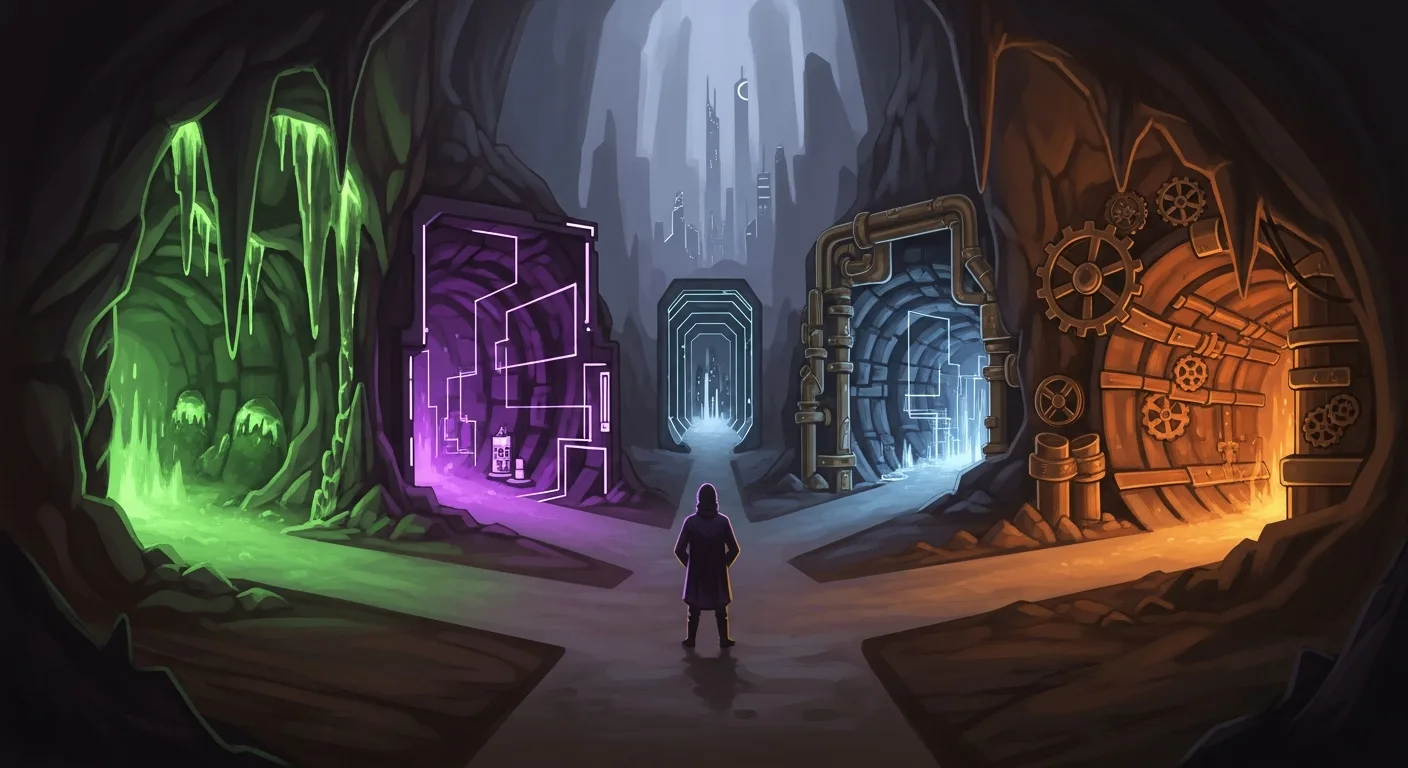
Stolen Hours is the December adventure for teams that want something more imaginative than another holiday trivia night. Santa's clock hands have been scattered across four genre worlds (postapocalypse, cyberpunk, steampunk, biopunk) and the team has 90 minutes to chase them back before Christmas Eve never arrives. The Pixar-style art keeps the cyber and biopunk stages warm rather than edgy, and the four-world structure surfaces different team strengths at different moments. We've watched teams who actively didn't want a standard holiday party absolutely love this one. It also works well in Marathon for global teams who can't all join a single live December session.
A note on customization that matters for adventure games particularly: the Story tier (a full narrative rewrite tying the game's plot to your team's actual situation) lands hardest in the high-stakes adventure formats because the energy of the game amplifies whatever frame you put around it. When we ran an event for BGaming, an international iGaming team of roughly 400 people, the Story tier worked because the historical-eras frame mapped naturally onto their company's growth story. The team finished the event having walked their own milestone arc.
Picking the Mystery: Deduction Without the Drama
Mysteries are the deduction-and-investigation games. The mechanics differ from adventures: less time pressure, more careful observation, more inter-team debate. They land particularly well for HR teams running events where the energy needs to be civilized rather than charged.
Wintervald Hotel Mystery is the most enterprise-appropriate game we offer. A sophisticated Agatha-Christie-style murder mystery set in a snow-bound luxury hotel, where teams play detectives working to name the killer before the storm clears in the morning. There's no body imagery, no graphic content, no horror element. The murder is a premise, not a depicted event. Closer to Knives Out than to anything uncomfortable. The HR teams we work with at law firms, financial services functions, and C-suite events book this game more than any other in December, because the office-parody energy that works for engineering cultures lands wrong in those rooms. It's also a strong year-round option for anniversary events at formal cultures.
Under the Big Top uses the same deduction mechanic as Wintervald Hotel Mystery but in a vintage circus setting. A headlining performer has vanished before the biggest show of the season, and the team plays a touring company of investigators working through a cast of intentionally quirky suspects: the gentle strongman, the trapeze couple who haven't spoken in a year, the ringmaster who knows more than he says. The whimsy is melancholic and warm (think Big Fish, not slapstick), and the troupe-on-the-road metaphor makes it a particularly good fit for anniversary events. The multi-day investigation rhythm also works beautifully in Marathon for international teams who want to debate suspects between time zones rather than under a shared clock.
The pattern that shows up most often when HR teams pick mysteries badly: they pick by aesthetic and miss the audience question. Wintervald Hotel Mystery for a team that loves Knives Out is a great event; the same game for a team that wanted high-energy gameplay produces polite participation. Under the Big Top for a team that warms to vintage-circus aesthetics is delightful; the same game for an engineering culture that hears "circus" and thinks "clowns honking horns" lands flat. A 15-minute culture conversation before game selection catches both errors. We'd rather have that conversation than ship the wrong game.
Customization Tiers and When HR Teams Should Actually Use Them
HeySparko offers three flat-price customization tiers (NPC, Logo, Story) that turn a stock game into a branded, situation-specific experience. Each tier is a flat-price add-on regardless of player count or game choice, and they stack. About 15% of our events use at least one tier; about 5% use all three. The decision of when to add customization is one of the most consequential the HR team makes, because customization is what shifts an event from "we ran something fun" to "this was clearly ours, not a vendor's."
Customize for your team
TYPE 1
Your team as in-game characters
Real team members, mascots, or characters from your games as NPCs.
TYPE 2
Your brand integrated natively
Logo and brand elements native to game environments — locations, items, UI.
TYPE 3
Your story woven into the game
Company milestones, products, and inside references woven into puzzles, dialogues, and tasks.
The NPC tier rewrites the game's characters to speak in your company's voice with internal references, naming conventions, and an inside joke woven into a character line. It generates the most Slack messages after the event in our data, because the recognition moment ("wait, that line was about our codebase") creates the shareable beat that drives the post-event chatter HR teams want. The Logo tier wraps the game UI, the leaderboard, and the completion certificate in your visual brand. It matters most for customer-facing events and for events doubling as recruitment moments where the visible brand experience is part of the value. The Story tier rewrites the entire narrative arc around your team's specific moment (a product launch, a milestone, a chapter closing) and it's the tier that turns the event into a strategic narrative beat for leadership. The operational note for HR teams: NPC, Story, and Logo each need 10 business days of lead time. Plan accordingly. Tier pricing details live on pricing.
What the Data Says About Engagement, Distance, and the Manager Lever
The research backing structured team-building investment is more rigorous than vendor content usually suggests. Three findings shape how we recommend HR teams think about this category.
Gallup's 2025 State of the Global Workplace put the baseline picture starkly: only 21% of employees worldwide are engaged in their work, with disengagement costing the global economy $438 billion annually in lost productivity. The same report's most consequential finding for HR teams is the manager-variance number — 70% of variance in team engagement is attributable to the direct manager, not to the team, not to the company, not to the role. That figure reframes what an engagement event is for. It isn't a company-wide morale tool. It's a data-collection mechanism that surfaces which manager-level pods need attention, and a context where managers see their team in a different mode. Marathon analytics, which produce by-team completion rates across multiple days, are the data shape that maps to that follow-through work; Big Game's single-day snapshot is less useful for the manager conversation but stronger for the shared-energy moment that doesn't show up in any spreadsheet.
The distance picture matters for the format question. Microsoft's 2025 Work Trend Index research (the Breaking Down the Infinite Workday report, drawing on a 31,000-knowledge-worker survey plus Microsoft 365 telemetry) found that 30% of meetings now span multiple time zones, an 8-point absolute increase since 2021. That number quantifies what HR teams running events for distributed organizations already feel. The cost of forcing a single live window is non-trivial, and someone always pays it. Marathon's async shape isn't a watered-down Big Game; it's the right product for the distance reality most distributed teams are living through.
The academic evidence aligns with both. Anog et al. (SSRN, 2023) conducted a systematic review of 60+ team-building studies and found that structured team-building activities increase satisfaction and reduce turnover, with effects amplified when integrated into a broader development strategy rather than run as isolated events. The "broader development strategy" phrase matters more than the headline finding. A single beautiful event in Q2 that doesn't connect to a manager conversation in Q3 produces a spike that decays. A predictable cadence of events (quarterly Marathon, annual Big Game milestone) with structured manager follow-up produces the engagement-score lift HR leaders need to defend the program at the next Finance review.
Our own portfolio data fills in the practitioner-level numbers the academic literature doesn't capture. Across the events we've run, the by-team completion rates from Marathon events correlate noticeably with the engagement survey data HR leaders see 60-90 days later. The pods with lowest Marathon completion tend to surface as the lowest-engagement teams in the next survey cycle. That correlation isn't a metric we sell. It's a pattern HR teams notice when they use the event as a surveillance signal for engagement risk, not as a one-off celebration. The HR teams who get the most out of the budget use both data shapes together: third-party benchmarks like Gallup's 70% manager-variance number as the framing, and the by-team breakdowns from their own events as the operational signal.
Frequently asked questions
How do you choose between Big Game and Marathon for an HR team's engagement program?
Team size and time zone spread make the decision for you in most cases. Within a 6-hour time zone window for a single moment (holiday party, kickoff, milestone event), Big Game's live shared energy is the right call. For globally distributed teams across 8+ hours or any quarterly engagement program needing by-team analytics across days, Marathon's async format produces both higher equity and richer data. The honest version: if you're losing sleep about RSVP-to-attendance ratios, Marathon is the format question your team has already answered for you.
Which virtual team building games work best for cross-functional groups?
Bureau of Magical Affairs is the game we recommend most for mixed-function audiences. Its four case-file structure gives different personality types distinct moments where they're the expert (negotiation, time-logic, observation, synthesis) so no single function dominates the leaderboard. The workplace-comedy tone reads as familiar across engineering, marketing, sales, and support functions. For more formal cross-functional groups, Wintervald Hotel Mystery handles the same cross-functional challenge through pure deduction logic that doesn't require shared cultural references.
How much do virtual team building games cost for HR teams?
HeySparko games are tiered by player count, with the per-player cost dropping sharply as group size increases. Small events run at the highest per-player cost; mid-size events of 75-500 players sit in the cost-per-engaged-employee sweet spot; large 1,000+ player events have the lowest per-player rate in the catalog. Marathon adds a day-count axis on top of the volume tier, and customization tiers are flat add-ons regardless of group size. The Booking Calculator on pricing shows the exact configuration cost before any contact form.
How long does it take to plan a virtual team building event from kickoff to execution?
For a stock game with no customization, 10 business days is workable for either Big Game or Marathon. NPC customization keeps the minimum at 10 business days; Story customization also needs 10 business days for the narrative rewrite and a 30-minute briefing call. For events over 500 players, we recommend a 3-week runway regardless of customization tier to allow proper participant communication. Last-minute bookings under 5 business days are possible for stock formats, but the pre-event communication window gets compressed and attendance rates reflect it.
What analytics do HR teams get from a virtual team building game?
Every HeySparko event produces a post-event analytics report within 24 hours. Big Game gives single-day metrics: participation rate, NPS pulse, team scores, and a by-team breakdown. Marathon gives the same metrics plus the multi-day shape: completion rate by team, which days drove highest engagement, where drop-off occurred, and by-team completion mapped against manager pods. The Marathon shape is the more useful one for HR teams downstream of a manager-effectiveness question, because the data lands ready for follow-through conversations the morning after the event ends.
Do virtual team building games work for teams that have already done lots of escape rooms?
Yes, but the game selection matters more than usual. Teams that have done multiple virtual escape rooms typically appreciate the deeper narrative structure of adventures and mysteries over generic puzzle-room formats. Mission 8-Bit and Stolen Hours both offer multi-stage arcs that read as fresh after escape-room saturation. For teams that want a complete category shift, Under the Big Top brings the deduction-debate format, which feels distinctly different from the puzzle-and-key escape mechanic that defines most virtual escape rooms.