


Sales orgs were the early adopters of distributed work, well before People Ops budgets caught up. By the time most companies hit the pandemic flip in March 2020, half the enterprise sales teams in North America were already running on Zoom-and-Salesforce, working their territories from home offices three days a week. What changed in 2020 was that the team events stopped happening — the regional steak dinners, the SKO ballroom, the President's Club cruise — and got replaced by whatever the AE-ops manager could pull together on a Wednesday afternoon. Five years later, we're still untangling what works and what doesn't for sales-team gatherings that happen on the screen instead of in a room.
Our portfolio: 1,500+ live virtual team events, 700+ companies served, 50+ countries reached, five years of operating data since 2020. A meaningful chunk of those events were sales-team-specific — kickoffs, mid-year resets, win celebrations, regional all-hands, top-rep recognition moments. The patterns that work for a 60-person fintech engineering org do not transfer cleanly to a 250-person enterprise sales floor. The reps have different incentives, different cultural reflexes, different tolerance for anything that looks like "mandatory fun."
So what virtual team building games actually work for sales teams that are quota-paced, time-zone-distributed, and already skeptical of anything labeled "mandatory fun"?
Why sales-team events need a different design than the rest of the company

Three things make sales teams unlike most other functions when you're designing a virtual event for them.
The first is that they're already competitive by selection — every person on the team self-selected into a job where they're publicly ranked every Monday. They've been to the SKO motivational speaker; they know the leaderboard mechanic intimately. A team event that just adds another leaderboard without giving them something fresh to compete on lands flat. The reps see through it immediately. What lands is a leaderboard tied to something the reps don't get to do in their day jobs: deduction, narrative thinking, cooperative problem-solving under time pressure.
The second is the territory-and-pod culture. Big sales orgs are tribally organized around regions, segments, and pod leaders. Reps know their pod-mates well and the other side of the org barely at all. A good sales-team virtual event has to dissolve those pods for at least the duration of the game — putting West Coast Enterprise next to East Coast Mid-Market next to EMEA next to LATAM in randomized breakout teams. In our work with distributed revenue orgs, we've seen the cross-pod team formation generate more Slack-channel-aftermath than the event itself.
The third is the timing constraint. Sales teams have hard quarter-end deadlines that reshape every calendar question. You cannot run a meaningful virtual event in the last two weeks of any quarter; you should not run one in the first week of a new quarter either. The booking windows that work are weeks 3-10 of each quarter, with the strongest fit at week 5-7 when pipeline is set but quota-close anxiety hasn't started.
Most "sales team building" content treats this the way it treats every other function: pick a game, schedule a Zoom, send a calendar invite. That's the design failure. A sales-team event needs to respect quota geography, mix the pods, and give the reps something genuinely new to compete on — otherwise it reads as one more performative motivation moment that the team will roll their eyes at on the way back to Outreach.
Big Game versus Marathon: which fits the sales-team rhythm
The single biggest design call for any sales-team virtual event is the format. There are two real options, and which one fits depends almost entirely on how your sales org is distributed and what calendar window you have.
Big Game is the 60-90 minute live event. Everyone on the same Zoom, same time, hosted by a HeySparko Game Host who runs the whole experience while your team participates as players. It's the right call when the sales team can coordinate a single live window — typically when the team is within a 6-hour time zone spread, or when you can split into two regional sessions (one EMEA-friendly, one Americas-friendly) and merge analytics afterward. Big Game pairs well with the natural cadence of a sales kickoff opener, a quarterly win celebration, or a President's Club virtual evening. The shared-leaderboard energy of watching pods compete in real time is genuine and hard to replicate async. We've run Apocalypse as the opener for several SKO weeks and the energy carries into the rest of the agenda — reps walk into the strategy session already loose with each other.
Marathon is the 1-5 day async format. Daily episodes drop into a leaderboard, players engage on their own schedule, and a single shared narrative arcs across the days. This is the right call when your sales org spans 8+ time zones — when forcing a live window means one region takes a 6am or 11pm call, which kills the engagement you were trying to build. It's also the right call for engagement programs (think Spirit Week, Q4 holiday push, mid-year reset) rather than one-off events. The Marathon format runs about 78-92% completion rate across the engagements we've seen at 500+ companies. In our experience that's a meaningfully higher participation number than what mandatory live virtual sales events deliver, because reps who can't make a 9am Tuesday will absolutely play a 30-min episode at 11pm from their home office.
The decision usually makes itself once you write down two things on paper: how many time zones the team spans, and whether you need a single shared moment or a sustained engagement arc. If you're running a SKO opener and the whole team is within 4 time zones, Big Game. If you're running a quarterly engagement program across a global team, Marathon. If you're somewhere in between — a 200-person sales org in 6 time zones running a mid-year all-hands — we usually default to Big Game with two regional sessions and one combined leaderboard. Don't pick the format based on which one sounds easier to organize; pick it based on which one your reps will actually show up to.
Five games that fit sales-team energy

Sales teams want pacing, stakes, and a reason to coordinate that isn't another deal review. Five games in our catalog reliably land for them, each for a different sub-flavor of sales-team event.
Apocalypse — for the SKO opener and the urgency-energy crowd
Apocalypse is our highest-energy adventure: an overnight outbreak, a vaccine race, four locations between the team and the cure, 80 minutes of pressure. It's the right call when the sales team self-identifies as a "we ship under pressure" culture and the SKO theme is something like "Q1 charge." The stress mechanic is energizing, not exhausting; teams come out invigorated and the cross-pod coordination that emerges in Stage 3 — when people self-organize into specialists — gives the leadership team genuinely useful intel about who's a quiet operator and who's a load-bearing coordinator. We've watched 30-person enterprise sales squads find their natural project managers in Stage 2 of the game.
Mission 8-Bit — for the kickoff that maps onto the quarter
Mission 8-Bit is the year-round adventure structured as three acts: escape, build, ship. A retro-aesthetic virus crisis, a 1980s computer to rebuild, an 8-bit final battle for the source code. The reason it lands for sales-team kickoffs is the structural metaphor — setup, build, launch — maps almost directly onto a quarter. The reps recognize the rhythm without anyone calling it out. Each player gets an 8-bit sprite of themselves at the end, which most teams turn into Slack avatars by the next morning. Cheap memento, high replay value in the team's social channels for weeks afterward.
Wintervald Hotel Mystery — for the enterprise sales floor that wants something elegant
Wintervald Hotel Mystery is the most enterprise-appropriate game in our catalog. An isolated luxury hotel, a private dinner, a body before sunrise, a snowstorm trapping the detectives for one night. It's Knives Out in flavor, not Saw — sophisticated deduction, no graphic content, the kind of evening that lands cleanly with finance teams, legal, the C-suite, and the parts of an enterprise sales org that would find Apocalypse a bit much. We've seen it work especially well for the closing event of a multi-day sales strategy offsite — it lowers the corporate temperature and gives the team a shared cultural touchstone that isn't a slide deck.
Under the Big Top — for the mid-year reset
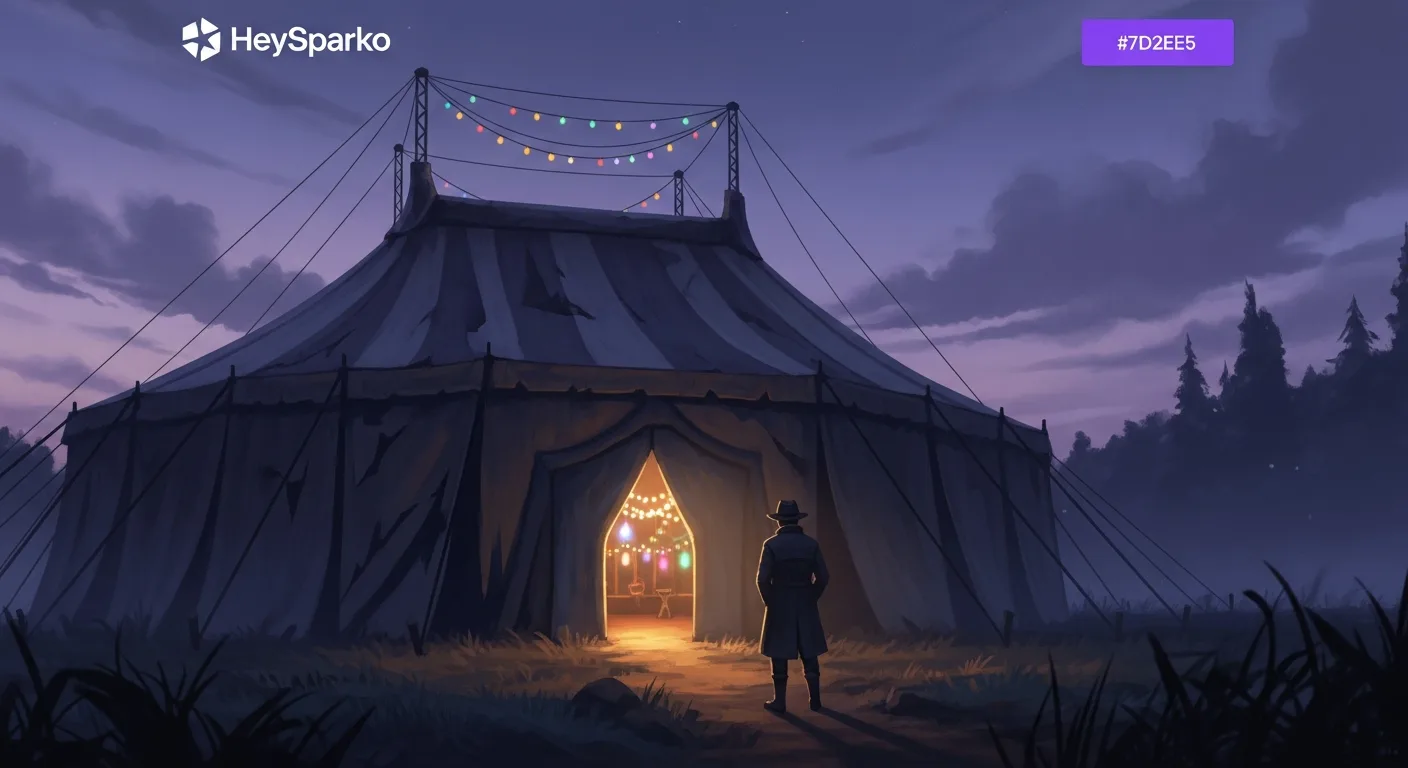
Under the Big Top is the summer-energy companion mystery: a vintage circus, a vanishing headliner, a wonderfully strange cast of suspects. Same deduction mechanic as Wintervald Hotel Mystery, entirely different aesthetic — warm whimsy, Big Fish tone, not slapstick. We see sales orgs book this for mid-year all-hands when the team is heading into the slower summer weeks and the energy of the room is half on PTO. The deduction structure pulls people back to the leaderboard between vacation days; you get genuine engagement during what's usually a dead month for team activities.
Stolen Hours — for the year-end celebration that needs to feel different
Stolen Hours is the genre-bending December adventure: Santa's clock hands stolen and scattered across postapocalypse, cyberpunk, steampunk, and biopunk worlds. It's the un-cliche move for a sales-team year-end event — sci-fi instead of Christmas-trivia, imaginative instead of office-parody, and the four-world structure lets the reps see different teammates shine in different stages. Engineering-leaning sales orgs (sales-engineering, technical AEs, partner solutions) tend to particularly enjoy this one. The Pixar-style art keeps it warm.
The honest reason to pick from this specific shortlist for a sales team is that adventures and mysteries give the reps something to think with — a narrative they can sink into for an hour or three days — rather than a quiz they're plowing through. Trivia formats work fine for casual all-hands, but for an audience that already lives on a leaderboard, the substance of the game matters as much as the competition. The five games above each carry a real story.
Customization that makes the event the sales team's, not the vendor's
Three customization tiers turn any of the games above into something that feels in-house instead of off-the-shelf. NPC tier replaces character voices with internal references — your CRO becomes a recurring NPC who shows up between stages, your top-rep slang appears in the dialogue. Logo tier integrates brand colors and assets across the game environment. Story tier rewrites the narrative arc to fit a real moment your sales team is in — a Series B close, a new logo win, the year you finally hit your quota number.
Customize for your team
TYPE 1
Your team as in-game characters
Real team members, mascots, or characters from your games as NPCs.
TYPE 2
Your brand integrated natively
Logo and brand elements native to game environments — locations, items, UI.
TYPE 3
Your story woven into the game
Company milestones, products, and inside references woven into puzzles, dialogues, and tasks.
For sales-team events the tier that tends to land hardest is Story. Reps are already telling stories about their year — the bookings story, the win story, the territory story. When the game's narrative reflects that story back, the event lands as part of the year-end recognition pattern instead of a separate thing they had to attend. The most ambitious sales clients stack all three tiers for a flagship SKO opener; most stop at one or two. Customization needs 10 business days of lead time, so it is not a same-week request — plan it into the calendar early. Full tier pricing detail lives on the pricing page; we don't try to walk reps through tier choices in the booking flow.
What the data says about sales-team engagement
The most important number in any sales-org engagement conversation is also the most uncomfortable one. Gallup's State of the Global Workplace 2025 reports that only 21% of employees worldwide are engaged in their work, with disengagement costing the global economy $438 billion annually in lost productivity, and 70% of the variance in team engagement is attributable to the direct manager. That last clause is the one sales leaders should sit with. The conventional wisdom in revenue orgs is that engagement is downstream of compensation design, territory fairness, and pipeline coverage — fix those, the rest follows. The Gallup data says something different: the single largest driver of how a team feels about its work is the immediate manager, not the comp plan and not the CRO's all-hands.
For a sales-team event, that translates into a specific design principle: the analytics need to surface manager-pod-level data, not company-wide averages. A virtual team event that gives you "the sales org engaged at 78% NPS" is mostly useless. A virtual team event that gives you "the West Coast Enterprise pod engaged at 91%, the EMEA Mid-Market pod at 64%, here's the gap" is actionable. The 64% pod has a manager problem; the 91% pod has a manager doing something right that the rest of the org can learn from. Marathon analytics produce this view across days; Big Game analytics produce it across the single session. Either way, get the by-pod breakdown into the post-event report — that's the data your CRO will care about.
The other lens that matters for sales teams is burnout. Deloitte's 2024 Burnout in the Workplace report found that 77% of professionals report burnout at their current job, with "lack of recognition" overtaking workload as the primary driver — 31% of respondents named it as the top cause. Sales orgs are particularly exposed here because the recognition rhythm is feast-or-famine: you're either at President's Club for the year or you're not. The mid-year reps who hit 95% of quota get an emotional flat-line. A well-designed quarterly virtual event with team-level recognition baked in is the cheapest mid-tier-recognition mechanism most sales orgs have available to them — and it's one of the very few that scales without the CRO having to write personalized notes to 200 people.
Academic literature reinforces the operational case. Anog et al. (SSRN, 2023) reviewed 60+ studies on structured team-building interventions and found consistent effects on satisfaction and reduced turnover, with the strongest results when team-building was part of a broader development strategy rather than a standalone event. That fits what we've seen in our own portfolio: a one-off Big Game produces a great Friday afternoon and minor lift in the Monday survey. A Marathon connected to a manager-development arc, a recognition cadence, and a leadership-readout produces measurable retention impact. The events are an amplifier, not magic — they reinforce what the surrounding manager system is already doing, for better or worse.
Two more numbers worth pinning down. SHRM's 2024 cost-per-hire calculation puts the cost of a non-executive departure well into the five figures once you fold in recruiting, ramp time, and lost productivity. For a 200-person sales team running at industry-average quits rate, even a 2-3 percentage point reduction in annual voluntary attrition pays back the entire engagement-program budget several times over. The US Bureau of Labor Statistics' 2025 JOLTS data puts the cross-industry monthly quits rate at 2.3% — sales-adjacent roles tend to run slightly higher because rep mobility is structurally high. The retention math is not subtle. The cheapest hire is the rep you didn't lose.
Frequently asked questions
How long does a virtual team building event for a sales team usually take?
For Big Game format, 60-90 minutes is the standard window — long enough for a real narrative arc, short enough that the reps don't lose patience. A Marathon program runs across 3-5 days with each daily episode taking each rep about 30-45 minutes of engagement. The 60-90 minute Big Game is the default for sales kickoffs; the multi-day Marathon is the default for distributed teams across many time zones.
What's the best virtual team building game for a sales kickoff (SKO)?
For a kickoff opener we usually recommend Mission 8-Bit — its three-act structure (escape, build, ship) maps cleanly onto the quarterly rhythm reps already think in, and the sprite mementos generate weeks of Slack-channel afterlife. If the SKO theme is more "we charge under pressure," Apocalypse lands harder because the time-pressure mechanic gives the team a shared "we got through this" memory.
How many sales reps can join a single virtual team building event?
Both Big Game and Marathon formats scale from 5 to 10,000 players in a single session. For a sales-team event, the sweet spot for engagement is breakouts of 4-8 reps per pod, with the leaderboard aggregating across pods. We've run sessions for 30-person regional sales teams and for 6,000-person global all-hands; the format holds at both ends. Above 1,000 participants we usually split into 2-3 parallel rooms with one shared leaderboard.
Do reps need to install any software to participate?
No. Every HeySparko game runs in a browser via a link the host shares at the start. There's no app to install, no account to create, no IT ticket to file. We've tested with corporate-locked laptops running Cisco AnyConnect, Crowdstrike Falcon, and the usual enterprise endpoint security stack. Reps join via the link, see the game in their browser, and submit answers without touching their laptop's permissions.
How do we measure whether the event actually worked for the sales team?
Three things to look at, in order. First, the by-pod participation rate — that's your manager-engagement signal, and it tracks Gallup's 70% manager-variance finding directly. Second, the post-event NPS pulse, which our system runs automatically and reports back within 24 hours. Third, the engagement-survey lift in the cycle that follows the event. The pod-level breakdown is the part most sales leaders end up using in their quarterly readouts.
What's the typical cost of a virtual team building event for a sales team?
Pricing is tiered by player count and format. Smaller teams running a single Big Game land at the lower end; larger multi-day Marathons with full customization sit at the higher end. The Booking Calculator on our pricing page shows the exact configuration for your team size, format, and customization choices before any contact form — no sales-gating, no "talk to us for a quote." For most mid-size sales orgs the total event cost is well under the cost of losing one rep to attrition.