
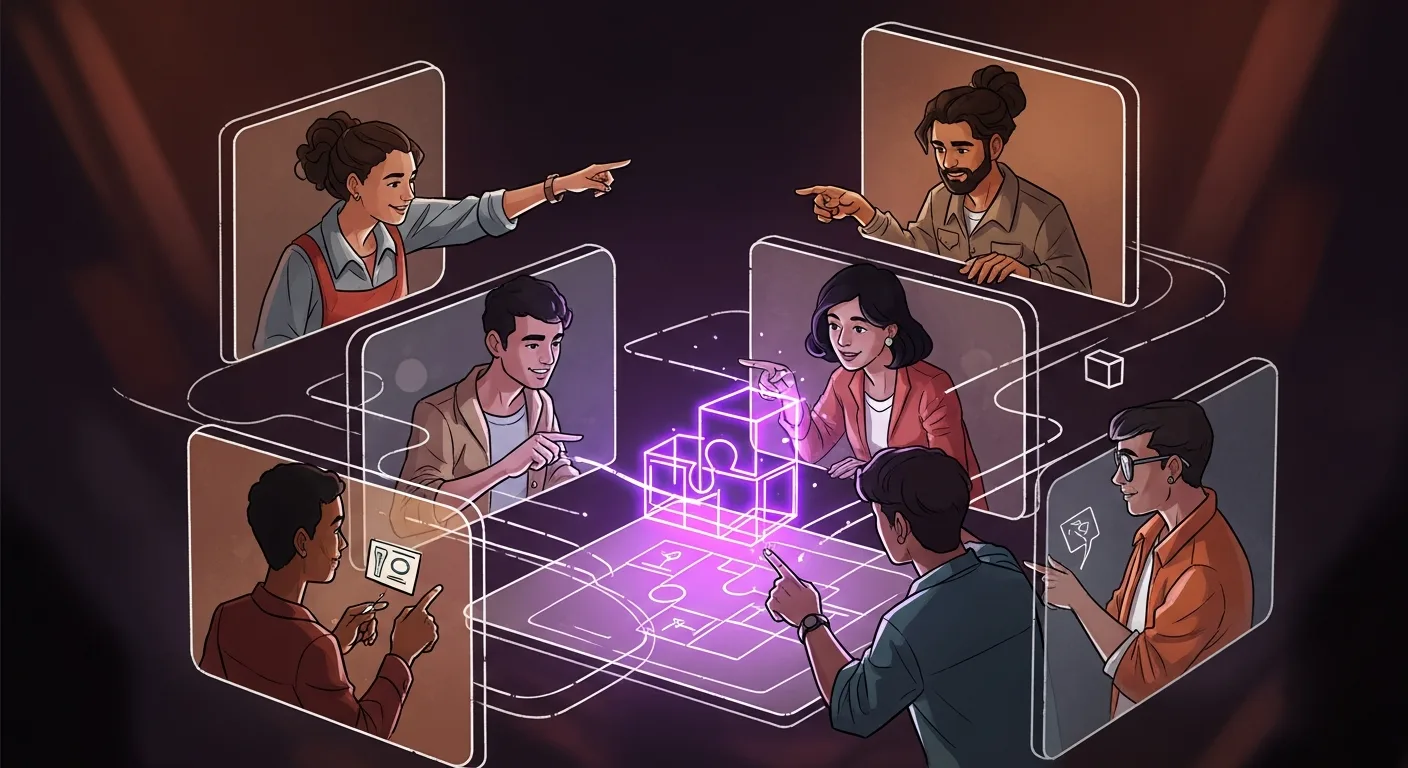

Remote team building games have been on People Ops calendars since 2020, but the budgets have grown faster than the results. HR Leaders report running events quarterly and still watching engagement survey scores flatten. The Zoom happy hour didn't die. It mutated into a vendor-hosted trivia round that produces the same polite attendance and the same post-event silence on Slack. The tool changed; the underlying assumption didn't. That assumption: if you gather the team, connection follows.
1,500+ virtual events later — across 300+ companies in 50+ countries since 2020 — the patterns are more consistent than most People Ops leaders expect. The pattern we see most often has almost nothing to do with which game you pick. It has everything to do with whether the event was designed for the team structure you have, or the one you wish you had.
What remote team building games actually work for distributed teams across multiple time zones?
How Remote Team Building Games Actually Work
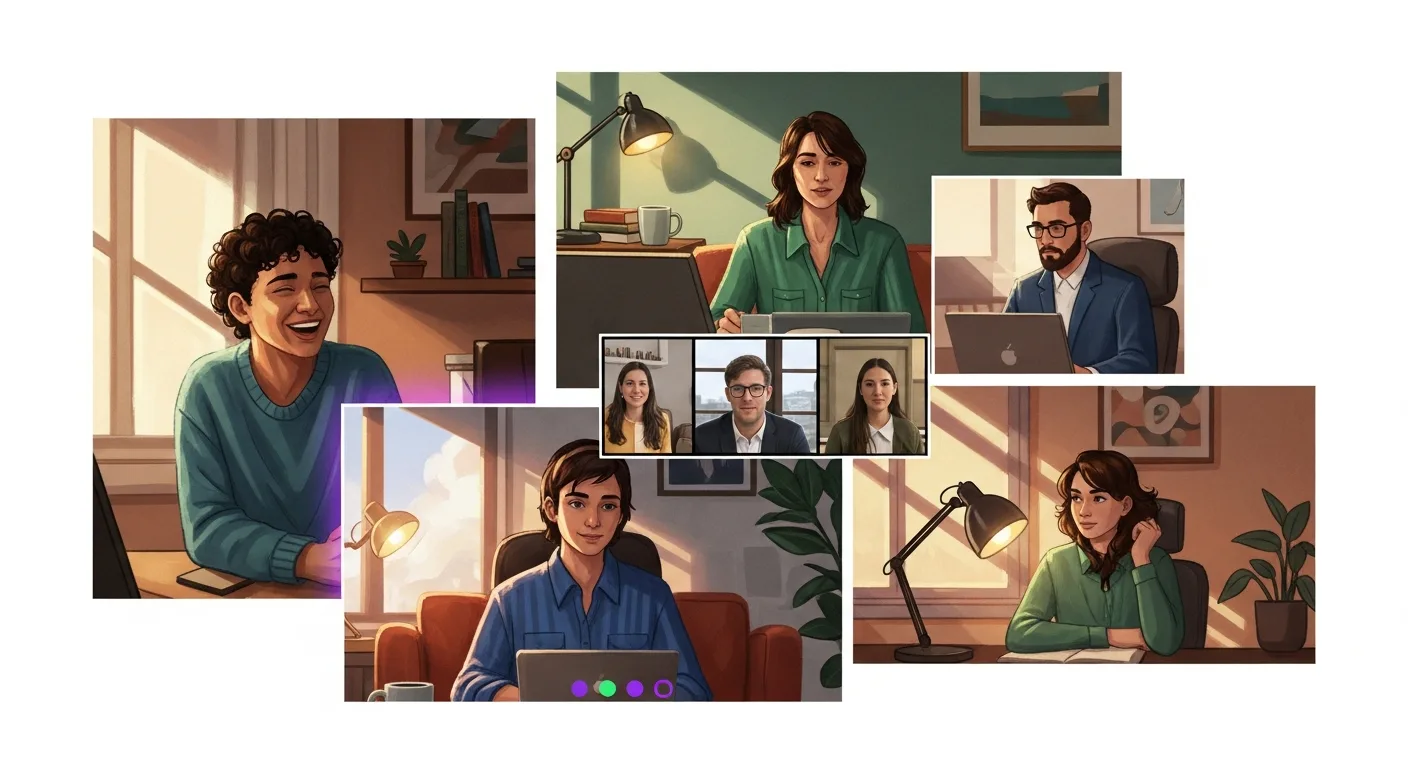
The gap between a remote team building game that generates real engagement and one that produces forty-five minutes of polite grid attendance comes down to three mechanics: narrative, team formation, and a live leaderboard.
Narrative gives distributed players something to care about that exists outside of work. When a team enters the Mayan temple in Last Temple Mystery, they're not answering trivia questions about company values. They're navigating a four-floor expedition as investigators, decoding symbols under time pressure, and arguing about which path through the Storm Floor loses the fewest points. The stakes are fictional and everyone knows it. But the coordination dynamic is real, and so is the memory. We see post-event Slack threads that reference specific moments from the game narrative weeks later: the team that blew the Storm Floor when they thought they had it figured out, the breakout that found the shortcut nobody else noticed. Generic events don't generate those references. Narrative events do.
Team formation is the second differentiator. Most video-call "team building" puts 20-30 people in a Zoom and calls it a team, but coordination in a group that large is noise, not teamwork. Every HeySparko game runs in breakout teams of 4-8 players. Small enough that each person's contribution is visible to everyone else. Large enough that different thinking styles surface naturally. The team that wins isn't the one with the strongest individual players; it's the one whose coordination holds under pressure. We've watched this pattern across hundreds of events: the coordination insight travels back into actual work. The colleague you'd never collaborated with directly, who turned out to be the fastest deduction thinker in your breakout — that's a weak tie that didn't exist before the event.
The leaderboard is what connects all those breakout teams into a single shared experience. Even in async formats, where nobody is live at the same time, the leaderboard updates continuously. People check it between their own play sessions. Slack threads form around score positions. The leaderboard is also what makes the format decision matter so much, because the experience of watching it shift in real time is only available in synchronous play, while the leaderboard-as-social-thread works just as well across time zones and days.
A technology team we worked with, about 320 people spread across four time zones, ran their first structured game event after two years of quarterly Zoom happy hours. Their People Ops lead was direct about the comparison in our debrief: the happy hours had about 40% of the company showing up, and the post-event silence was reliably complete by the next morning. The game event had 74% of the company finish all three stages, and the Slack channel stayed active for five days. The mechanic that changed everything wasn't the game theme. It was the coordination pressure and the leaderboard.
Big Game or Marathon: The Format Decision That Comes First

HeySparko offers two event formats with fundamentally different structures, and the format decision should happen before you discuss game themes. Most mismatched remote events we see weren't badly executed. They were poorly matched to the team's actual structure.
Big Game is the synchronous format: one live 60-90 minute event, every player present at the same time, hosted entirely by a HeySparko Game Host. There's no client MC burden, so your team participates as players, not as producers. The energy of a Big Game is irreplaceable when it works: watching a leaderboard shift in real time while your breakout team debates the final puzzle, the Slack thread exploding when a result posts. Mission 8-Bit and Apocalypse hit especially hard in Big Game format because their urgency mechanics (time pressure, specialist roles, racing finales) require the shared live moment to land with full force. Running Apocalypse's Stage 3 laboratory sequence asynchronously loses about 60% of what makes it work; the tension of the clock running while other teams are already submitting is the point.
Big Game is the right choice when your team fits a genuine shared window, typically a six-hour or smaller time zone spread. US + Western Europe is workable. Anything adding Asia-Pacific into a mix that already spans the Americas, or bridging 8+ time zones, produces a window that disadvantages someone materially. And the social fallout from the half of your team that took a 6am slot to "attend" a fun event is real. It registers in the next engagement survey, not in the event NPS.
Marathon is the asynchronous format: 1-5 days of daily game episodes, released on a schedule, players engaging when their day allows. No mandatory call window. No host required during play. The Tokyo cohort plays at 3pm local; the Austin cohort plays at 3pm local; both contribute to the same leaderboard that runs for the full event duration. In our data, Marathon events at distributed companies see 65-78% completion rates for opt-in events, a figure that holds because the format respects calendars instead of overriding them. We also see roughly 35% more total participants compared to forced-synchronous alternatives: the people who miss live events aren't checked out; they're in a time zone that made the window inaccessible.
The most important Marathon operational variable isn't the game — it's mid-event communication. Events that send a Day 1 launch message and then go quiet underperform events where managers post a brief team-position update at Day 2. Something as minimal as "we're 5th of 12 pods, day two releases in the morning" generates a measurable lift in Day 2 and Day 3 completion. The leaderboard creates pull; the manager creates urgency. Both are necessary.
When to use each format:
- Big Game → shared live window exists, you want the energy of a real-time event, kickoffs or holiday parties where the synchronous moment itself has meaning
- Marathon → 8+ time zone spread, you want to reach people who opt out of live events, quarterly engagement programs where sustained engagement across days beats one 90-minute window
For most distributed teams, the honest default is Marathon. Reserve Big Game for the moments when the shared live experience is specifically the point.
Matching the Right Game to Your Team's Culture

Once format is settled, game selection comes down to two variables: energy level and experience type. HeySparko's catalog divides cleanly into adventures (time-pressured expeditions with urgency and coordination mechanics) and mysteries (deductive investigations where teams reason together toward a collective conclusion). Neither is better — they match different cultural profiles and occasions.
Adventures are the right call when you want energy, urgency, and the shared "we did that together" momentum. Apocalypse is the highest-intensity option in the catalog — a four-stage vaccine race through a city outbreak that puts real time pressure on the team and surfaces coordination patterns that don't come up in day-to-day work. It runs 80 minutes in Big Game format and works as a Marathon across 1-5 days. Best fit for engineering, fintech, and startup teams who handle urgency well; less appropriate for very new teams (under 90 days together) or buttoned-up enterprise audiences where the stakes feel discordant.
Mission 8-Bit is the year-round adventure that works best for kickoffs and quarterly events — the three-stage arc (escape, rebuild, ship the patch) maps so closely onto how technical teams think about project phases that engineering managers keep booking it for Q1. The 8-bit visual style and the post-event sprite sheets become team mementos that show up as Slack avatars months later. For teams with strong gaming culture or nostalgia sensibilities, it's hard to beat.
Last Temple Mystery bridges the gap between adventure energy and deductive structure — a four-floor Mayan temple expedition that demands coordination under pressure but moves more slowly than Apocalypse and rewards observation as much as speed. It scales cleanly from 15-person startups to 10,000-person enterprises, and the international mythology base means it travels without cultural adjustment across global teams. Strong year-round option, particularly for company anniversaries and summer events.
For December events where your team wants something more creative than standard holiday programming, Stolen Hours offers a genre-bending cross-world chase — the team races through postapocalyptic, cyberpunk, steampunk, and biopunk worlds to recover stolen clock hands before Christmas Eve disappears. The Pixar-style art keeps it warm despite the genre palette. Strong fit for teams with genre-fiction sensibilities; pair with Marathon format if international. For teams that want the same exploratory narrative variety without the urgency mechanics, Adventure Through the Ages takes the same cross-world impulse and routes it through historical eras instead, which tends to land better with culturally mixed cohorts that prefer discovery over time pressure.
Mysteries work differently. Instead of urgency, they create deliberation. Teams slow down together, compare evidence, argue about alibis, and arrive at a shared conclusion. The emotional payoff is different from an adventure: not "we did it under pressure" but "we figured it out together." Mystery teams come out more reflective than invigorated.
Wintervald Hotel Mystery is the most enterprise-appropriate game in the catalog — a snow-bound hotel whodunit in a sophisticated Agatha Christie register that works for finance functions, legal teams, and C-suite cohorts. No slapstick, no genre-specific prior knowledge required. When Coca-Cola HBC ran formal corporate events, the mystery deduction format was a consistent choice because it travels across cultures without needing adaptation. Wintervald Hotel Mystery peaks in December and works year-round for anniversaries.
Under the Big Top is the summer-energy companion: same deduction mechanics wrapped in warm vintage-circus atmosphere. A missing performer, a colorful cast of suspects with real depth, a reveal that usually surprises teams who thought they had it solved by Stage 2. It works well for companies with whimsical or culture-strong identities. The Marathon format suits it particularly well — the multi-day investigation rhythm lets teams live inside the mystery, debate theories asynchronously in Slack, and arrive at the finale with more invested reasoning than a 90-minute synchronous event allows.
If you want the event to feel like your organization's rather than a vendor product, the three customization tiers (NPC, Logo, and Story) work as add-ons to any game and either format. NPC inserts your company's voice and inside references into the game's characters. Logo puts your brand through the visual player experience. Story rewrites the narrative arc around a specific company moment: a rebrand, a product milestone, an anniversary chapter. Each tier is a flat add-on; the details and current pricing are on our pricing page. About 15% of HeySparko events use at least one customization tier, and the events that use all three produce the highest post-event engagement in our analytics reports.
Game selection should happen after format, and cultural fit should drive the adventure-vs-mystery call. The most common game mismatch we see isn't a bad game — it's a high-energy adventure game run in async format for a team that needed deliberation, or a sophisticated mystery compressed into a 45-minute Big Game slot that didn't have room for the deduction to land. The container matters as much as the content.
What the Research Says About Remote Engagement
The case for structured remote team building isn't anecdotal, and the research is sharper than the category often gets credit for.
Deloitte's 2024 Global Human Capital Trends report on workplace microcultures found that organizations embracing microcultures are 1.8× more likely to achieve positive human outcomes and 1.6× more likely to achieve desired business outcomes, and that 71% of business and HR leaders say focusing on individual teams and workgroups is the best place to cultivate culture, agility, and fluidity. This framing matters for how you think about team events: a team-level event is itself a microculture intervention. Structured games operated at the team level, with team-specific analytics delivered afterward, are one of the few engagement instruments that operate where the leaders surveyed said the action actually is — at the workgroup level — not the org-wide layer where most programs live and diffuse.
Anog et al.'s 2023 systematic review of 60+ studies (SSRN) found that structured team-building activities consistently increase satisfaction and reduce turnover, with effects amplified when integrated into a broader development strategy rather than treated as one-off events. The academic framing matters here because it addresses the most common objection from Finance: "we ran a game, it was fun, then nothing changed." The research shows effects compound across recurring events. A Marathon per quarter, three quarters in a row, isn't three separate games — it's an engagement program with measurable trajectory, and the trajectory is what produces retention impact.
Microsoft's 2024 Work Trend Index found that 57% of distributed workers prefer asynchronous engagement options over live ones. In our own Marathon data, roughly 35% of completers are people who consistently don't attend live events. When you combine those figures, the implication for budget justification is concrete: a significant segment of most distributed teams will never show up to a synchronous Big Game event. If your only format is live, you're structurally excluding a third of your potential participants before the event launches. Offering both formats is not a preference accommodation — it's the math of distributed engagement.
Deloitte's 2025 Global Human Capital Trends report, drawing on 14,000+ executives and HR leaders across 95 countries, found that 88% of executives now rank belonging in their top three HR priorities. "Belonging" is harder to build than satisfaction — it requires shared reference points that accumulate over time and are difficult to manufacture through org-level messaging. Structured narrative games, run consistently, are one of the few mechanisms that create shared reference points at scale. In the BGaming anniversary event we ran for their ~400-person international team, 23% of their engineering cohort specifically called out the event in the following month's engagement survey free-response — not prompted, not guided, just mentioned because the experience was specific enough to be memorable. That specificity is what belonging is built from.
The financial justification for sustained engagement programs follows directly. SHRM's 2024 cost-per-departure research puts average non-executive replacement costs well into the five figures once recruiting, onboarding, and productivity-ramp time are included. CultureAmp's 2024-2025 State of Culture report found that companies with above-median engagement scores have 31% lower voluntary turnover than below-median peers. A recurring game-based engagement program — quarterly Marathon events for a 200-person team — costs a fraction of a single voluntary departure. It's a retention instrument with a defensible ROI, and the specificity of team-level analytics makes it one of the few People Ops programs where you can show team-by-team data rather than company-wide averages that Finance already treats with skepticism.
The comparison that usually lands cleanest in executive conversations: the cost of a quarterly Marathon for 200 people is less than the cost of losing one analyst. Not the cost of hiring a replacement. The cost of losing the person already in the seat.
Frequently asked questions
How many people can participate in a remote team building game?
HeySparko games scale from 5 players to 10,000 in a single session. Small groups (under 50) get the tight-knit adventure feel where everyone's contribution is visible. Larger groups split into competing breakout teams of 4-8, all chasing the same shared leaderboard. We've run events for 6,000+ employees simultaneously — the Coca-Cola HBC LearnFest 2021 closing event reached employees across 28 countries. The format matters more than headcount for the quality of the experience.
What's the difference between Big Game and Marathon for remote teams?
Big Game is synchronous: everyone plays at the same time in a 60-90 minute live event, hosted by a HeySparko Game Host with no client production burden. Marathon is asynchronous: 1-5 days of daily game episode releases that players complete on their own schedule, no shared window required. Big Game delivers higher shared energy when your time zone spread allows it. Marathon reaches distributed teams across every time zone without forcing anyone into a 6am call, and typically draws in 35% more participants than forced-synchronous alternatives. The right format depends on your time zone spread and whether the synchronous live moment is specifically what you need.
Do participants need to download any software?
No downloads, no account creation. All game activity runs in a standard browser — players join via a link, which matters for teams on corporate-managed devices where IT controls what can be installed. We've run events for enterprise security teams on locked-down device policies without a single IT incident. No app store installs, no plugins, no IT tickets required on the player side. The Game Host manages all the technical orchestration; your team just needs a browser and a calendar block.
How do we pick the right game for our team's culture?
The first decision is adventure vs. mystery. Adventures, like Last Temple Mystery or Apocalypse, are time-pressured expeditions that reward speed and coordination under urgency. Mysteries, like Wintervald Hotel Mystery, are deductive investigations where the team reasons together to a shared conclusion. High-energy cultures, engineering and fintech teams, and kickoff contexts tend to land better with adventures. Enterprise, formal, or mixed-seniority groups often prefer the sophistication of a mystery. Culture is a stronger predictor than company size.
How long does it take to plan a remote team building event?
For a standard Big Game or Marathon with no customization, ten business days is a comfortable minimum. We've run tighter timelines for urgent situations, but ten days allows proper pre-event communication and logistics setup. Customization requires more lead time: Logo branding needs 7 days, NPC character work needs 14 days, Story narrative rewriting needs 21 days. For company-wide events over 500 people, two weeks is the minimum to ensure pre-event communications don't feel rushed. December events, especially the first two weeks, book out weeks in advance because multiple companies are scheduling for overlapping windows.
How do we measure whether a remote team building event actually worked?
HeySparko delivers an analytics report within 24 hours of the event: participation rate, team-by-team engagement breakdown, coordination metrics by game stage, and a post-event NPS pulse. For pre/post impact measurement, pair the event with a three-question engagement pulse sent before and five days after. The metric that most surprises HR Leaders is the by-team breakdown — it usually shows workgroup-level variance that company-wide survey averages obscure. As Deloitte's microcultures research found, 71% of business and HR leaders say focusing on individual teams and workgroups is the best place to cultivate culture; the team-level analytics from a game event are one of the few mechanisms that make that workgroup variance visible in a non-threatening context.