
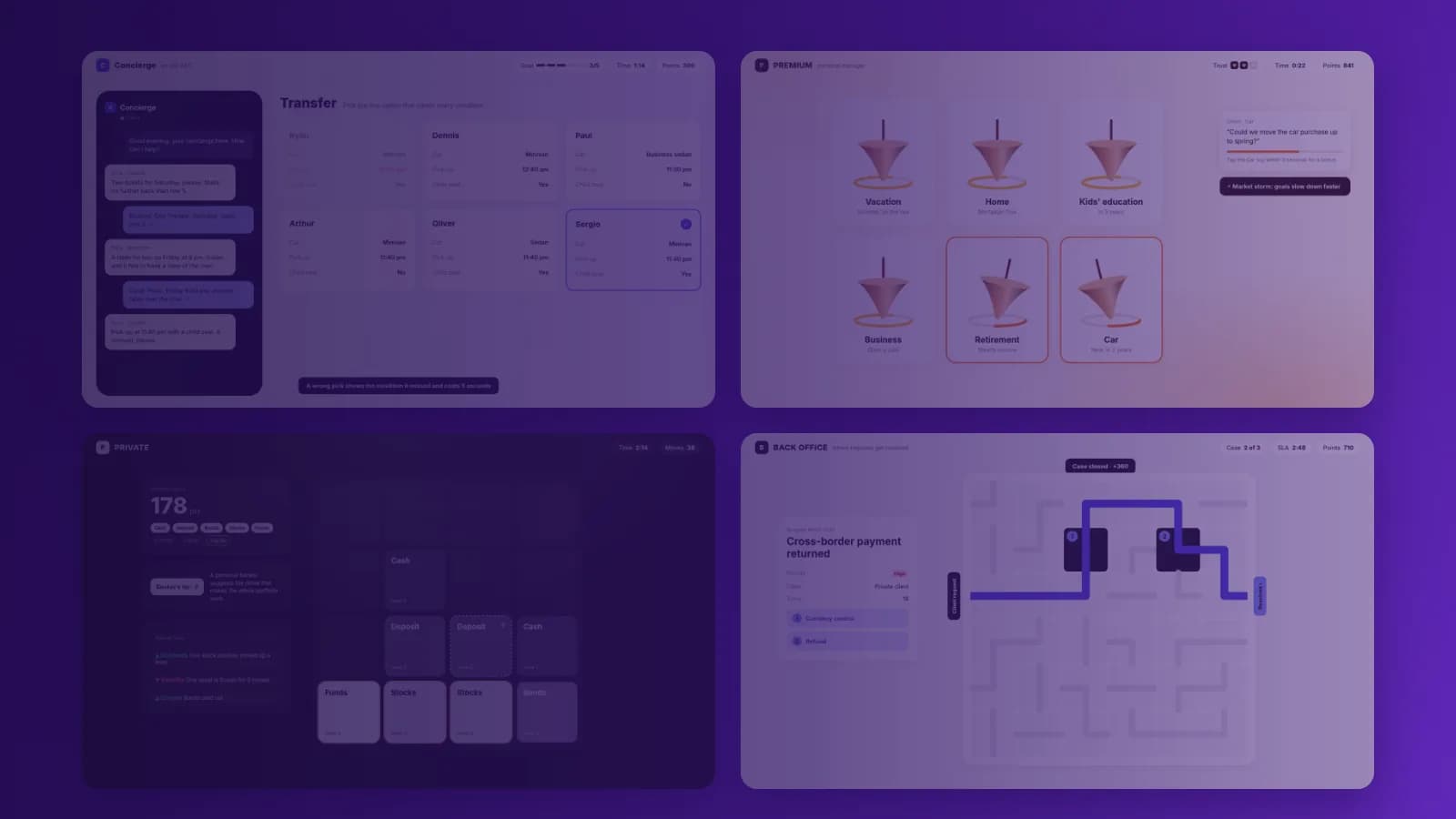

"We have four departments, each with its own birthday, and they do completely different things. We need one event, but everyone has to see themselves in it."
That was the brief from a top-5 consumer bank. The client's name stays under NDA.
- Client: a top-5 consumer bank
- Audience: 2,500 employees across four departments
- Occasion: the birthdays of four departments
- Format: solo Async Marathon, open for 32 hours across two working days
- Built from scratch: 4 browser games that did not exist before
- Brief to launch: 4 days, including all four games
How do you run one team building event for departments whose work has nothing in common? You stop looking for a shared theme and build each department its own game, then put all four in one event.
The challenge: one occasion, no common language
The four departments were Concierge, Premium, Private and Back office. Concierge finds the one option that fits a client's long list of conditions. Premium juggles several of a client's financial goals at once. Private grows and consolidates a client's assets over years. Back office pushes each request through a chain of checks before anything moves.
They shared an occasion, but not much else. A standard trivia night or escape room would have landed with nobody in particular. Each department would have played a game about someone else's world, or about no world at all.
There was a second constraint. Most of the 2,500 people work on client lines. The bank could not pull them off shift for 90 minutes at the same time, so a single live session was out from the start.
What we built: a two-day solo marathon of four department games
We ran the event as a solo Async Marathon: one link, open from 10 am on day one to 6 pm on day two, played from a phone or a laptop whenever someone had a free few minutes. Each game takes 90 seconds to three minutes, with a short rules briefing before it. All four fit into about 15 minutes. No install, no scheduling, no one leaves the queue.
Every game feeds the same marathon leaderboard: the faster and more accurate you are, the higher you climb.
The core of the project was four new games. Each one turns a department's real job into a game mechanic.
| Department | What they do at work | What they do in the game |
|---|---|---|
| Concierge | Find the one option that meets every condition a client sets | At Your Service. Six cards, one right answer: pick the only option that passes every condition. Five requests in 90 seconds. |
| Premium | Balance several client goals at the same time | Keep Them Spinning. Each client goal is a spinning top. Keep them all spinning for 75 seconds while you answer incoming messages within three seconds. |
| Private | Grow and consolidate a client's assets | Compound Interest. Merge matching assets to climb a ladder toward the highest status. Two and a half minutes. |
| Back office | Route each request through a chain of checks | Behind the Scenes. Rotate tiles to build a request's route through every verification stage. Three minutes for three cases. |
Each department got a game that reads as its own job, sped up and made playable. Everyone could play all four.
Concierge: At Your Service
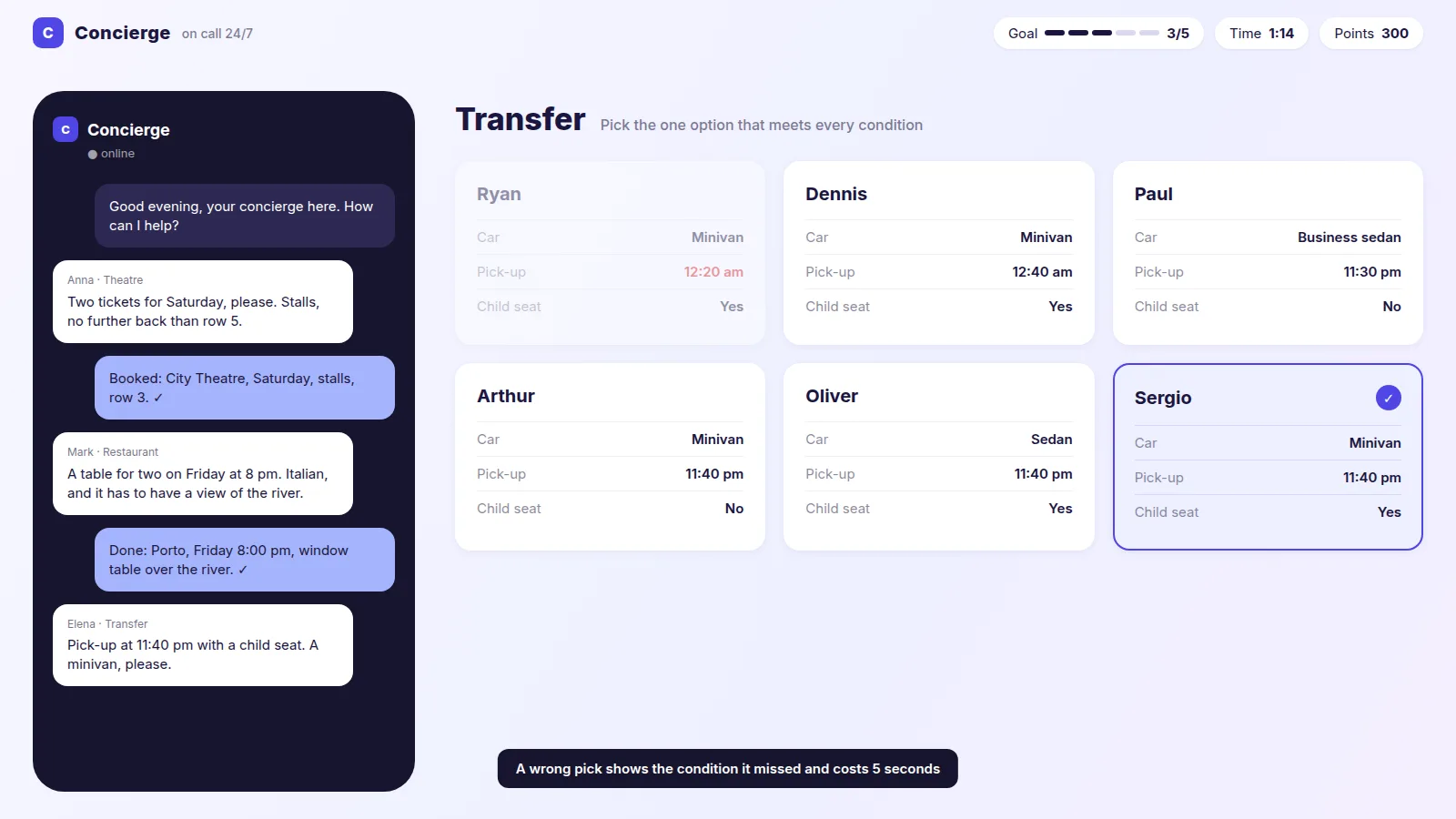
Clients write to the concierge: a table by the window, a hotel that welcomes dogs, two seats in the stalls. The player reads the request and picks the one card out of six that passes every condition. A wrong pick highlights the condition it missed and costs five seconds. Five requests in 90 seconds wins the shift.
Premium: Keep Them Spinning
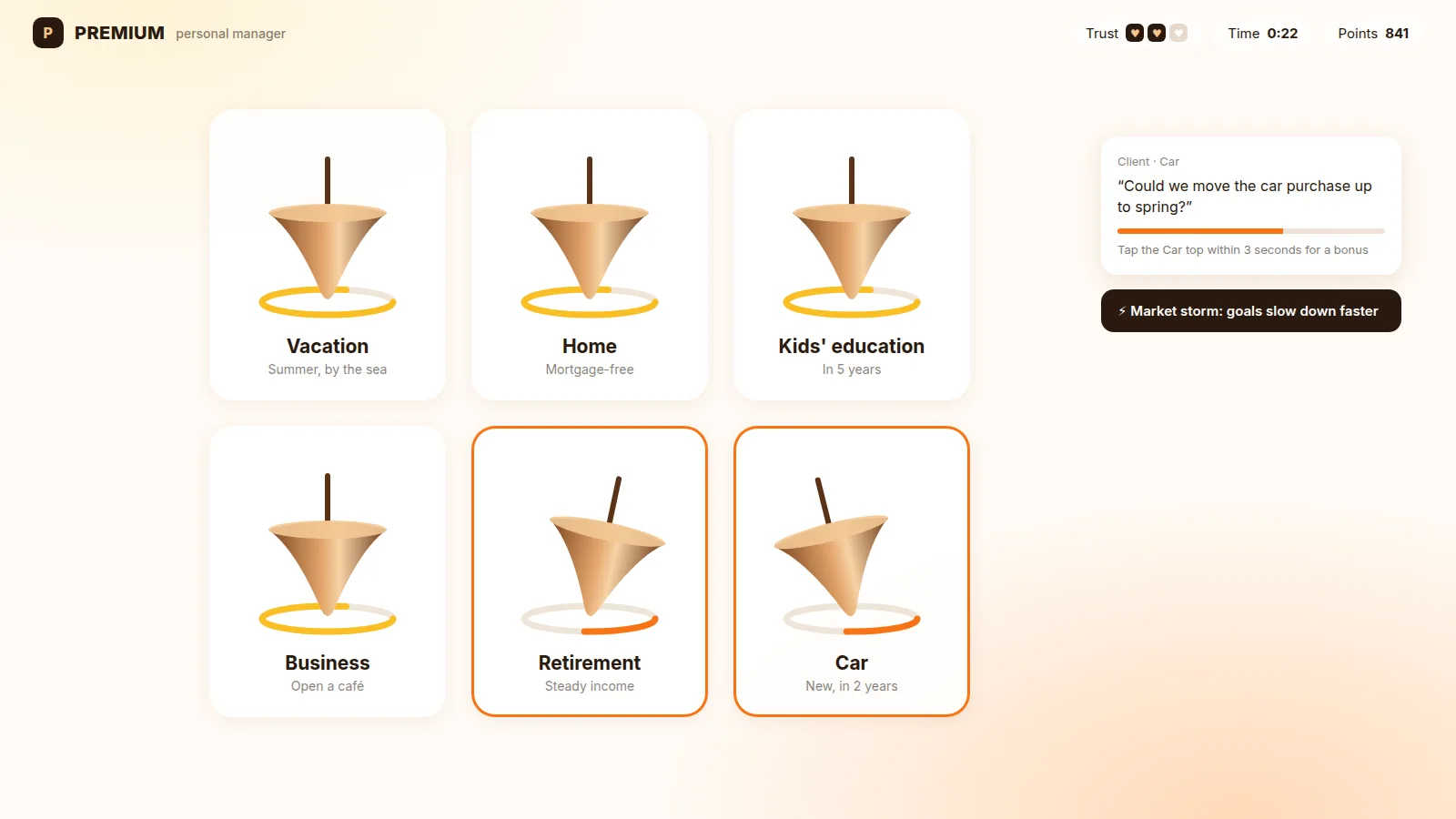
The player is a personal manager. Each client goal (a vacation, a home, a child's education) is a spinning top that keeps turning only while someone looks after it. It starts with one goal and grows to six. At the 50-second mark the market turns stormy and every top slows down faster. When a client writes, tapping their top within three seconds earns a bonus. Three dropped goals and the shift is over.
Private: Compound Interest
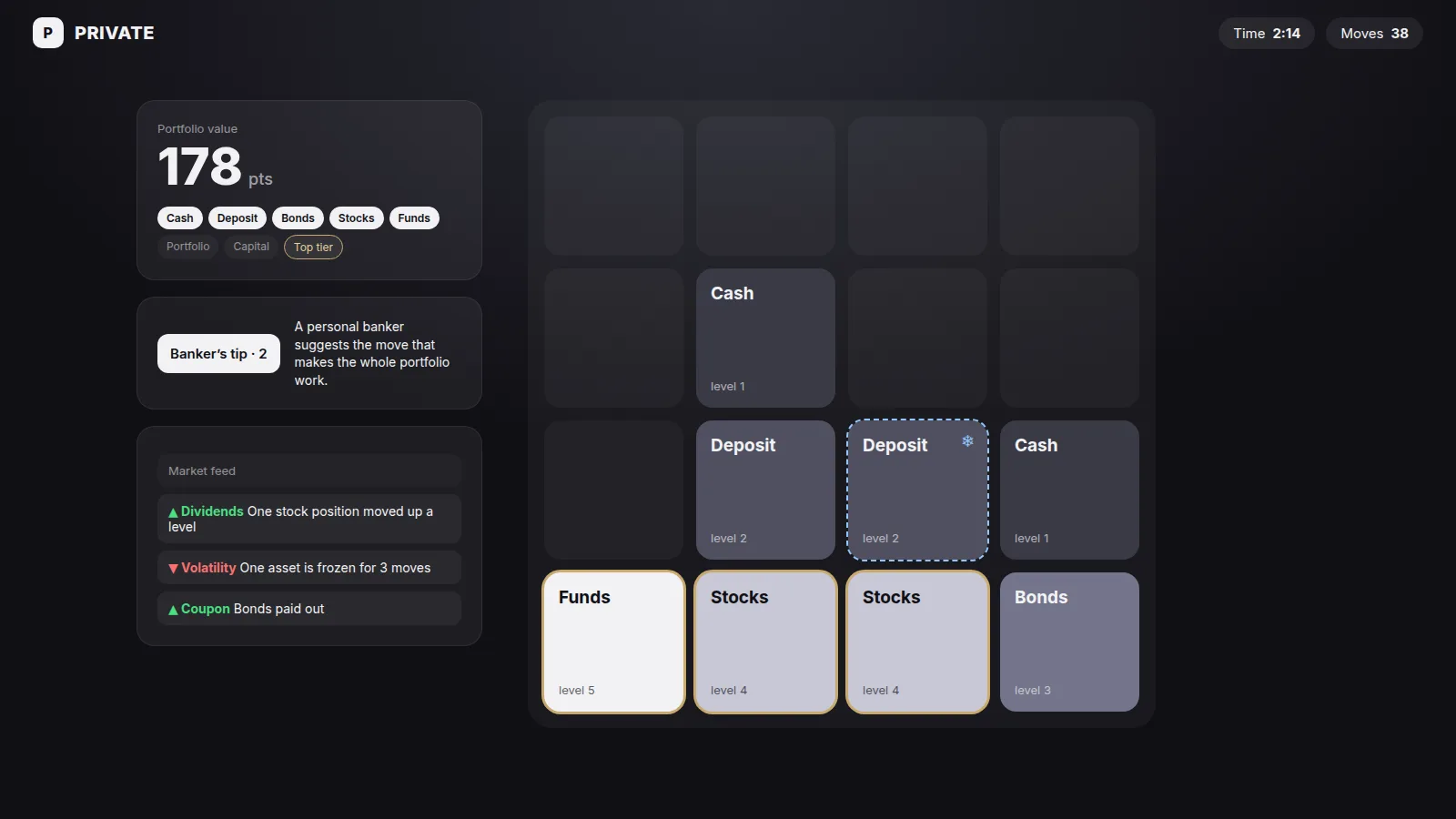
Capital grows when assets work together. Players swipe or use the arrow keys to slide every asset on the board, and two matching assets merge into the next level, from cash and deposits up through bonds, stocks and funds to the top tier. A market feed keeps things moving: dividends lift an asset, volatility freezes a tile. Two banker's tips suggest the best move. The goal is the top tier in two and a half minutes.
Back office: Behind the Scenes
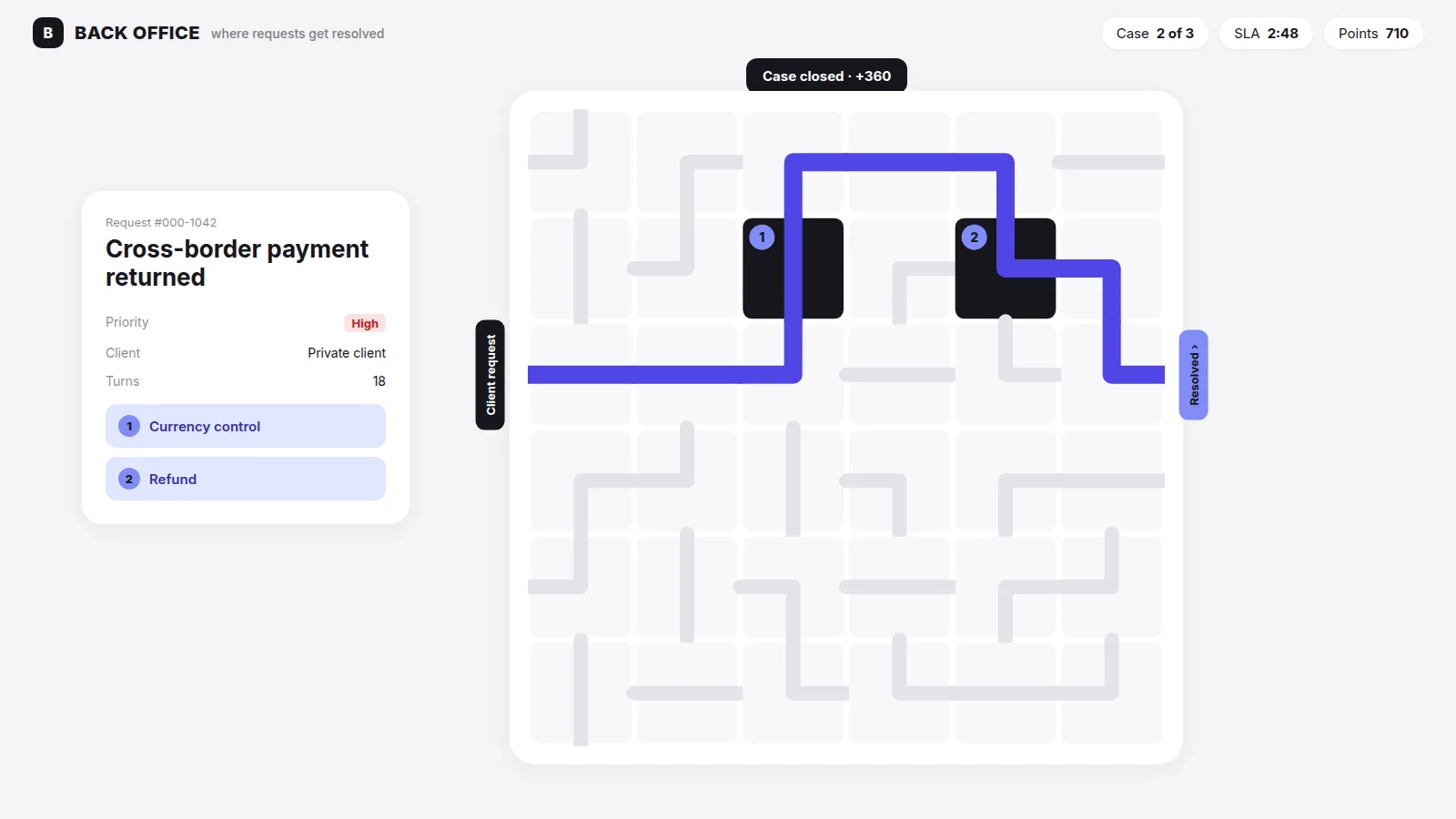
The client only ever sees a short "Done". Behind it, the request goes through checks, approvals and reconciliations. Players rotate tiles to connect "Client request" on the left to "Resolved" on the right, and the route has to pass through every numbered stage of the case. Three cases of rising difficulty, all before the SLA runs out. Fewer turns earn more points.
Screens recreated in English with neutral styling for this case study. The original games ran in the client's own branding and language.
The whole build took four days, from brief to launch, including the four games, the marathon shell and the leaderboard. Prizes went to the top players once the marathon closed.
What it changed: two minutes inside another team's job
The occasion was the birthdays. The effect was something else: for many employees, it was the first time they saw a neighboring department's work from the inside.
Two minutes of Behind the Scenes explains why a request takes a while to clear back office better than a slide on process does. Back office players who tried At Your Service got a feel for what goes into the requests that land on their desk. Nobody had to sit through a presentation to get there.
The format did its part too:
- Nobody left the client lines. People played in their own free minutes across two working days, not in one blocked-out slot.
- Reach covered the whole audience. All 2,500 employees in the four departments had access from any device.
- A shared leaderboard and prizes gave the four departments one competition to talk about, even though each played a different home game.
Why a bespoke build, not a catalog game
A catalog game is a good fit when the goal is to bring people together around something fun. This client needed every department to recognize its own work, and that's a job only a new game can do.
What made it possible in four days is that we don't start from zero on the platform: the marathon format, the leaderboard, avatars, analytics and the no-install browser player already exist. The new work went into the four game mechanics, so that's where the four days went.
If your company has teams that rarely see each other's work, the same approach scales. One game per team, one shared event, played in the gaps between real work. See how custom builds work, or look at the Marathon format the event ran on.
Frequently Asked Questions
Can you really build a new game in four days?
Yes, when the game is a short browser mini-game running on our existing platform. In this project, the marathon shell, leaderboard, avatars and analytics were already in place. The four days went into designing and building four game mechanics, each 90 seconds to three minutes long, plus testing and launch. Larger story-driven games take longer, and we scope the timeline on the first call.
Why build a separate game for each department?
Because the departments did very different work, and the client wanted each of them to see itself in the event. A single shared game would have been about nobody's job. Four games, each based on one department's real work, gave every team its own game, and the shared marathon let everyone try the other three.
How do you run team building for people who can't leave their posts?
Run it async. In this project, the marathon stayed open for 32 hours across two working days, and each game took three minutes or less, so people played between client calls instead of in one scheduled session. Nobody had to be pulled off the line, and the whole 2,500-person audience could take part on their own schedule, from a phone or a computer.
Can the games carry our branding instead of yours?
Yes. Bespoke games can be fully branded with your logo, colors and internal terms, or kept neutral if the event needs to stay internal. In this project the games used the client's own department names and work scenarios, which is what made them recognizable to the players.
Have teams that rarely see each other's work? Tell us about them →