
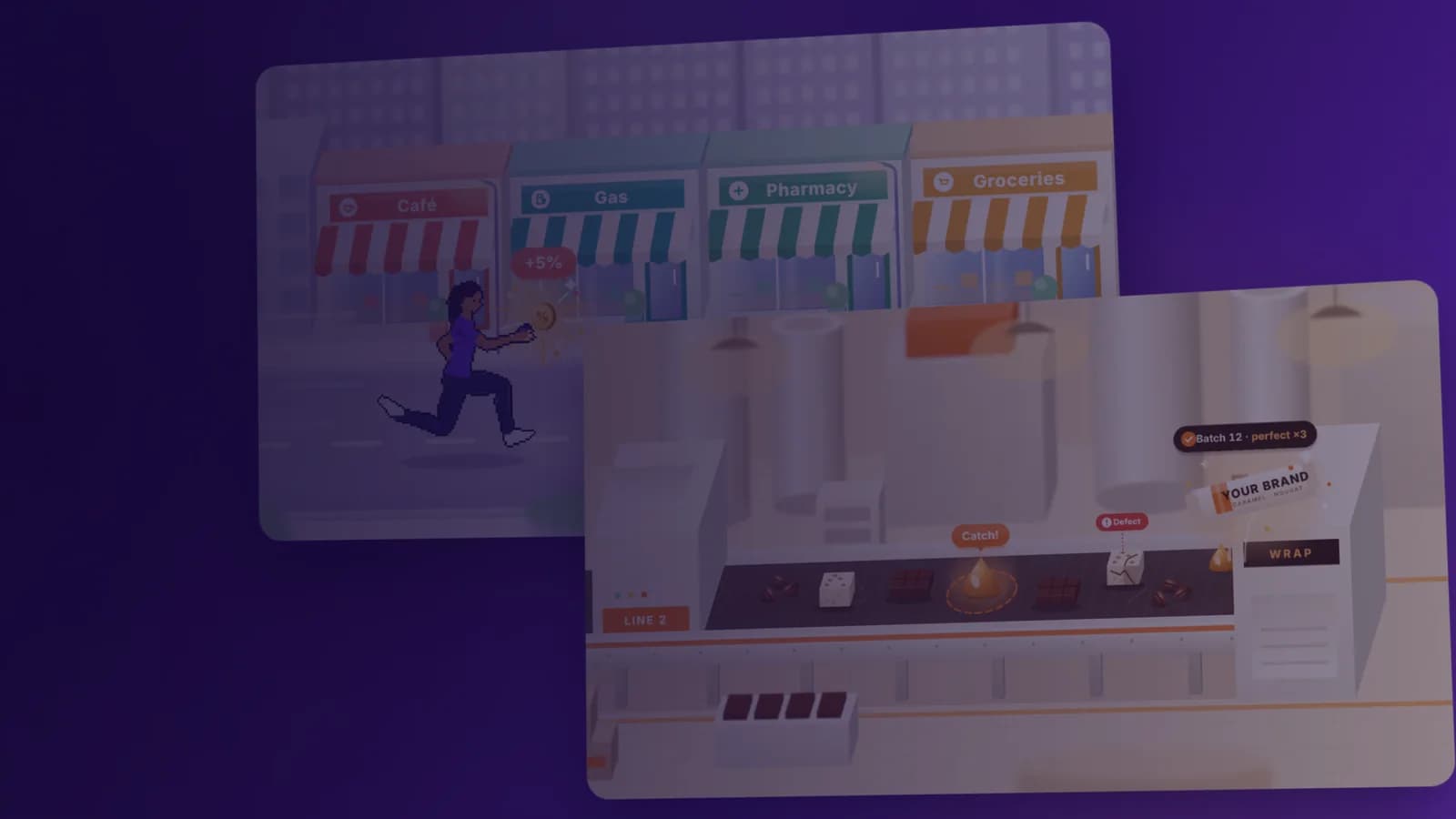

For years we have built short browser games for employees: marathons, onboarding, events for companies with thousands of people. The same engine works outside the company. A game can explain a product faster than a product page, and it can tell a brand something about a visitor before they ever fill in a form.
Here are two of those games: a cashback game for a retail bank and an on-pack promo for a snack brand.
How can a bank or a consumer brand use a short browser game to explain a product and collect first-party data? Put the game where the decision happens, on the product page or on the pack, and let people play before you ask them for anything.
A bank: "Your money in 90 seconds"
The client
A retail bank or a neobank with four to six products: a cashback card, a savings account, investing, a loan, insurance. It has an acquisition budget and a separate problem with activation.
The problem
- The product page doesn't convert. People come to look at a card, read three paragraphs about cashback categories and leave. A benefit you have to calculate doesn't land when you just read about it.
- New customers don't use what they signed up for. They open the card, never turn on their categories and never hear about the savings account. The bank pays for acquisition and misses lifetime value.
- Traffic is expensive and bounces fast. The bank pays for the click and gets 40 seconds.
- Before the application, the bank knows nothing about the visitor except the UTM tag.
What we build
Four mini-games of 60 to 90 seconds each. Each one explains one product by letting people do it instead of reading about it. They sit right on the product page and play without sign-up.
| Game | Product | What the player does | What they take away |
|---|---|---|---|
| Cashback Run | Cashback card | Runs down a street catching purchases: café, gas, pharmacy, groceries. Each category pays a different rate, the same rates as the real card. | Where the card pays more, and why choosing categories matters |
| The Cushion | Savings account | Life happens: the car breaks down, a vacation, a doctor's bill. The player splits money between spending and saving and sees if the month holds. | Why an emergency fund matters, without a word about interest rates |
| Hold the Line | Investing | The chart jumps around and the player has to resist selling on the dip. After 60 seconds it shows how sellers did against holders. | What volatility feels like, not just what it means |
| The Ladder | Premium package | Merges matching assets to climb a ladder of status levels. | How saving up works and what the next tier gives |
The lead game is Cashback Run. It's the most visual of the four and the closest to what banks actually sell.
The player's path
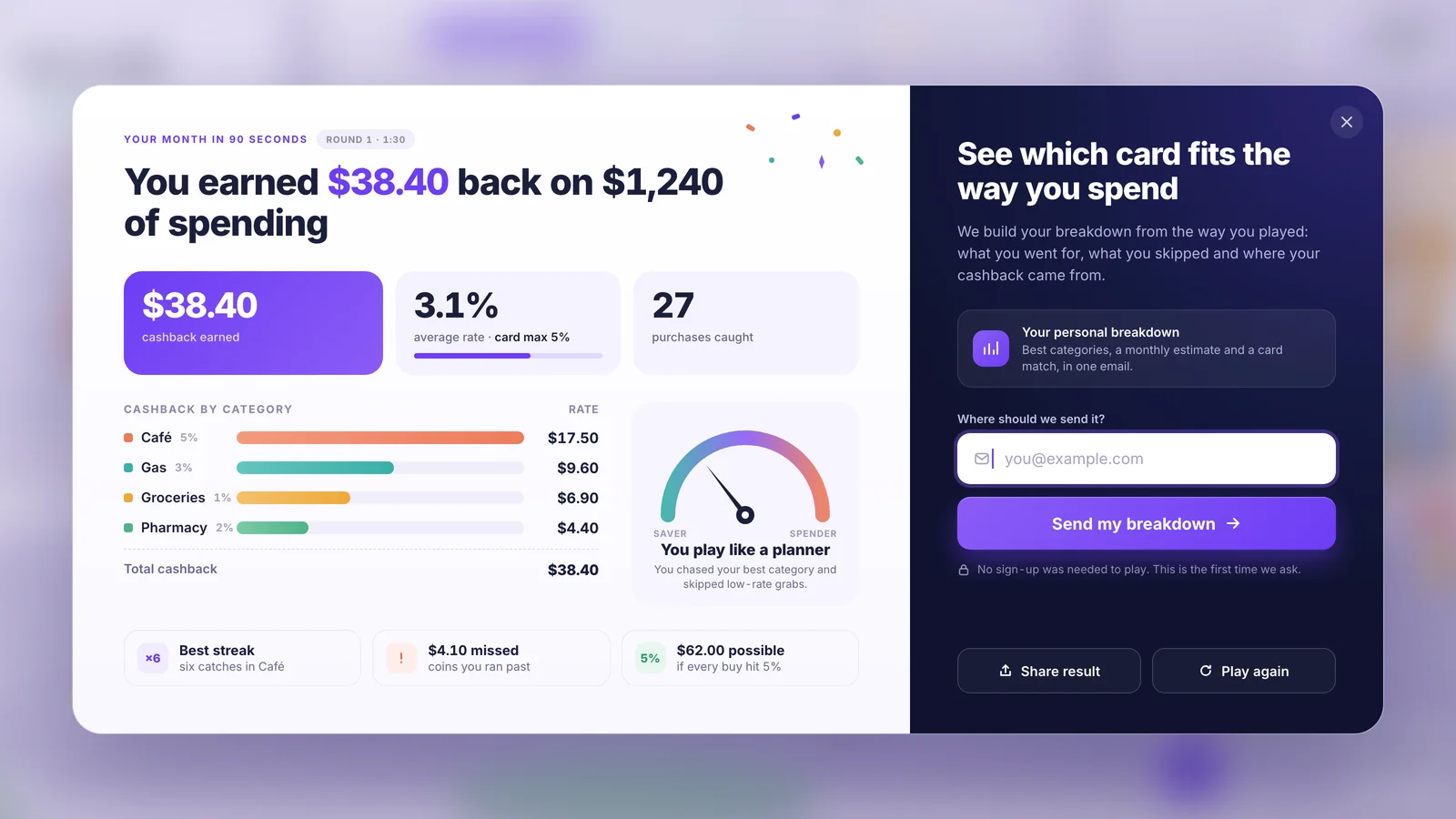
A visitor arrives from an ad and sees the game on the first screen. They play without signing up. At the end they get their score and one question: want to see which card fits the way you spend? Only now does a contact field appear, after they've already got something out of it. Leave an email and get a personal breakdown, because how someone plays shows whether they lean toward saving or spending.
The point of the design: people reach the product through their own behavior, not through a sales pitch. The breakdown at the end isn't an ad. It's the result of their own game.
What makes it feel premium
This isn't pixel art. Retro works for employee events because it's nostalgic. On a bank's website it reads as cheap. Instead: clean 2.5D scenes, soft gradient light, a slight depth of field in the background, and the bank's own palette plus one accent. The mood of a calm, premium mobile game, not an arcade.
- No hard cuts. Every screen change is animated.
- Numbers count up instead of appearing. Score, cashback and balance tick up and slow down toward the final value.
- Easing everywhere. Objects have weight and inertia, and nothing moves in a straight line at constant speed.
- Every catch has feedback: particles, a slight camera squeeze, a tone that rises as the streak grows, and haptics on phones.
- 60 frames per second. Without it, nothing else on this list matters.
- An original score whose layers come in as the streak builds, not stock sound effects.
- The bank's typography, with the same fonts, corner radii and spacing as its website. The game should look like part of the product, not a widget on top of it.
- The final screen is an infographic, not a "Game over". It's something the player wants to share.
What we measure
Before launch we agree on targets with the bank, then instrument every game and report how it performs against them.
| Metric | Typical product page | Target with the game |
|---|---|---|
| Time on page | 40–60 seconds | 3+ minutes |
| Completion | Not measured | 60%+ of players finish |
| Click-through to application | 1–3% | 8–15% of players who finish |
| Contact left | Low single digits | 25–35% of players who finish |
| Return visits during the promo | Almost none | 2+ sessions per player |
| Played two or more games | — | 40%+ |
And one benefit worth saying out loud: for the first time, the bank gets behavioral data on a visitor before the application.
A snack brand: an on-pack promo with a daily game
The client
A mass-market snack or beverage brand: a chocolate bar is the classic example, with codes under the wrapper. It sells through retail, has no direct contact with the buyer, and spends on code promotions every year.
The problem
- Few codes get entered. A typical "enter a code for a chance to win" promo activates a few percent of the packs sold, and nothing happens after the code goes in.
- No first-party data. The retailer knows the buyer. The brand doesn't.
- The brand doesn't stick at the shelf. The decision takes three seconds.
- People don't cross over to other products. Someone buys the same item for years.
- Nothing holds attention between purchases.
What we build
A promo where the code is the start of a habit, not a lottery ticket.
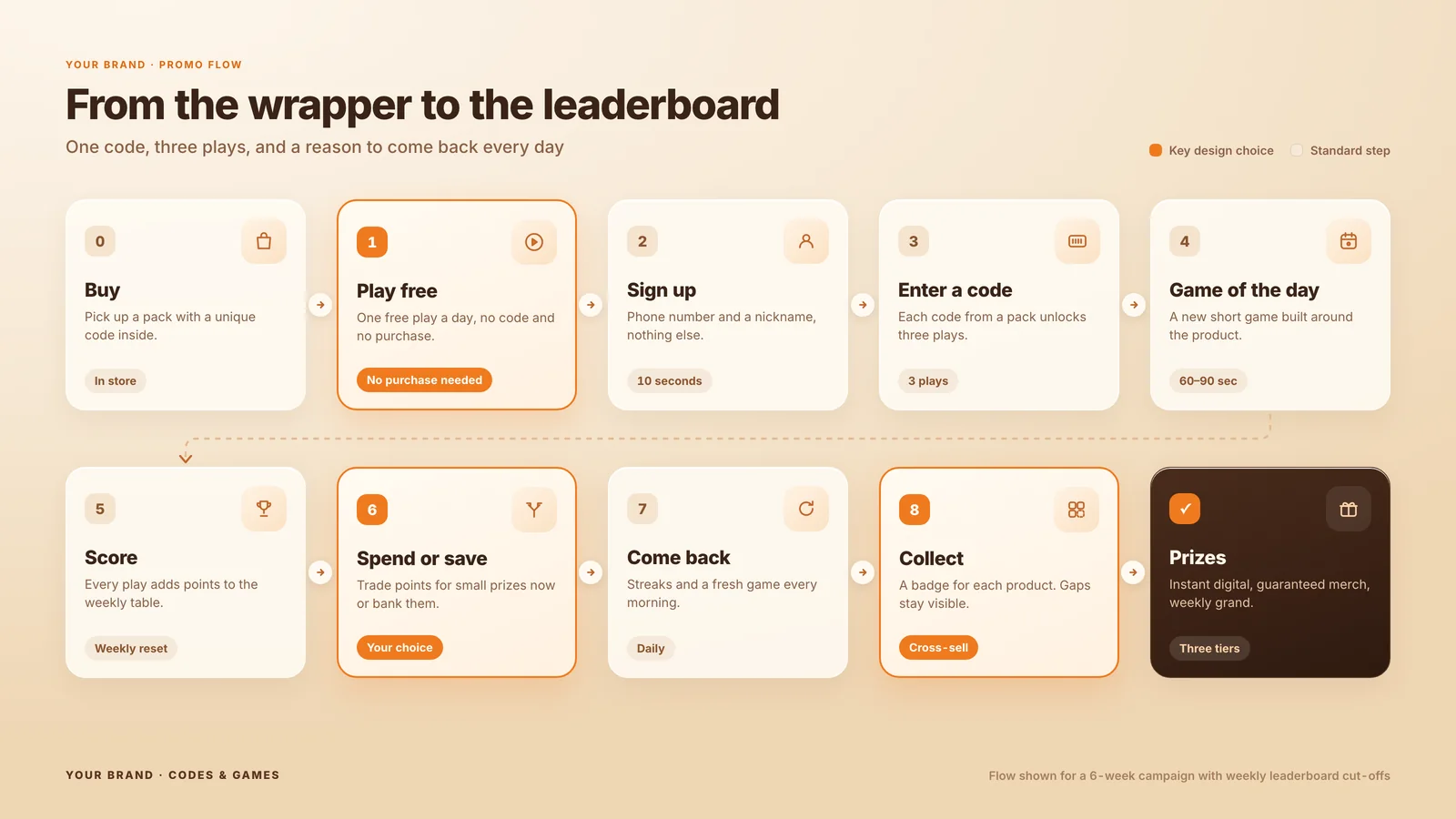
- Buy. A code under the wrapper, a QR code and a short link on the pack.
- Play free. Anyone can play right away, with no sign-up and no code: one game, one try a day, and points don't count. This is the top of the funnel and, more importantly, a legal requirement (more on that below).
- Sign up. A phone number confirmed by a text-message code, and a nickname for the leaderboard. We ask for name and address only when someone claims a physical prize.
- Enter a code. One code gives three plays, and plays don't expire.
- Game of the day. Three games rotate daily, so there's a reason to come back tomorrow.
- Score. Points go to the player's account and to a weekly leaderboard.
- Spend or save. Take an instant prize now or save up for a bigger one. Making that choice is what keeps people around.
- Come back. A free play every day and a weekly leaderboard reset, with a reminder on reset day.
- Collect. A code from each product unlocks its own badge, and collecting the whole line wins a separate prize. That is cross-selling built into the game.
| Game (60–90 seconds) | What the player does | What it sells |
|---|---|---|
| Factory Run | Catches ingredients in the right order as the belt speeds up. A wrong catch is a defect. | What's inside and how it's made, without a line of label copy |
| Shelf Sprint | Stocks a store shelf by merchandising rules in 30 seconds | Pack recognition: the player looks straight at the packaging for 30 seconds |
| Recipe of the Day | Builds a dish from the brand's products, following a hint | Cross-selling: people discover the rest of the line |
The lead game is Factory Run. It has lots of objects on screen and real physics, so the production quality shows immediately.
The player's account
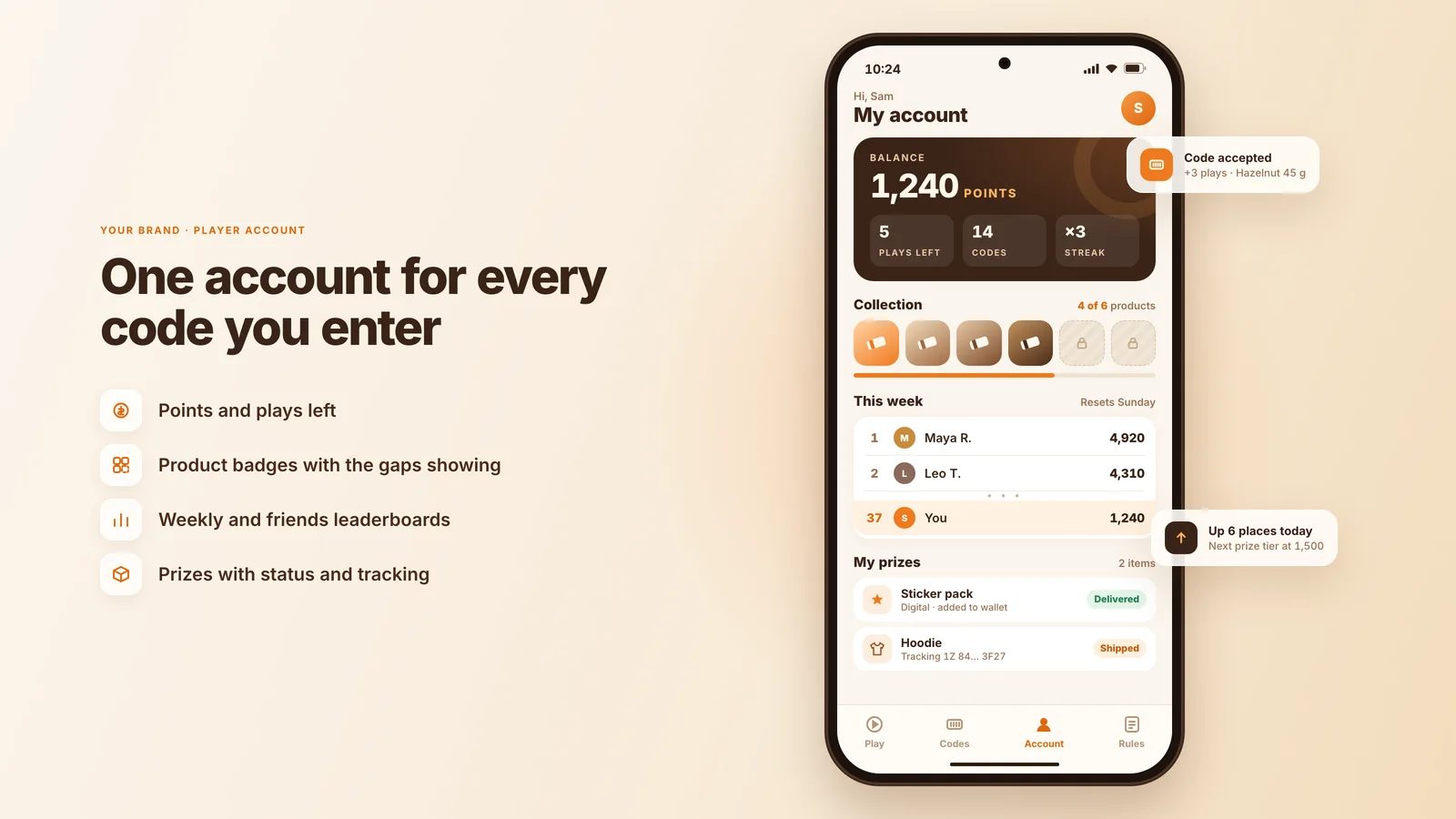
Points and plays left. A history of entered codes. A badge for each product, with the missing ones showing. An overall leaderboard, a weekly one, and one just for friends via a referral link. Prizes with their status and tracking number. The full promo rules.
A referral earns a play for each friend who gets as far as their first game, not just for signing up. Rewarding sign-ups alone invites fraud.
Three prize tiers
- Instant digital prizes. A partner promo code, a sticker pack, wallpapers. They unlock automatically at a threshold, with quotas set in advance. People need to win something on day one, or they won't come back.
- Guaranteed prizes for saving up. Merch. Reach the threshold, claim it in the account, enter an address. It's guaranteed, not a draw, and that keeps the players who don't top the leaderboard.
- Grand prizes. Weekly prizes by leaderboard and a final one. The cutoff time is fixed, the table is snapshotted, and the top players are checked by hand before anything ships.
The legal detail that usually shows up late
In most jurisdictions, a promotion with a chance-based prize has to offer a way to enter without buying anything. That's why the free daily play in step 2 isn't only there for retention. It's how the promo stays legal. We build it in from day one instead of reworking the promo right before launch.
Fraud protection, in short
A promo doesn't get past the client's lawyers without it.
- Codes are generated cryptographically, not in sequence, with a checksum inside so an invalid code is rejected before it reaches the database. Each code is tied to one account forever. Code entry is rate-limited, with a CAPTCHA after that.
- Accounts need a verified phone number: one number, one account. Devices are fingerprinted, and matching shipping addresses go to manual review.
- Scores aren't sent by the player's device. The device sends a stream of game events, and the server recalculates the result itself, which stops the most common way to cheat. On top of that, plausibility checks flag scores above what's physically possible, reactions faster than a human, and perfectly even timing.
- Audit: a log of every action in the promo period, a leaderboard snapshot at every cutoff, and a report on every prize issued and why.
What makes it feel premium
The same principles as the bank game, in a brighter register: the packaging style carried into a game scene. The product is in the frame as an object, not a logo in the corner. No stock art: every scene is drawn for the brand.
What we measure
As with the bank, we agree on targets with the brand before launch and report against them.
| Metric | Typical code promo | Target with the game |
|---|---|---|
| Codes entered, as a share of packs sold | 1–3% | 5–8% |
| Sessions per participant | 1–2 | 4+ |
| Players who play without a code | No such option | 25%+ of all players |
| Players entering codes from two or more products | Not measured | 30%+ |
| Opt-in contact base | Depends on the promo | Counted and handed to the client |
| Average time with the brand | Seconds at the shelf | Minutes per session |
The last row is the one a marketing director cares about most. Consumer brands almost never get to buy minutes of attention. They buy impressions.
Both games live inside your app
Today most consumer engagement happens in a brand's mobile app, not on its website. For a bank, the app is the main channel and often the only one. For a consumer brand, it's a loyalty app or a promo page opened on a phone.
We don't build mobile apps. We don't make native apps, ship to the App Store or Google Play, or take over a client's release cycle. And none of that is needed. The game runs in the browser, so it opens inside the client's app as a web view. There's nothing to download, no app-store release, and updating the game doesn't require an app update. We don't build you an app: we live inside the one you already have.
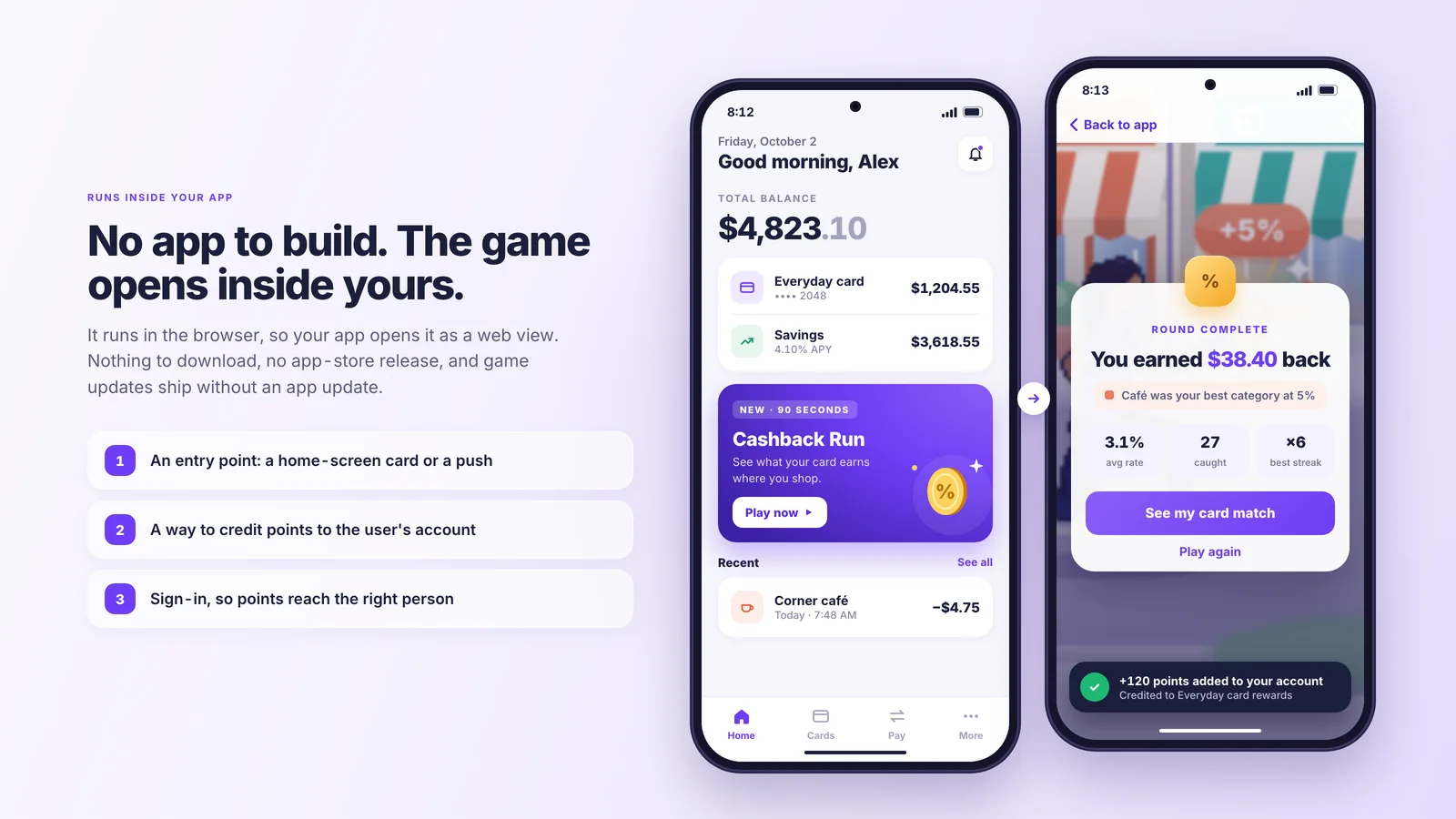
What we need from the client:
- An entry point: a card on the home screen, a loyalty tab or a push notification.
- A way to send the result back, usually by crediting points to the account the user already has.
- User identification, so the points reach the person who played.
It's the same setup as plugging our employee games into a company portal. Outside, it's the client's app and loyalty program. Inside a company, it's the intranet and the internal rewards store. We build it as one mechanism for both.
Product names, rates and figures on the screens are examples.
If you want to see how we build games around a specific job rather than from a catalog, read the four-departments case, or see how custom builds work.
Frequently Asked Questions
Do people need to download anything to play?
No. Both games run in the browser. On a website they sit right on the product or promo page. In a mobile app they open as a web view inside the app the customer already has, so there's nothing to install and no app-store release. Updating the game doesn't require an app update either.
How do you know whether the game is working?
Before launch we agree on targets with the client: time on page, completion, click-through, contacts left, return visits. Every game is instrumented from day one, so the client sees each of those numbers against its target, along with the behavioral data from every session.
Why let people play the promo game without a code?
Two reasons. It's the widest part of the funnel, because people try the game before they buy. And in most jurisdictions a promotion with a chance-based prize must offer a way to take part without a purchase. The free daily play covers that from day one, so the promo doesn't need reworking right before launch.
How do you stop people from cheating on the leaderboard?
The player's device never sends a final score. It sends a stream of game events, and the server recalculates the result on its own. On top of that, plausibility checks flag impossible scores, inhumanly fast reactions and suspiciously even timing. Codes are cryptographic and tied to one account, accounts need a verified phone number, and top players are checked by hand before prizes ship.
What does the game need from our existing systems?
Three things: an entry point (a page, an app card or a push), a way to credit the result to the user's account, and user identification so the result reaches the right person. If the app or loyalty program can't accept results from outside, we'll tell you on the first call what would need to change.
Want to see what a game could do for your product page or your next promo? Tell us about it →