
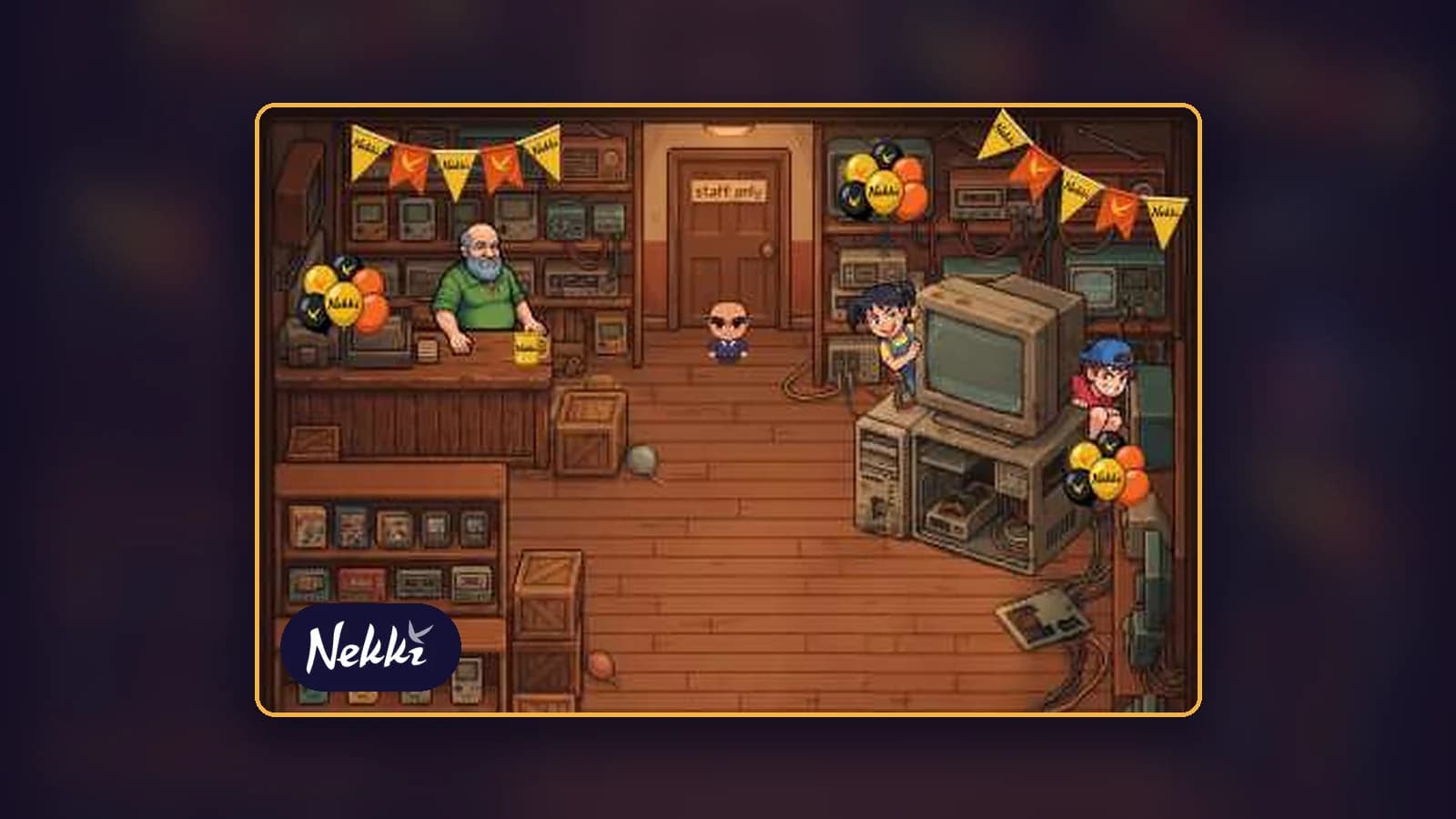

Game developers accept a team game only when nothing in it is generic, because spotting a shortcut is their job. For its 24th birthday, the international game studio Nekki ran a hosted online game we rebuilt around the company itself: their own office as a game location, their characters walking through it, their in-jokes turned into puzzles. 240 people played in 30 teams, 88% of those invited joined, and the event produced zero support tickets.
- Client: Nekki, an international game development studio
- Occasion: the company's 24th birthday
- Format: live online event, hosted by our game host
- Game: Mission 8-Bit, rewritten around Nekki
- Customization: all three layers, logo, characters and story
- Result: 240 players, 30 teams, 88% of invited staff joined, 0 support tickets
Why is team building hard for game developers?
Because the audience makes the product. People who design levels, write quests and balance puzzles for a living see how a game is built while they play it. A stock escape room with a logo in the corner is noticed in the first thirty seconds and mocked in the company chat by minute two. A quiz feels like homework. And "let's play something together" is a harder sell to a studio than to any other company, because playing is what they already do all day, only better produced.
Nekki's brief came down to one requirement: whatever we ran had to survive the scrutiny of people who would know exactly where we had cut corners.
What did we build for Nekki's anniversary?
We started from Mission 8-Bit, our arcade adventure, and rewrote it around the company:
| Layer | What it became for Nekki |
|---|---|
| Location | Nekki's own office, rebuilt as a pixel-art level players walk through |
| Characters | Nekki's characters, inside the game world |
| Puzzles | The studio's in-jokes, turned into tasks only an insider solves quickly |
| Mini-games | The arcade classics their team grew up on, woven into the levels |
| Ending | A closing screen thanking Nekki for a happy childhood |
The ending matters more than it looks. A line like that can only be written for a company you have actually read about, and the room knows it. That is the difference between a branded template and a game made for one team.
What were the results?
| Metric | Result |
|---|---|
| Players | 240 |
| Of those invited, joined | 88% |
| Teams | 30 (about eight players each) |
| Support tickets during the event | 0 |
Two numbers are worth reading together. 88% turnout from a team that is professionally sceptical of games says the event was something people chose to attend. Zero support tickets across 240 players says the entry was a link in a browser and nothing else: no install, no account, no "I can't get in" in the organiser's inbox.
Why did it work?
Almost nothing in the event was generic. The office was their office, the jokes were their jokes, and the games in it were the ones that made them want to build games in the first place. The audience that is hardest to please went looking for the shortcut and did not find one.
It also became a programme rather than a one-off. Nekki has run five events with us since October 2023, including this one with their characters and logo inside Mission 8-Bit. A studio that keeps coming back is the most honest review a team game can get from game developers.
When is a fully custom game the right choice, and when is it not?
Choose it when the audience is sceptical or technical, when the occasion is a company milestone the team will remember, and when the company has a world worth using: an office, characters, a history, a running joke. Those are the inputs that make a rewrite feel personal.
It is not the right choice when the date is less than two weeks away, since customization takes about ten working days, or when the group just needs a light hour together. A catalogue game run by a host does that job at a fraction of the effort. For a small team, the free ten-minute game at heysparko.com/play is a fair test of whether your people take to the format at all.
More client stories: all case studies.
Frequently Asked Questions
What team building activities do game developers actually enjoy?
Ones that feel made for them. In our experience game studios respond to games with real mechanics and time pressure, not quizzes, and to content that is specific to the company: their own office, characters and jokes. Nekki's 24th anniversary game, rebuilt around the studio, drew 88% of invited staff, 240 players in 30 teams.
How do you customize a team building game for a company?
There are three layers. Logo places the brand in the game and on the leaderboard. Characters puts the company's own people or mascots in the game with dialogue written for them. Story rewrites the plot around the company. Nekki used all three: their office became a level, their characters walked through it, and their in-jokes became puzzles.
How many people can play one online anniversary game?
Nekki's event had 240 players in 30 teams of about eight, in one live hosted session. The platform runs a single session for groups from five people up to 10,000, in teams the game forms itself.
How far ahead do you need to book a custom anniversary game?
Customization needs about ten working days before the event. A catalogue game with a host can run on shorter notice. For a company anniversary, booking four to six weeks out leaves time to agree the story, gather the company's material and send invitations.