
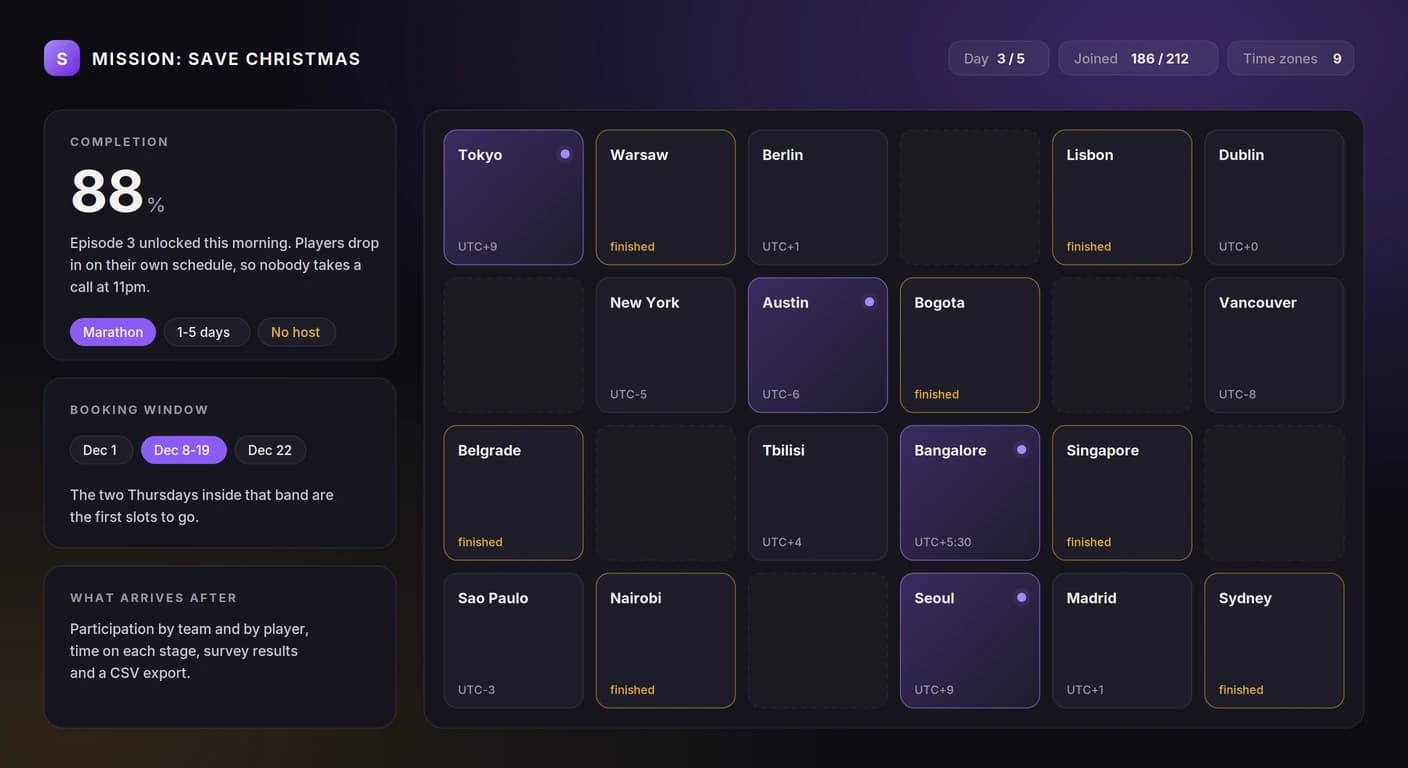

A virtual holiday party works when it gives people something to do together, not something to watch. The formats that hold up for distributed teams are a hosted game of 60 to 90 minutes, a multi-day async event people drop into on their own schedule, or a small-group format that splits a large company into rooms of eight to twelve. What does not hold up is a video call with a quiz bot and an open bar nobody can share.
Events run December 1 to 22, and the second and third weeks go first: in 2026 that is December 7 to 18. Booking opens in early November for most vendors, which means the shortlist happens now.
The window is narrower than it looks
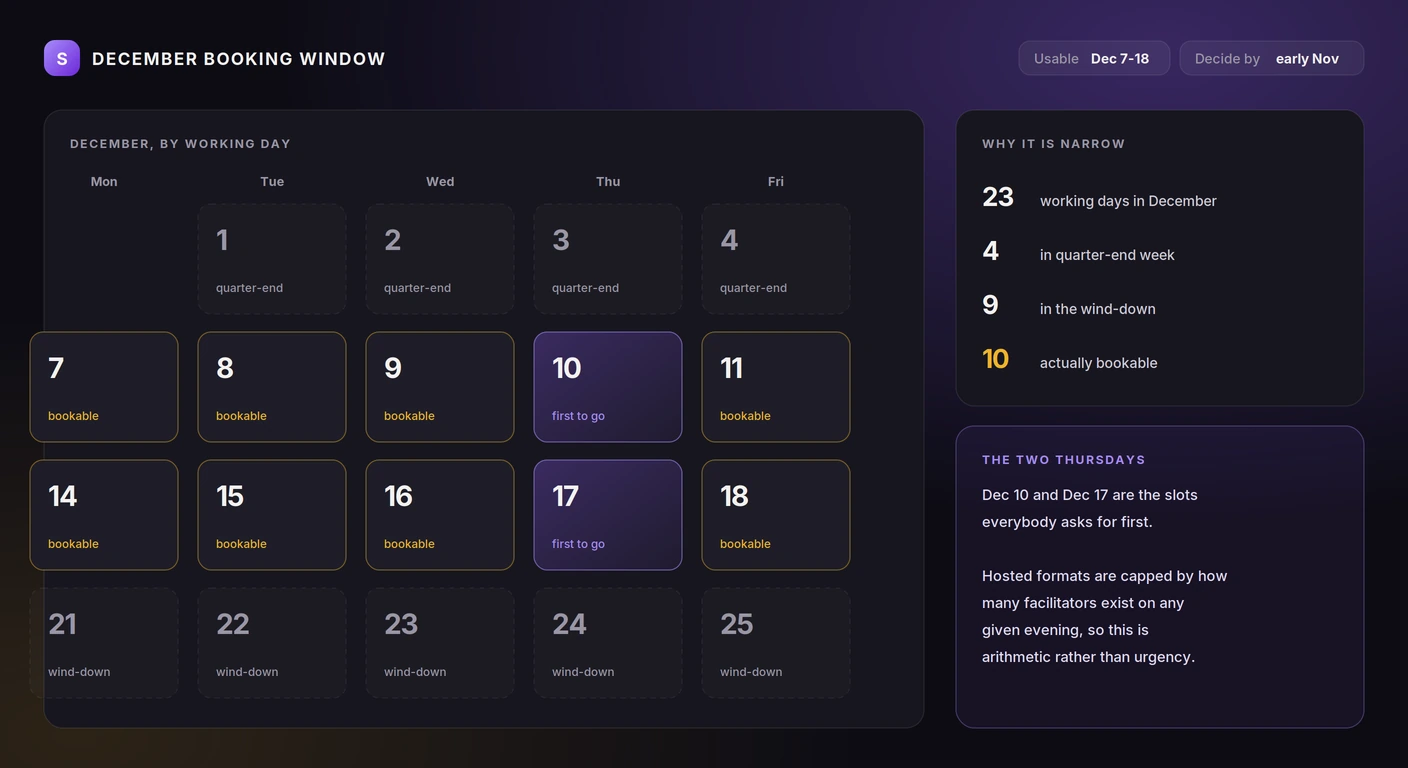
December has about sixteen working days before most companies wind down, and a holiday party cannot sit on any of them. The last week is written off to handovers and half-empty calendars. The first week still has quarter-end work in it. In 2026 that leaves December 7 to 18, and inside that window the two Thursdays, the 10th and the 17th, are the slots everyone asks for.
That is the practical reason to decide in October or early November rather than late November. It is not vendor urgency, it is arithmetic: a two-week usable window across a whole market, and hosted formats are capped by how many facilitators exist on any given evening.
If your team spans more than six time zones, the window gets narrower still, because there is no single hour that is evening for everyone. That is the case where an async format stops being a compromise and starts being the only honest option.
Four ideas, sorted by the problem they solve
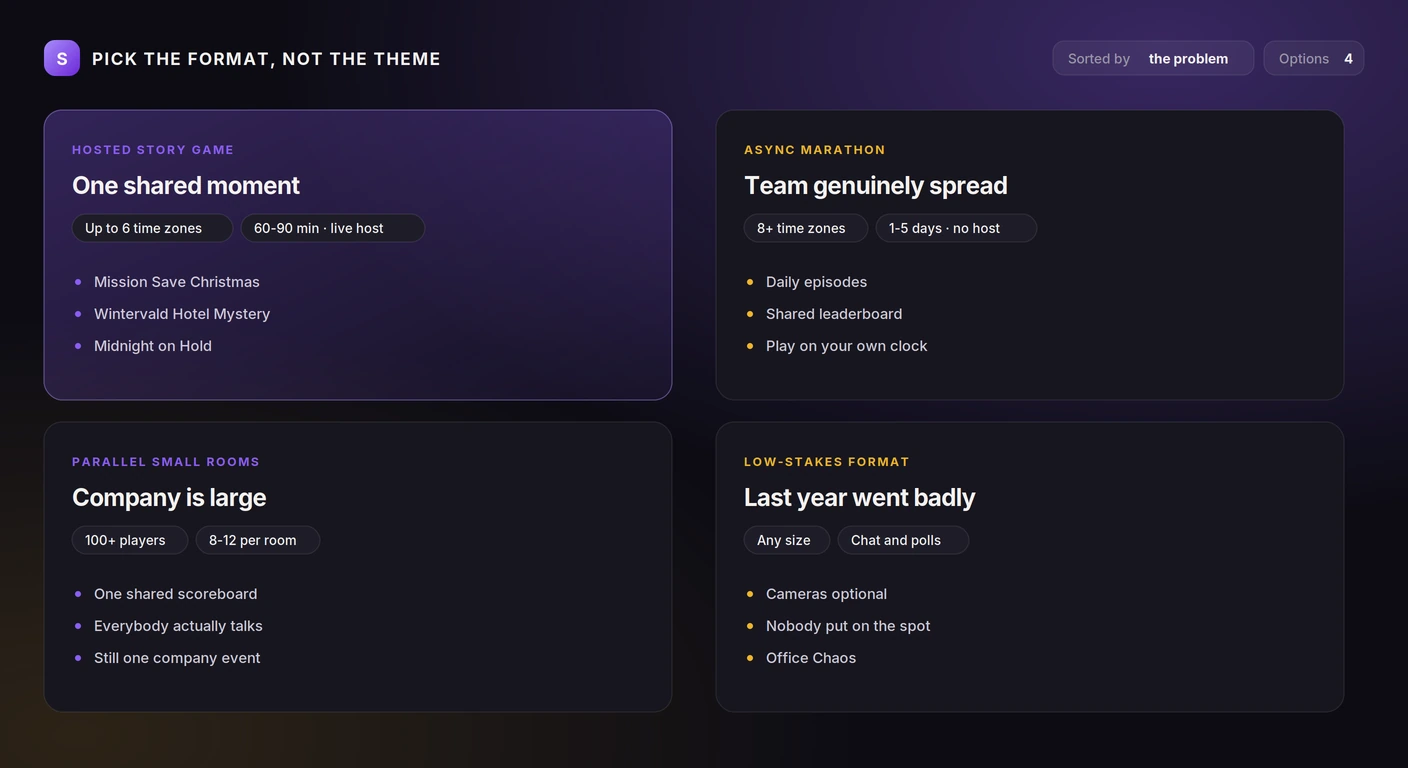
Most lists of holiday party ideas are sorted by theme. That is the wrong axis. A team with a hundred people across eight time zones and a team of eighteen in two cities have different problems, and the theme is the last thing that matters.
1. A hosted story game, when you want one shared moment
Everyone joins the same call, a facilitator runs the session, and the team plays through a single narrative in 60 to 90 minutes. This is the closest thing to the in-person party: one room, one story, one set of jokes that survives into January.
It works when your team fits inside a six-hour time zone spread and when the point of the event is that everyone was there at the same time. Mission Save Christmas and Wintervald Hotel Mystery are both built for this slot. Midnight on Hold is the one to pick when the team's humour runs dry rather than festive.
It stops working past roughly eight time zones, because somebody is taking the call at 11pm so the company can have fun, and that is a reminder of distance rather than a bridge across it.
2. An async multi-day event, when the team is genuinely spread
The same story runs over three to five days. Content unlocks each morning, people play when their schedule allows, and a shared leaderboard creates pull without requiring anyone to be awake at an inconvenient hour.
This is the format for a team across Tokyo, Warsaw and San Francisco. It also absorbs the December calendar problem: nobody has to protect a 90-minute block in the busiest fortnight of the year.
The trade-off is real and worth saying out loud. You lose the single shared moment. What you get back is attendance, which on a hosted December event is rarely what the headcount promised.
3. Small rooms, when the company is large
Above roughly a hundred people, a single room stops being a party and becomes a broadcast. The fix is parallel rooms of eight to twelve with a shared scoreboard: small enough that everyone talks, connected enough that it is still one company event.
Worth asking your vendor directly, because the answer differs by product. Some platforms cap a game at about ten players and split a group of eighty into eight separate stories, which is a different event from eighty people inside one. Neither is wrong. Know which one you are buying.
4. A low-stakes format, when last year went badly
If the previous holiday event is remembered as the one with the forced icebreaker, the room arrives defensive and the best game in the catalog underdelivers. The format that recovers from that is the one with the lowest participation cost: play by chat and polls, cameras optional, nothing that puts a single person on the spot in front of the whole company.
Office Chaos is built around that constraint, with mini-games that need two or three people acting together rather than one person performing.
What usually goes wrong
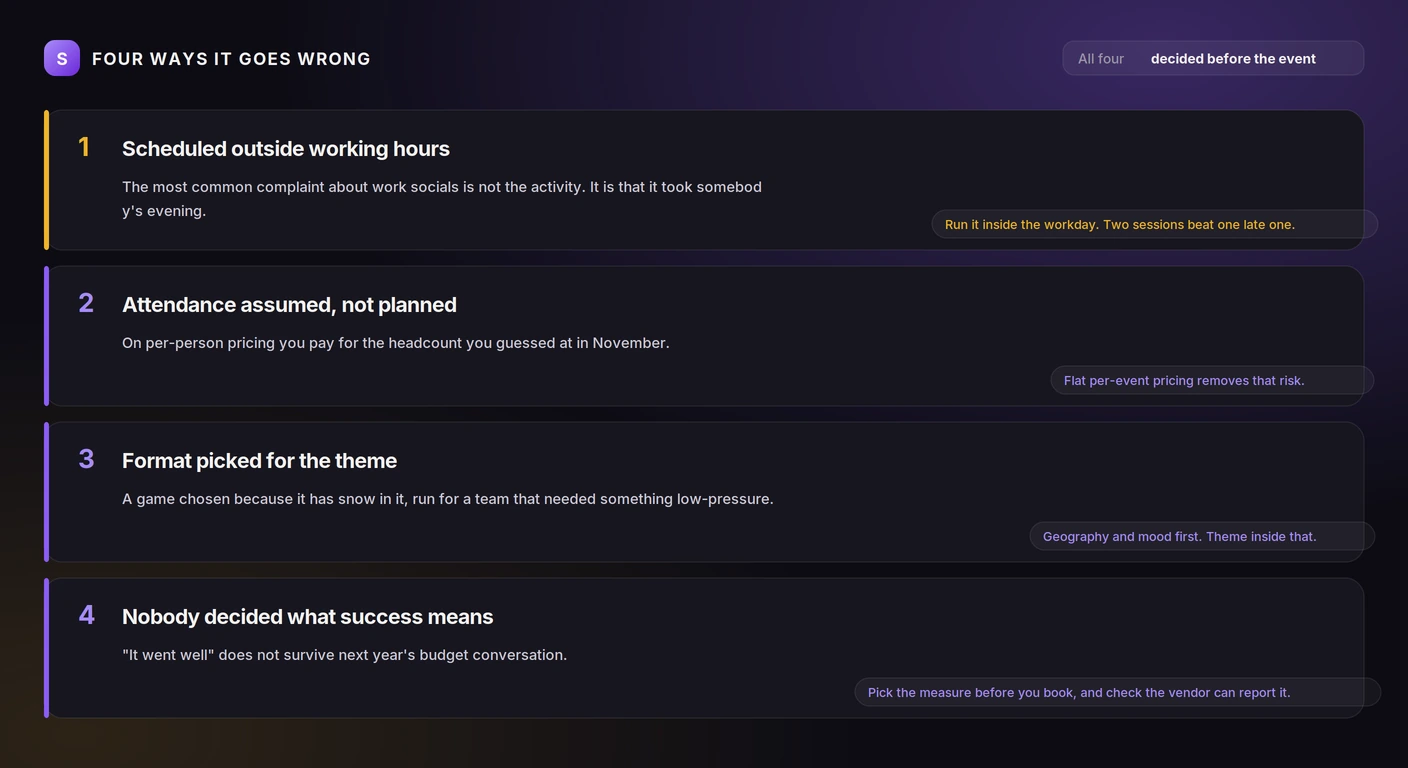
Four failure modes account for most of the bad December events we see, and all four are decided before the event starts.
It is scheduled outside working hours. This is the big one, and it is not close. The most common complaint about work social events is not the activity, it is that it took someone's evening. December is the month companies are most tempted to do it, because an evening slot solves the calendar problem. It solves the calendar and creates the resentment. Run it inside the workday.
Attendance is assumed rather than planned. Optional events do not get full attendance, and a December event competes with every deadline in the quarter. If the vendor charges per person, you are paying for the headcount you guessed at in November. Flat per-event pricing removes that specific risk, which is why it matters more in December than in any other month.
The format is picked for the theme. A game chosen because it has snow in it, run for a team that needed something low-pressure, produces an awkward hour. Pick the format for the team's geography and mood first, then pick the theme inside that.
Nobody decides what success looks like. "It went well" is not something you can take into next year's budget conversation. Decide in advance whether you are measuring attendance, completion, or whether people would do it again, and make sure the vendor can actually report it. Most cannot: we read 27 vendor sites in September 2026 and eight offered any measurement at all, none of which published what it contains.
What it costs
Published prices in this category are unusual, so these are ours rather than a market survey. We charge per event rather than per person, so the per-head figure falls as the group grows.
| Group size (up to) | Price per event | Per person |
|---|---|---|
| 15 | $550 | $36.67 |
| 50 | $1,300 | $26.00 |
| 100 | $1,800 | $18.00 |
| 200 | $3,000 | $15.00 |
| 500 | $5,300 | $10.60 |
For the market around us, independent benchmarks put hosted virtual events roughly between $30 and $105 per person, with most bookings in the $40 to $65 band. Per-person models are cheaper than flat pricing on a team of twelve and more expensive above about fifty. Work out the per-head number at your real headcount before comparing quotes, because the published figures are not comparable as printed.
The other number worth having is the one you are implicitly comparing against. An in-person holiday party runs somewhere around $100 to $150 a head once the venue, the catering and the travel are counted. That is the budget line a December virtual event is actually competing with, not the line for a team-building tool.
Branding, custom characters and a rewritten story are priced separately on our pricing page.
A short plan that fits in October
- Decide the format from geography, not theme. More than six time zones means async. Under that, hosted.
- Pick the slot now. December 7 to 18, and name a second choice, because December 10 and 17 go first.
- Confirm the headcount model. Per person or per event, and what happens if fewer people come.
- Put it inside the workday. If that means two sessions for two regions, run two.
- Agree what gets reported afterwards before you sign, not after.
The full occasion page, with the games mapped to this window and the booking dates, is at December party planning.
Frequently asked questions
What are the best virtual holiday party ideas for a remote team?
A hosted story game of 60 to 90 minutes when the team sits inside a six-hour time zone spread, an async multi-day event when it does not, parallel small rooms with a shared scoreboard above about a hundred people, and a low-pressure chat-and-polls format if the previous year's event went badly. The theme matters far less than matching the format to the team's geography and mood.
When should we book a virtual holiday party?
Most December events run between December 1 and 22, and the usable window is narrower than that: the last week goes to handovers and the first still has quarter-end in it. The realistic slot is December 7 to 18, and the two Thursdays inside it, the 10th and the 17th, book first. Shortlisting in October or early November is not vendor urgency, it is a two-week window across a whole market with a fixed number of facilitators in it.
How much does a virtual holiday party cost per person?
Independent benchmarks put hosted virtual events roughly between $30 and $105 per person, with most bookings between $40 and $65. Our own pricing is flat per event, which works out at $36.67 a head for 15 people, $18.00 for 100 and $10.60 for 500. Per-person models are cheaper for small teams and more expensive above about fifty, so convert any quote to a per-head figure at your actual headcount before comparing.
Should a virtual holiday party be during work hours or in the evening?
During work hours. The most common complaint about work social events is not the activity but that it took someone's evening, and December is the month companies are most tempted to schedule one, because an evening slot appears to solve the calendar problem. It solves the calendar and creates the resentment. If a single workday hour cannot cover every region, run two sessions rather than one late one.
What works for a team spread across many time zones?
An async format. The same story runs over three to five days, content unlocks each morning, and people play on their own schedule with a shared leaderboard. You lose the single shared moment, and you gain attendance that a hosted December event rarely delivers. Past roughly eight time zones there is no hour that is evening for everyone, so the choice is between async and asking somebody to take an 11pm call.
How do we know whether the holiday event actually worked?
Decide the measure before you book, and check the vendor can report it. Useful measures are the share of invited people who joined, the share who finished, and whether participants say they would do it again. Most vendors in this category cannot provide any of that: of 27 sites we read in September 2026, eight offered measurement of any kind, and none published what their report contains. Ask for a sample report before signing, not after.