
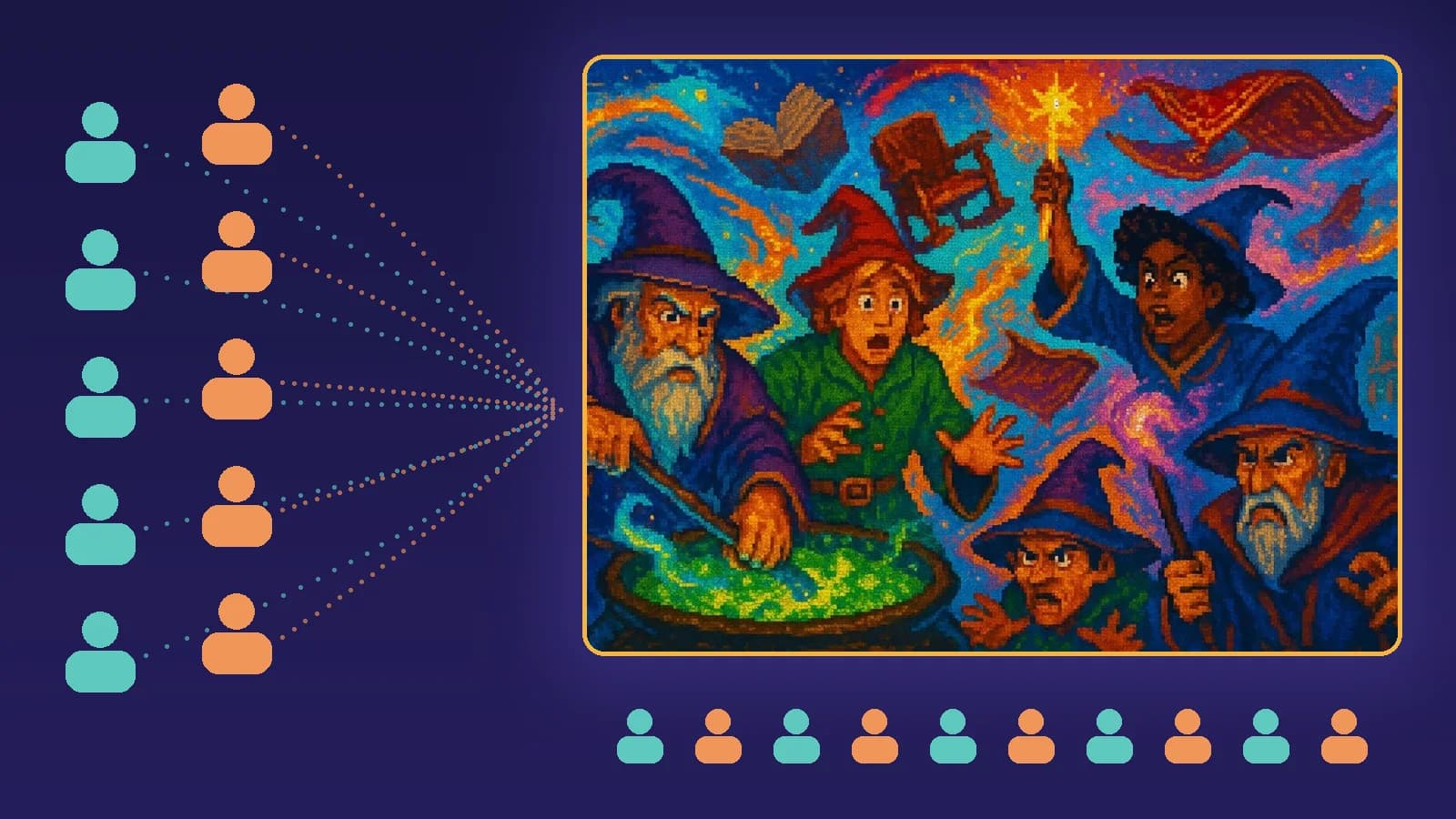

The fastest way to turn two groups into one team after a merger, an acquisition or a year of fast hiring is one shared task in mixed teams: people from both sides depend on each other to finish something with a score, in a story neither side owns, inside working hours, with a short live finale where both leaderships announce the result. Run it once people know where they stand, usually a month or two after the announcement, not on day one. Then check participation by team and department, because the number that tells you whether it worked is whether both sides showed up in equal measure.
That is the whole method. The rest of this guide is how to do each part, and the four situations where HR gets this task: a merger, an acquisition, a hiring wave, and a company that has grown into several offices. A company anniversary is a fifth case, not because it creates the gap but because it gives you the date to close it.
Four situations, one problem
Every one of these leaves a company with two groups who do not know each other, and every one of them hands the problem to the people team.
| What happened | The two groups | What goes wrong without a plan | What to run |
|---|---|---|---|
| Merger of equals | Two companies, two sets of habits, two leaderships | People keep working with whom they know; "their side" and "our side" harden within weeks | Mixed teams, a neutral story, both CEOs in the finale |
| Acquisition | The buyer and the acquired team | The acquired team feels absorbed, watched, and judged on the buyer's terms | Mixed teams in which acquired people hold visible roles; nothing themed on the buyer's history |
| Hiring wave, +50% in a year | People who were there and people who just arrived | New hires know their own team and nobody else; the founding group still runs on memory | Teams mixed by tenure, so every team has old and new |
| Several offices, or office and remote | Head office and the others; the office and the people at home | Events happen where the most people sit, and everyone else hears about them afterwards | One event everyone joins on their own device, in their own working hours |
| Company anniversary | Year one and year ten | The company story belongs to the people who were there, and most of the company was not | The same mixed-team event, on the date that already matters (anniversary events) |
The last two rows came up in our own calls this autumn. An organiser at a company with offices near London, in Malta and in Gibraltar put it plainly: "the thing we've struggled with this year is involving the remote workers ... a lot of the remote workers get forgotten." Another, at a services company of about 120 people across 10 to 12 regional offices, described the old answer and why it stopped working: they used to fly everyone in for a Christmas party, and "as that grew, so did the pricing."
The five rules that make it work
The conventional advice after a merger is right as far as it goes: mix the groups, give them a shared challenge, avoid forced vulnerability. What it leaves out is how to build the event so that the advice actually happens on the day.
1. Build the teams by rule, never by company. Every team gets people from both sides, and nobody plays with their own manager. A team of eight after a merger is four and four; after a hiring wave, a mix of tenures; across offices, at least three locations per team. Never run "company A against company B": it turns a bonding event into a rematch of the deal, and the side that loses goes home with a story about it.
2. Pick a story neither side owns. A quiz about the company's history rewards the people who were there. A quiz about the buyer's products is an exam for the acquired team. A game world that is new to everyone, a hotel mystery, a temple, an arcade, a magical bureau where every player is the new hire, puts both sides on the same footing from the first minute. The shared reference people take away is the game, not the org chart.
3. Make people depend on each other. The game should not be finishable by the one person who is fastest. When the step only works if two people from different sides act together, they have to talk, and the conversation is the point. This is the part an icebreaker round cannot do: it asks people to talk about themselves, while a shared task gives them something to talk about.
4. Put it where everyone can actually join. Inside working hours, on a laptop or a phone, with no install. After a merger the two sides often keep different tools and different security rules for months; a game that runs in a browser from a link avoids being the first integration project. If the two sides work in shifts or time zones that never overlap, run it as a multi-day Marathon where people play on their own schedule and share one leaderboard, as a bank did for 800 shift and branch staff in a single day (case study).
5. End with a short live moment, owned by both leaderships. Fifteen minutes is enough: the result, the winning teams, one sentence from each side's leader. The services company above landed on exactly this shape for its offices: a campaign through the month and "like 15 minutes just to show like, hey, here's the culmination of your last 3 weeks."
When to run it
Not in the first week. In the first weeks after an announcement people are thinking about their roles, their managers and, sometimes, whether they will have a job. A cheerful game on top of that reads as tone-deaf, and the people with the most at stake will not come.
| When | What it is for |
|---|---|
| Announcement, weeks 0 to 3 | Nothing playful. Clear communication about roles and what changes. |
| Weeks 4 to 10 | The first shared event, once the new structure is known. Mixed teams, a neutral story, a short finale. |
| Around day 90 | A second one with new mixes, ideally around a work milestone, so the habit forms. |
| The next company anniversary | The first one the combined company celebrates together, which is worth more than any of the others. |
For a hiring wave the clock is the onboarding calendar instead: run the first mixed event when a cohort of new hires has been in for a month, so they have something to compare. Our onboarding events page covers that version.
What to measure, so you know it worked
The question after a merger event is not whether people enjoyed it. It is whether both sides took part, and whether people met someone from the other side. Two numbers answer that:
- Participation by team and by department, compared with headcount. If 90% of the acquiring company joined and 40% of the acquired one did, the event told you something more important than any survey. Our reports show participation by team and player, time per stage and completion, and some formats break results down by department.
- One question afterwards: "Did you meet someone today you had not worked with before?" Ask it in the same week. A yes rate is a clearer integration signal than a satisfaction score.
What it costs for a merged company
HeySparko prices per event, not per person, with the host included. For headcounts typical after a mid-sized deal:
| Combined headcount | One live Big Game, 70 to 90 minutes | Marathon over 3 days |
|---|---|---|
| Up to 150 | $2,500 | $5,000 |
| Up to 300 | $3,800 | $7,600 |
| Up to 500 | $5,300 | $10,600 |
A Marathon costs the Big Game price × (1 + 0.5 × (days − 1)). Customization is a fixed amount per layer: putting both companies' logos in the game, writing characters for them, or rewriting the story around the new company. For a merger, a story built around neither company's past but around the new one is the version that does the most. The game picker shows the price for your exact headcount and three games that fit your team.
What not to do
- "Company A vs company B" anything. Quizzes, leaderboards, sports. It hardens the line you are trying to erase.
- A quiz about the buyer's history or products. It is an exam the acquired team did not study for.
- After hours, or cameras on by order. The people least sure of their place are the first to skip an event that costs them their evening.
- A long speech before the game. Every minute of it is spent on the side that already agrees.
- Leaving the remote people or the smaller office for "next time". That is the group most likely to read the event as proof of how things now stand.
When a game will not help
If the real issue is uncertainty about jobs, a reorganisation that has not been announced, or a conflict between leaders, no event fixes it, and running one first can make it worse. Communicate first; play second. The same is true when the two companies are going to stay separate in practice: a shared game cannot create a shared team that the org chart does not have.
Which games we would start with
Every HeySparko game runs in a browser on a laptop or phone, hosted by our game host over your own Zoom, Teams or Meet call, or as a Marathon.
| Game | Why it fits a newly combined company |
|---|---|
| Bureau of Magical Affairs | Every player is the new hire at a secret bureau, so nobody arrives knowing the rules |
| Office Chaos | The first day at the most chaotic office in town: a shared joke about working somewhere new |
| Wintervald Hotel Mystery | A neutral setting and a deduction that needs every team member's piece |
| Last Temple Mystery | Real time pressure for teams that want a winner, and a short self-paced version for shift work |
Teams spread across countries and languages have their own version of this problem; our guide to team building for multicultural teams covers it.
Frequently asked questions
What team building works after a merger?
A shared task in mixed teams. Build every team with people from both companies, give them a game world that is new to everyone so neither side has an advantage, make the steps impossible without cooperation, run it inside working hours on whatever device people have, and end with a 15-minute finale where both leaderships announce the result. Avoid anything framed as one company against the other.
When should you run the first team event after an acquisition?
Once people know where they stand, usually four to ten weeks after the announcement. In the first weeks employees are focused on roles and job security, and a playful event reads as tone-deaf. Run a second one around day 90 with new team mixes, and make the next company anniversary the first one the combined company celebrates together.
How do you stop an "us vs them" culture after a merger with an event?
Never let the teams follow the old company lines. Mix them by rule, half and half, with nobody playing alongside their own manager, choose a story that belongs to neither company, and measure participation by team and department afterwards. If one side joined far less than the other, that gap is the problem to work on next.
What does a team event for a merged company of 300 people cost?
At HeySparko, $3,800 for one hosted live game of 70 to 90 minutes for up to 300 people, host included, or $7,600 for a three-day Marathon that people play on their own schedule. Prices are per event, not per person. Putting both companies' logos or a story about the new company into the game is a fixed extra per layer.